

Hong Kong leader John Lee has not directly answered whether the city’s authorities had requested Singapore to extradite wanted activist Nathan Law before he was denied entry to the Southeast Asian country.

Lee sidestepped the question at a weekly press conference on Tuesday, saying that no country should harbour criminals and that the Hong Kong government “will strictly enforce the law.”
“Nathan Law is suspected of committing offences endangering national security. He is the subject of a court warrant. He is a specified absconder under national security legislation. We will hold this person to account,” the chief executive said.
“We will take all measures possible as we go after those criminals,” Lee added.
Law, who is wanted by Hong Kong’s authorities on suspicion of national security-related offences, has been in self-exile since 2020.
The pro-democracy activist said on Monday that he was detained and questioned by Singaporean immigration authorities for four hours after arriving from San Francisco on Saturday.
The Singaporean authorities did not offer an explanation when they informed Law that he had been denied entry, said the former student leader, who holds a UK refugee passport.
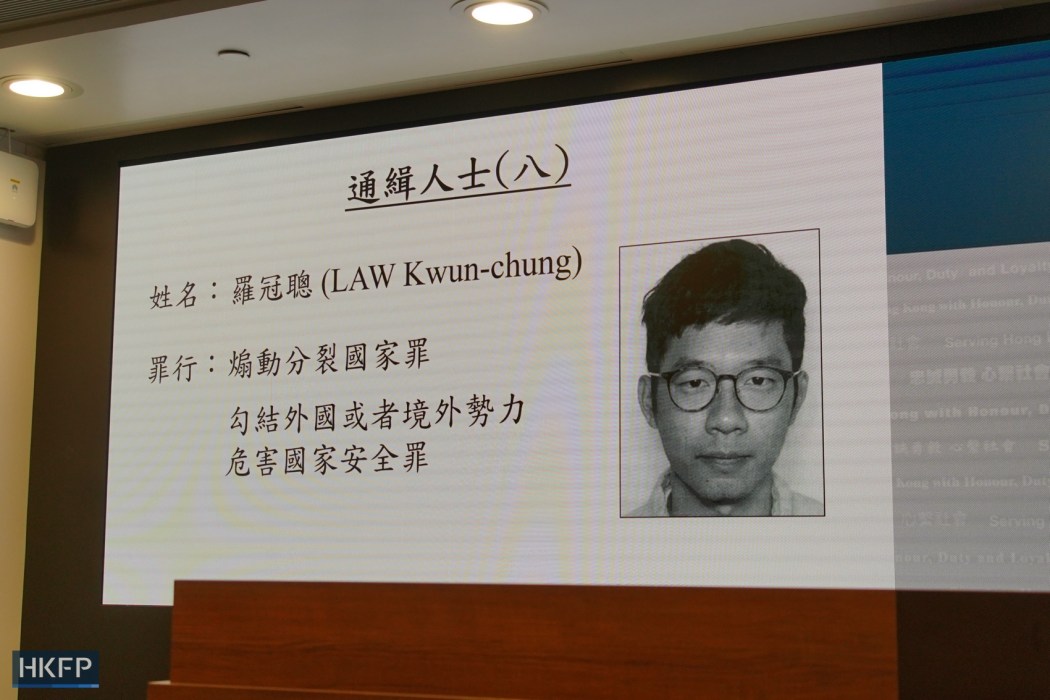
Singapore’s Ministry of Home Affairs later told HKFP on Monday: “Law’s entry into and presence in the country would not be in Singapore’s national interests.”
Singapore has an extradition treaty with Hong Kong.
‘Political middle ground’
Barrister and government adviser Ronny Tong said on Facebook on Monday that political prosecutions typically would not be handled under extradition agreements, citing the United Nations’ Model Treaty on Extradition, a non-binding recommendation for states to handle matters related to extradition.
“Singapore’s refusal to grant Law entry on grounds of ‘national interests’ can be seen as a political middle ground, avoiding confrontation with both the UK and the US while also not offending China and Hong Kong,” he said.
This stance was preferable to the actions of some nations that demand other countries respect UN guidelines when it suits them, only to disregard those guidelines when it does not, Tong wrote.
He pointed to the arrests of Meng Wanzhou, the deputy chairperson and chief financial officer of Chinese tech giant Huawei, and former Philippine president Rodrigo Duterte as cases that did not adhere to the treaty’s recommendations.
When asked about Law China’s Ministry of Foreign Affairs spokesperson Guo Jiakun said at a Monday press conference that each country has the right to independently manage immigration-related matters.
“The individual you referred to is an anti-China destabiliser who is wanted by Hong Kong police in accordance with the law,” he said.


