

The Hong Kong government should take “decisive action” in waste reduction, a local environmental NGO has said, after the municipal waste charge scheme was shelved following repeated delays.

The Green Earth raised concerns on Tuesday that Hong Kong may not be able to fulfil its goal of cutting the per capita municipal solid waste disposal rate by 40 to 45 per cent by 2035, after the government announced it would not implement the waste tax within the current term.
The announcement was made in a paper submitted by the Environment and Ecology Bureau to the Legislative Council this month, in which the bureau said the public preferred “assistive and encouraging” waste reduction and recycling measures, as opposed to a “punitive waste charge.”
The government cited a telephone survey it commissioned, as well as polls conducted by media outlets and other organisations, saying the results showed around 70 to 80 per cent of residents believed it was not suitable to roll out the waste-charging scheme at this stage.
See also: Hong Kong public does not want waste charging scheme implemented ‘for now,’ environment chief says
The policy, first floated by the government in 2005 and approved by the legislature in August 2021, was designed to reduce the amount of rubbish Hongkongers send to landfills by requiring people to pay for what they discard using designated rubbish bags.
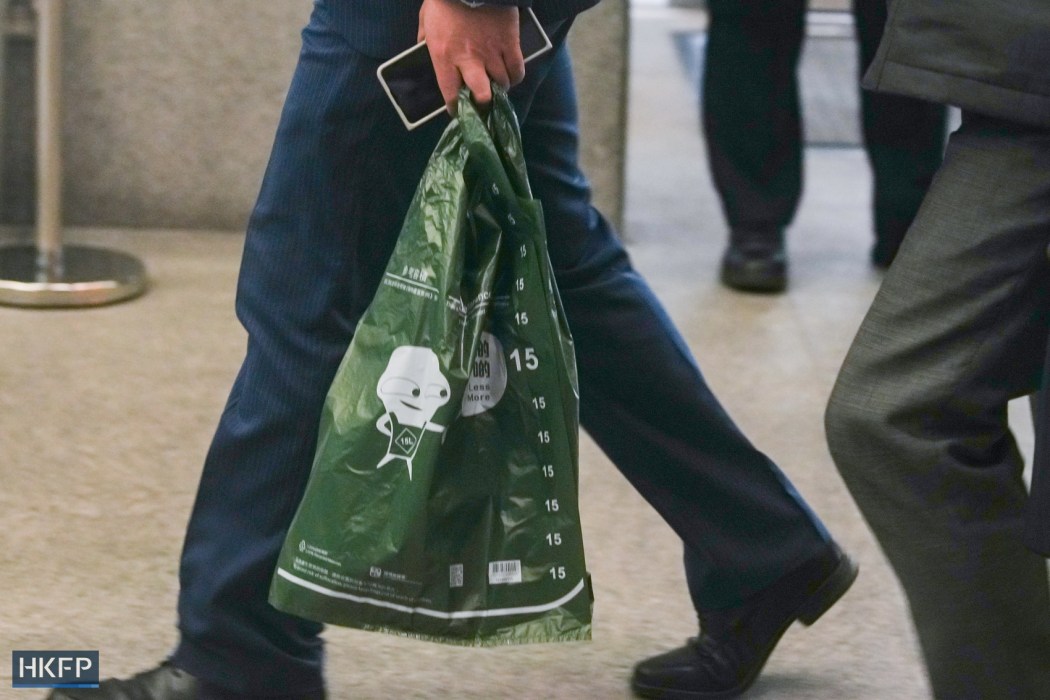
The scheme was finally scheduled to launch on April 1, 2024. In January last year, the government pushed the official roll-out date to August, citing “public concerns,” although a trial run for the scheme started on April 1 at 14 premises.
The policy was then halted in May amid public pushback, with residents who took part in the trial run describing the scheme as a “public disturbance.”
In Tuesday’s paper, the bureau said representatives from the property management, catering, and cleaning sectors expressed concerns that the waste charge scheme would raise their operational costs and increase the workload of their frontline workers.
The bureau went on to say Hong Kong is facing multiple challenges, including “a global trade war” and “an increasingly complex geopolitical landscape.” The government needed to “adapt its strategy” for promoting waste reduction and recycling to the current situation and “maximise overall social benefits,” it said.
“Considering that the current administration’s various waste reduction and recycling efforts have already shown notable results, the government will maintain its decision to suspend the waste charging scheme…” the paper read.
The bureau said the average daily disposal of municipal solid waste had decreased for three consecutive years since 2021. It saw a 7.5 per cent drop from 11,358 tonnes in 2021 to 10,510 tonnes last year. The per capita disposal rate also fell from its high of 1.53 kilograms in 2021 to 1.40 kilograms in 2024.

The bureau pledged to continue pushing for reducing waste at its source, enhancing recycling networks, working with different sectors to implement environmentally friendly policies, and developing green infrastructure.
In response, The Green Earth said the government’s publicity work last year was “not effective” and that the general public did not understand the “real reason” for taxing them on municipal waste.
The Waste Blueprint for Hong Kong 2035, published by the government in 2021, relied on waste charging as “the key driver for waste reduction,” the NGO said.
The government has repeatedly stressed that the amount of waste is linked to the state of the economy, and the current decline in Hong Kong’s waste volume may only be a result of the economic downturn. The volume may rebound when the economy recovers, The Green Earth said.
“If the bureau can use in-depth publicity and educational work to let citizens know that the real reason for the charging scheme is not financial difficulty, but to reduce waste and improve the environment and quality of life, we believe that this will remind citizens of why they supported the charging legislation in 2013,” the NGO said.


