

Around two weeks ago, Hong Kong authorities announced they had halted a contract worth tens of millions of dollars to supply mainland Chinese bottled water to government offices, after the supplier allegedly used fraudulent means to secure the contract.

Public outcry erupted, with the government now facing questions about loopholes in its tendering and due diligence procedures. Investigations by a government task force and the public spending watchdog are now underway, looking into potential oversights.
HKFP explains the controversy, who might be held responsible, the steps the authorities have taken to address the scandal, and the government’s tendering procedures.
How did the controversy begin?
Following an open tender in March, the Government Logistics Department (GLD) in June awarded Xin Ding Xin Trade Co. (XDX) a HK$52.9 million contract to supply bottled water to public offices around Hong Kong Island and the outlying islands.
According to the contract, the firm was to provide government offices with bottled water brand “XinLe Guan Yin Shan,” manufactured by Robust (Guangdong) Drinking Water’s Guangzhou branch, for 36 months starting from June 23.
Besides XDX, two other Hong Kong companies won tender bids. AS Watson Group, a subsidiary of tycoon Li Ka-shing’s conglomerate CK Hutchison, would supply its locally produced bottled water to public offices in Kowloon. Professional Trade International Limited would provide water from Dongwa Drinking Water, a Dongguan-based manufacturer, to government offices in the New Territories and part of Lantau Island.

It was the first time mainland Chinese brands won a government contract for bottled drinking water, sparking a controversy. After the deal was made public in July, local media reported that water produced by Robust and Dongwa had violated mainland China’s safety standards in previous years.
Civil servants expressed concerns about the quality, with some reportedly ordering or bringing their own bottled water.
On August 3, Chief Executive John Lee attempted to give assurances about the safety standards, saying that the bottled water complied with “international standards” and expressing his confidence in the tendering process.
How did the scandal come to light?
The scandal broke on August 16, when the GLD announced that it had “partially terminated” the contract. “Having received information on [Xin Ding Xin]’s business operation recently, the GLD was not satisfied that [it] would still be capable of performing the contract,” the department said, adding that it had referred the case to the police for investigation.
Two days later, the government fully terminated the contract.

Law enforcement’s action was swift. The police force and customs authorities arrested a couple who own XDX – director Lui Tsz-chung and his wife Chan Pik-lam – over suspected fraud and providing false information on August 17 and 20, respectively.
The police probe also revealed that XDX had supplied water from a Dongguan plant, instead of the one in Guangzhou, as stipulated in the contract terms.
The government has since terminated at least five other contracts with XDX and other firms tied to it. These included a chemical supply contract with the Drainage Services Department (DSD) and a data entry contract with the Fire Services Department, worth some HK$6 million and HK$5 million respectively.
The GLD also arranged for AS Watson Group to replace XDX as the bottled water supplier to offices on Hong Kong Island and the outlying islands. The contract awarded to Professional Trade is still valid so far.
How did the logistics chief react?
Director of Government Logistics Carlson Chan was noticeably absent from an urgent meeting called by Secretary for Financial Services and the Treasury Christopher Hui on August 17.

Chan only broke his silence on August 21, five days after the termination of the XDX contract. He attributed the blunder to inadequacies in the GLD’s procurement procedures and publicly apologised for it.
He admitted that his department may have overlooked elements of fraud in the deal with XDX and that the company may have utilised “improper” means to acquire legitimate documents, or used forged documents to meet tender requirements and secure the government contract.
According to the police and customs authorities, the firm was found to have no relationship with the Guangzhou company it claimed to be sourcing water from.
However, they said, it used a water quality certificate provided by the Guangzhou plant to meet tender requirements, albeit without the plant’s knowledge.
Who might be held responsible?
Public outcry erupted after the scandal unravelled, raising questions about loopholes in the government’s tendering procedures and due diligence, as well as landing the GLD in hot water.
In his public apology, Chan said: “I understand that this incident, this hoax, has raised huge public concerns over government procurement and caused concern for our colleagues in the government about the water supply.”
He added: “In this respect, we feel that there were indeed inadequacies in our procedures, and I would like to apologise to everyone on behalf of the Government Logistics Department.”

He admitted that the GLD had adhered to the “lowest bidder wins” principle, as it did for its last contract with a different company. Under the new contracts, the government – which has been facing budget deficits for years – would have saved HK$16 million annually.
It remains unclear whether Chan, or others within his department, will face disciplinary action over the contract blunder.
Treasury minister Hui dodged questions as to whether any officials would be held accountable or forced to resign. “We see that the whole incident is problematic; there are inadequacies,” he said on August 20.
What steps has the government taken?
When addressing reporters on August 23, the chief executive only said that human factors or negligence would be handled “seriously and impartially in accordance with civil service management rules.”
Lee also said that price should not have been the sole criterion when selecting a tender bid.
The scandal has also revived discussion over Lee’s proposed new accountability system to monitor the performance of senior civil servants. In June, he suggested permanent secretaries and directorate-level officials could face penalties such as pay freezes or salary cuts for poor performance or mistakes.

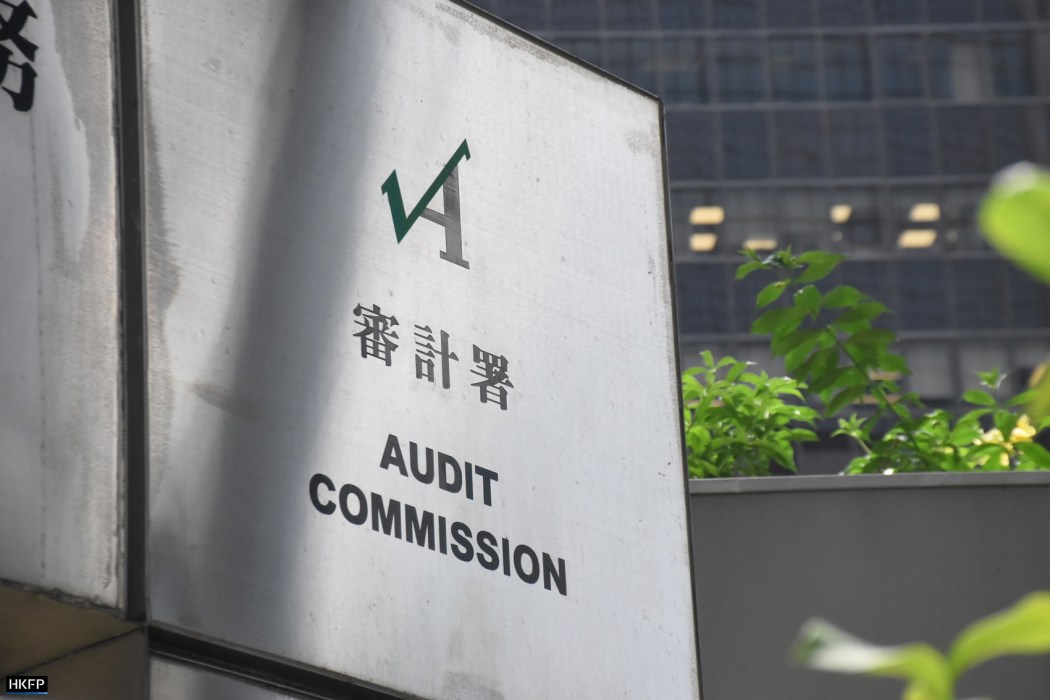
The Financial Services and the Treasury Bureau (FSTB) announced on August 17 that it had invited the Audit Commission, the public spending watchdog, to review the tender procedure and identify any negligence or deficiencies.
The decision on whether action will be taken against officials will depend on a report by the Audit Commission.
In addition, Hui also set up a task force to review the government’s procurement regime. The task force – comprising the Development Bureau, the Civil Service Bureau, the Commerce and Economic Development Bureaus, and the Department of Justice – will issue interim investigation results, ahead of a full report expected in three months.
The task force’s interim report will look into potential “red flags” such as the due diligence required in the procurement process, as well as issues of contract management and quality control, Hui said. It is unclear when the interim report will be released.
The task force’s probe will be conducted separately from the Audit Commission’s investigation, the government said.
Lee said that the task force’s review of the incident will look into both systemic and human error.
Meanwhile, the commission’s investigation will involve a review of the government’s tender procedures and seek out any mistakes made by government employees involved, as well as the reasons for their mistakes, such as whether it was an issue of ability or negligence.
What are the proper procedures?
Lee has called into question the logistics department’s bidding mechanism, saying that price should not have been the only determining factor. The chief executive said the authorities must also consider whether the contract offers “value for money.”
He seemed to refer to a 2012 Audit Commission report, which said that “achieving best value for money and maintaining open and fair competition are the twin policy objectives for government procurement.”
The FSTB, according to several official documents, some as recent as 2020, encourages the government to adopt marking schemes with “sufficient technical weighting” to assess potential benefits provided by bidders.
The FSTB has also adjusted the weightings for the marking scheme criteria to assign more importance to technical aspects over price. Technical weighting now constitutes up to 70 per cent of the decision, while the weighting for price ranges between 30 and 50 per cent.
Bureaus or departments may decide against using marking schemes in “special and warranted circumstances,” provided that approval is obtained from directorate-level public officers.
According to local newspaper Ming Pao, the logistics director appeared to have deviated from usual practices as recommended by the government by vetoing the use of a marking scheme when choosing a bidder during the tender exercise.
The GLD told Ming Pao that it was Chan who green-lit the decision not to use a marking scheme for the water contracts.
What are the reactions from LegCo and others?
Following Chan’s apology, members of Hong Kong’s “patriots-only” legislature have joined a chorus of support for the government’s decision to scrutinise the contract blunder, including Chan Kin-por, Priscilla Leung, and Lai Tung-kwok, who all lauded the government’s “decisiveness.”

In particular, Leung said members of society should allow time for the authorities to conduct their investigation. “We may as well wait for the results of the investigation before making a fair judgement,” she said.
Others like Doreen Kong and Peter Shiu criticised the government for the oversights and demanded tougher vetting of bidders. Kong also said officials should be held accountable, as the scandal was only “the tip of the iceberg.”
John Burns, honorary professor in the Department of Politics and Public Administration at the University of Hong Kong, believes the government’s response has been so far inadequate.
In the event that civil servants are found to have made errors, they can claim they did not violate civil service regulations as they had followed standard operating procedures for procurement, he said.
“I can imagine that authorities may be unable to point to any civil service regulation that the GLD civil servants violated,” Burns wrote in an op-ed piece for HKFP.

He calls on the government to allow the Legislative Council to set up a select committee, pointing to previous moves by the city’s legislature to set up a committee and push the government to establish a commission of inquiry.
“I urge authorities to allow LegCo to play the role it was designed to play and has the formal resources to play. This will improve trust in government and heighten the legitimacy of LegCo,” Burns said.


