

Hong Kong has summoned the UK and Australian consuls general to express “strong opposition” over the two countries granting asylum to activists wanted by the city’s national security police.

Former pro-democracy Hong Kong lawmaker Ted Hui said in a social media post on Saturday that he had been granted asylum by the Australian government, while pro-independence activist Tony Chung said on Sunday that he had secured asylum status in the UK.
Hui and Chung are among several overseas activists subject to HK$1 million police bounties over allegations that they have endangered national security while residing abroad.
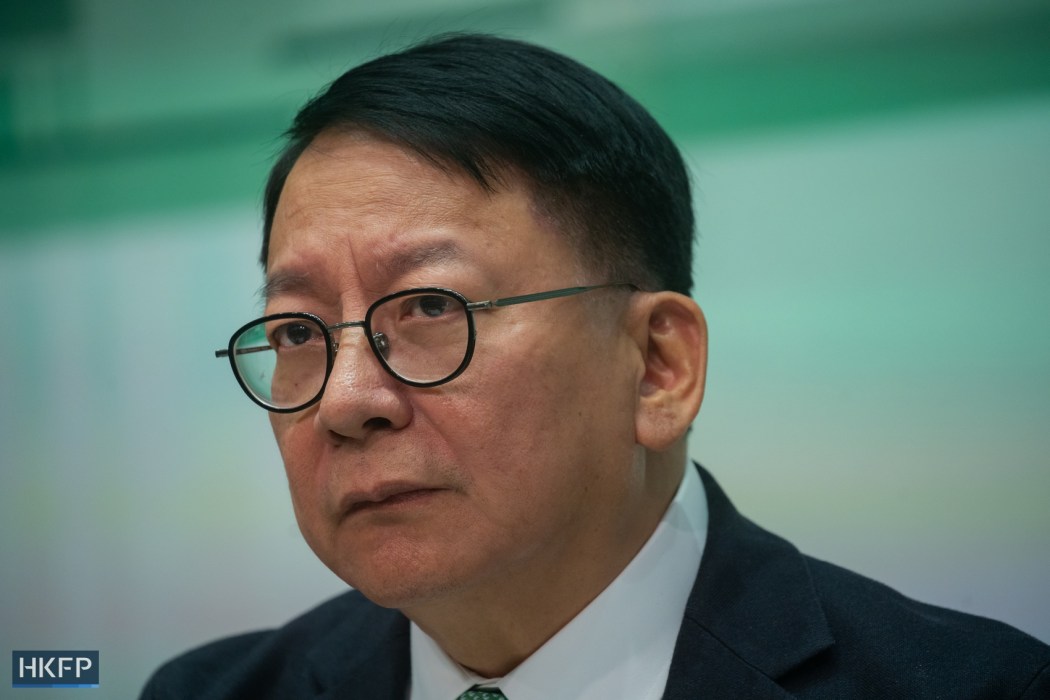
The Hong Kong government said on Monday that Eric Chan, the city’s no. 2 official, summoned the Australian Consul-General in Hong Kong Gareth Williams, and the British Consul General in Hong Kong Brian Davidson.
‘Harbours criminals’
Chan “solemnly pointed out that the HKSAR Government opposes any country harbouring offenders in any form and is strongly dissatisfied with any conduct that harbours criminals under any pretext,” a government spokesperson said in a statement.
“[S]uch harbouring effectively allows certain individuals or organisations to be immune from legal consequences for their illegal acts, which is no different from granting a special privilege to break the law,” Chan was quoted as saying in the statement.
According to the statement, Chan told the foreign envoys that the arrest warrants issued by the city’s police were “fully justified, necessary and legitimate,” while Hong Kong’s courts will handle all cases “in an independent, fair and just manner.”
“There is no question of political persecution in Hong Kong,” the government spokesperson said.
Chan also said that human rights were protected in the city’s national security laws and urged foreign governments to “stop interfering” in Hong Kong affairs.
Security chief Chris Tang also attended the meeting, according to the government statement.
Hui, formerly a lawmaker of the Democratic Party, has been a vocal critic of Hong Kong and Beijing authorities, even after he resettled with his family in Adelaide in 2021.
Hong Kong national security police have accused Hui of inciting secession, subversion, and foreign collusion and placed him on a wanted list in 2023.
Chung, formerly the convenor of the now-disbanded pro-independence group Studentlocalism, left Hong Kong in late 2023, after serving a sentence for inciting secession and money laundering.
Authorities accused him of breaching a post-release supervision order and declared him “wanted” in December 2024.

The arrest warrants targeting Hong Kong activists living overseas have been a friction point between the city government and western countries like the UK.
Last month, after Hong Kong announced new arrest warrants targeting overseas activists, UK Foreign Secretary David Lammy and Home Secretary Yvette Cooper called the move “another example of transnational repression.”
Australian Foreign Minister Penny Wong has also objected to Hong Kong’s arrest warrants targeting people living in her country.
“Freedom of expression and assembly are essential to our democracy,” she said last month on X.
The Hong Kong government has rejected foreign criticism, calling such statements “smears with distorted facts.”
Beijing inserted national security legislation directly into Hong Kong’s mini-constitution in June 2020 following a year of pro-democracy protests and unrest. It criminalised subversion, secession, collusion with foreign forces and terrorist acts – broadly defined to include disruption to transport and other infrastructure. The move gave police sweeping new powers and led to hundreds of arrests amid new legal precedents, while dozens of civil society groups disappeared. The authorities say it restored stability and peace to the city, rejecting criticism from trade partners, the UN and NGOs.


