

Handpicked judges presiding over jailed media tycoon Jimmy Lai’s national security trial have questioned whether content in his pro-democracy paper amounted to “seditious publications,” as stipulated by the prosecution.

The court continued hearing closing arguments on Tuesday after proceedings were twice delayed last week, first owing to bad weather and then to health concerns relating to the 77-year-old tycoon’s heart.
Delivering arguments for the seditious publications charge, lead prosecutor Anthony Chau referenced articles published in Lai’s Apple Daily including an editorial calling for sanctions against Beijing and Hong Kong authorities.
He said that those articles did not include “rational criticism,” and that none of them provided recommendations or ventured “to suggest any solutions.”
But High Court judge Esther Toh, one of the three judges chosen to preside over the security trial, cast doubt on the prosecution’s argument that critical articles must propose solutions to be considered not seditious.
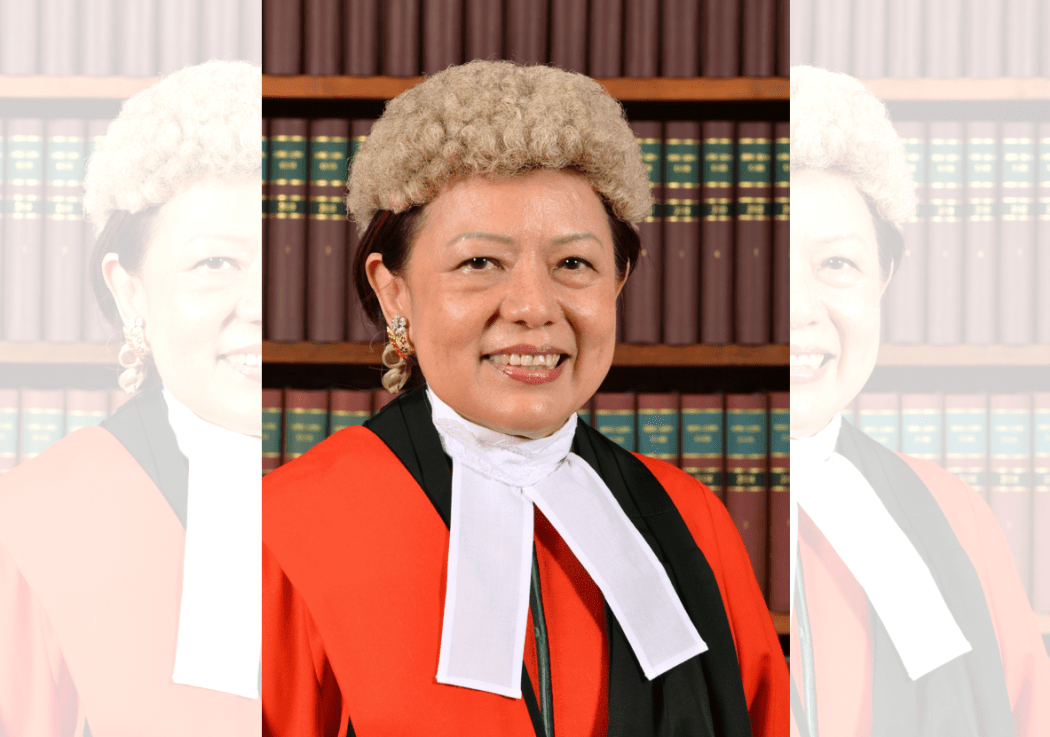
“Did they actually have to venture that? You can write a critical article about the water problem, but do you have to venture to offer solutions?” Toh asked, appearing to reference a recent contract fraud case involving the drinking water supply at government offices.
Judge Alex Lee pointed to Apple Daily articles calling for the now-shelved extradition bill which sparked widespread protests and unrest in 2019 to be withdrawn, saying: “They were opposing the very introduction of the extradition bill… was that not a suggested solution?”
The 2019 protests escalated into sometimes violent displays of dissent against police behaviour, amid calls for democracy and anger over Beijing’s encroachment. Demonstrators demanded an independent probe into police conduct, amnesty for those arrested and a halt to the characterisation of protests as “riots.”
Lee on Tuesday added that an article could not be considered seditious if its purpose was to highlight pitfalls in governance, “but if it was to defame the government causing the people to lose confidence or to turn hostile against the government, that would be a case of sedition.”

Chau also referenced Lai’s text messages directing the paper’s English news division, which the court had earlier heard was set up to appeal for international support.
Lai had told senior management that the paper was not supposed to have a “balanced view” and only needed a view of the “yellow” side — the colour associated with the city’s pro-democracy movement, Chau added.
Calls for sanctions ‘in disguise’
Besides the charge of conspiracy to publish seditious materials under colonial-era legislation, the tycoon also stands accused of two charges of conspiracy to commit foreign collusion under the Beijing-imposed national security law. He faces life behind bars if convicted.
Based on Lai’s prior exchanges with US politicians and diplomats, one could infer that the pro-democracy paper’s criticism of the Chinese authorities were an “indirect” means of calling on foreign governments to interfere, Chau told the court on Tuesday.
That was after judge Toh asked whether the prosecution meant that the paper’s articles were calls for sanctions “in disguise.”

The prosecution has alleged that Lai used his ties with foreign officials and politicians to impose sanctions against authorities in mainland China and Hong Kong.
Beijing inserted national security legislation directly into Hong Kong’s mini-constitution in June 2020 following a year of pro-democracy protests and unrest, criminalising subversion, secession, collusion with foreign forces and terrorist acts – broadly defined to include disruption to transport and other infrastructure.
The move gave police sweeping new powers and led to hundreds of arrests amid new legal precedents, while dozens of civil society groups disappeared.
Chau also maintained that the media baron had called for what the prosecution labelled “Sanctions, Blockades, or Hostile activity” (SBHA) against the central Chinese authorities, despite not having made any open or direct requests for such actions after the enactment of Beijing’s national security law in Hong Kong.
The prosecution submitted that Lai had adopted a “calculated and strategic approach” for foreign sanctions to be imposed on China and Hong Kong by deliberately and “falsely” picturing the Chinese Communist Party in a negative light.

Prosecutors named retired US army general Jack Keane, ex-US deputy secretary of defence Paul Wolfowitz, ex-US state department advisor Christian Whiton, and Mary Kissel, an advisor to then US secretary of state Mike Pompeo, as Lai’s foreign connections, among others.
Chau also told the court that Lai had admitted, during his testimony, that he continued international lobbying efforts even after the enactment of the national security law to inform foreign governments of what was happening in Hong Kong and to appeal for condemnation of the Hong Kong and Beijing authorities.
However, he denied lobbying overseas governments to influence foreign policy.
Chau is expected to conclude oral submissions of the prosecution’s closing arguments on Wednesday.


