

Hong Kong can expect more extreme weather due to the impact of climate change, a former Observatory official has said, as the city hoisted its fourth black rainstorm signal of the year in a week.

Leung Wing-mo, former assistant director of the Hong Kong Observatory (HKO), said on Tuesday that climate change was bringing more extreme conditions to the city – both very dry and very wet weather.
“By nature, the weather fluctuates,” Leung told HKFP in Cantonese. “Climate change exacerbates these fluctuations, causing weather to be more unstable and more extreme.”
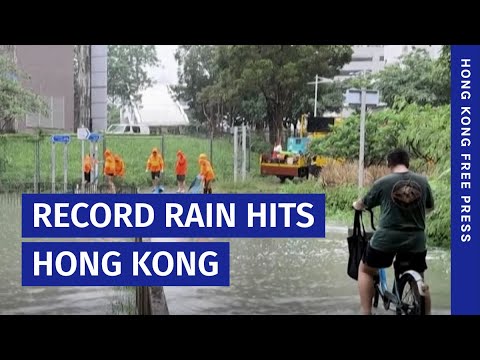
The meteorologist’s comments came as heavy rain continued to batter Hong Kong, flooding streets and prompting landslide warnings.
The Observatory raised the black rainstorm twice within six hours. It first hoisted the signal at 11.45pm on Monday before lowering it to the red rainstorm warning at 2.10am on Tuesday, then amber at 3am.

The red rainstorm warning returned at 5.20am on Tuesday. It was upgraded to the black rainstorm signal half an hour later, before it was lowered more than 11 hours later, at 5.05pm, to amber.
According to the Airport Authority, the airport’s operations were “largely normal” under the rainstorm in the morning, with 61 departure flights and 40 arrival flights delayed.
The MTR closed multiple exits temporarily on Tuesday, including in Kwun Tong, Sham Shui Po, Wong Tai Sin, and Wan Chai.

The weather is expected to remain “unsettled” on Wednesday, with heavy showers forecast, the Observatory said. The rain will ease on Thursday, and hot weather should return over the weekend.
Flooding
According to the HKO, 355.7 millimetres of rain were recorded at its headquarters in Tsim Sha Tsui as of 2pm on Tuesday, already making it the highest daily rainfall in August since records began in 1884.
The Drainage Services Department said that as of 1pm, it had handled 25 cases of flooding.

They included an outdoor car park in Po Lam where around 20 cars were partially submerged in muddy rainwater, as well as the entrance to Queen Mary Hospital in Pok Fu Lam, where flooding prompted the temporary diversion of some patients.
Leung, who was the assistant director of the Observatory from 2009 to 2011, said the recent rainstorms were severe, but not the worst the city had seen.

He pointed to heavy rains causing the “618 landslide” in mid-June 1972, which killed 138 people in Mid Levels and Sau Mau Ping.
More recently, in September 2023, a torrential downpour that flooded subway stations was termed “once-in-500-years” rainfall and flooding by the authorities. There were at least two casualties and over 140 people injured, according to the Observatory.

The rainfall in recent days did not rival those two weather events, Leung said, but he warned that Hong Kong should brace for a higher frequency of extreme weather due to the climate crisis.
He said it was important that the different government departments, such as the Drainage Services Department and the Civil Engineering and Development Department, enhance coordination.
On an individual level, those who live in areas more prone to floods and landslides, especially near private slopes that are not under the government’s purview, should also take steps to protect themselves, Leung added.


