

The newspapers are full, as is customary at this time of the year, of stories about local kids who have done well in the school-leaving exams.

It seems that most of the stars of this show want to become doctors, which shows a touching faith in the inability of artificial intelligence (AI) to take over the routine parts of medicine.
For a discordant note, readers could turn to The Economist, which printed a long piece lamenting the fact that, as a headline and subsidiary headline put it, “Why today’s graduates are screwed: The bottom has fallen out of the job market.”
The primary evidence for this comes from America, where graduates in their 20s have been found in one study to have higher unemployment rates than the general population.
Things are moving in a similar direction, but much more slowly, outside America.
Graduates – again, from the evidence, we are back in the USA – find jobs harder to come by and also less satisfying than they used to be.
The Economist’s writer dismisses as an unsatisfactory explanation the claim that many graduates of American universities are ill-educated and, in some cases, actually illiterate. These stories may be true, but the brightest and best are also finding employment elusive.
Some formerly entry-level jobs are certainly falling to AI. A more original suggestion is that people used to go to university to achieve digital literacy. Now, everyone gets it from their smartphone, so for many button-pushing jobs, a degree looks unnecessary.
The writer concludes that many American students are now deciding that university is not worth it: the time, the debt, and the disappointment. This is not happening in Europe, where, as our scribe puts it, “Governments are subsidising useless degrees, encouraging kids to waste time studying.”
What do we mean by “useless degrees”?
“Outside America, the share in arts, humanities and social sciences mostly grows. So, inexplicably, does enrolment in journalism courses. If these trends reveal young people’s ideas about the future of work, they truly are in trouble,” says the writer.
Really? Underlying this lament appears to be the unspoken assumption that the main or only reason for any form of study is to increase your future income. Education of any other kind amounts to “encouraging kids to waste time.”
I am reminded of Oscar Wilde’s lament that people “know the price of everything and the value of nothing.”
This might usefully be adapted. Economists – and The Economist – know the price of everything and erroneously suppose that the value is the same thing.
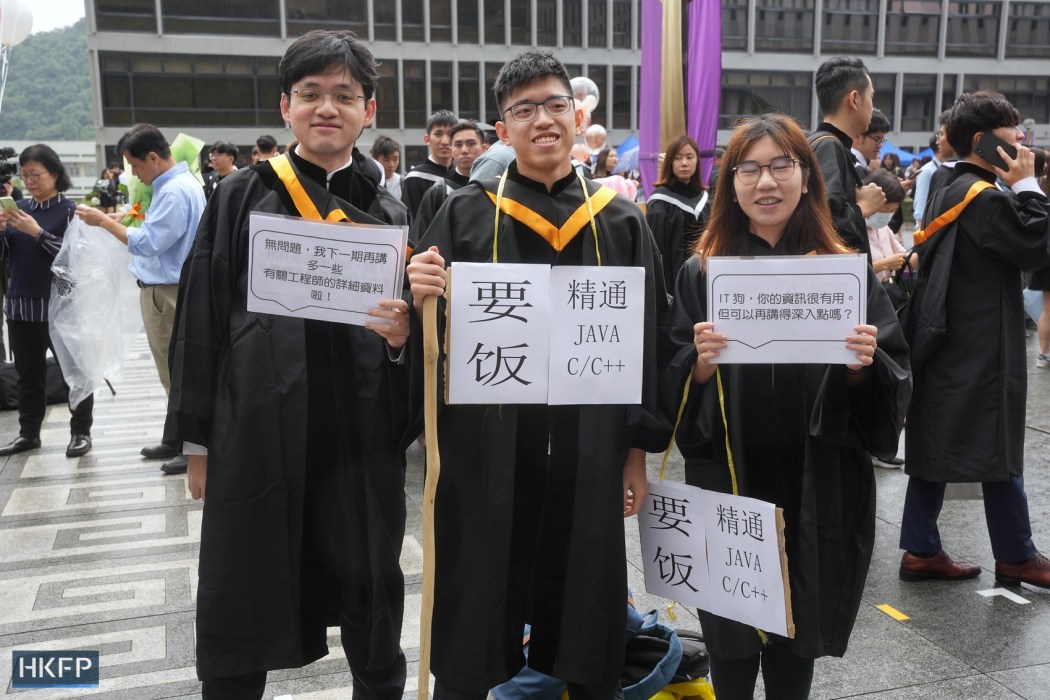
“Until recently,” says our author, “the obvious path for a British student hoping to make money was a graduate scheme at a bank.”
But making money is only one of the things people hope to find in a job. Some British students would rather shovel sewage for a living than work in a bank, and I was once one of them.
Only a philistine society will limit its educational offerings to subjects with an immediate practical application, or indeed an ironclad promise of future wealth attached to them.
Indeed, there are some areas of human activity where the attainment of the highest standards requires that many be tested, most of whom will fail.
Training for air traffic controllers is a notorious example. Thousands apply, hundreds are accepted, tens actually complete the course and get into a control tower, some of whom drop out later when they find the work too stressful.
Many of the more demanding military specialities have similar attrition rates. In university programmes, this is obscured by the fact that every student who makes a reasonable amount of effort will get the degree.
But in general, music grads do not become musicians, English literature grads do not become novelists, philosophy grads do not become professional philosophers, and the only archaeologist graduate I ever met was teaching in a primary school.
This brings us to the “inexplicable” attraction of journalism courses, which I flogged happily and successfully for nearly three decades. It was a platitude among teachers of journalism that most of our students were not going to be journalists, or if they became journalists, would not stay that way.
At one time there was a spirited debate in the journalism education business about whether we should continue to design courses on the basis that the graduate would be able to meet the requirements of the trade (art, craft, science, con trick or disease, whichever you prefer) or we should accept that we were teaching non-journalists and adapt courses accordingly.
Generally, we concluded that the practical aspects of a journalism programme were one of the things which students liked, even if they were not going to be practitioners themselves.
Most of my students never became journalists. A surprising number (at least to me) became police officers.
Journalism may be – as British journalist Max Hastings puts it – a pursuit for “cads and bounders,” but it still has a whiff of adventure around it that you are not going to get in the business school. But if you really want to be rich… your choice.
| HKFP is an impartial platform & does not necessarily share the views of opinion writers or advertisers. HKFP presents a diversity of views & regularly invites figures across the political spectrum to write for us. Press freedom is guaranteed under the Basic Law, security law, Bill of Rights and Chinese constitution. Opinion pieces aim to constructively point out errors or defects in the government, law or policies, or aim to suggest ideas or alterations via legal means without an intention of hatred, discontent or hostility against the authorities or other communities. |


