

An ex-lawmaker who was found guilty in Hong Kong’s largest national security case and jailed for six and a half years was a “diligent” legislator who believed what he was doing was lawful, a court has heard.

Raymond Chan, along with 11 other pro-democracy activists, appeared at the West Kowloon Law Courts Building on Tuesday for the second day of the case’s appeal hearings. He wore a black jacket over a white collared shirt and appeared visibly thinner.
They were among the 45 activists convicted of conspiring to commit subversion over their role in an unofficial primary in 2020 aimed at strategising votes for an upcoming Legislative Council election. Out of the 47 people charged, only two were cleared, and the government is appealing one of the acquittals.
Chan’s barrister, David Ma, told the court that his client served Hong Kong as a lawmaker for eight years. He was a “diligent” legislator who had a meeting attendance rate of 99 per cent, Ma said.
Chan was “no doubt” very familiar with the functions and duties of the Legislative Council as described in the Basic Law, Hong Kong’s mini-constitution, the barrister said.

“So with all this background and disposition… his propensity in committing a serious crime that is subversion would be brought into question,” Ma added.
At the crux of the case is the prosecution’s argument that the defendants had agreed to indiscriminately veto the government budget and force the chief executive to step down, a mechanism provided for under the Basic Law.
Ma said Chan had a track record of working with the pro-establishment camp and supporting the government.
He suggested that Chan had “genuinely and honestly believed” that what he intended to do was lawful, and that the trial judges’ conclusion that he intended to subvert the government was not a “safe” inference.


Chan and 10 others who pleaded not guilty are applying for leave to appeal their convictions and sentences. They include activists Owen Chow, Gordon Ng and Gwyneth Ho, who received some of the longest jail terms in the case, of up to seven years and nine months.
Activist Wong Ji-yuet, who pleaded guilty, is applying for leave to appeal her sentence. She was jailed for four years and five months.
‘No evidence’
Ex-lawmakers Lam Cheuk-ting and Helena Wong are also appealing their sentences and convictions. Lam was sentenced to six years and nine months, and Wong to six years and six months.
Barrister Erik Shum, representing both former lawmakers, drew comparisons between his clients’ verdicts and those of Lawrence Lau, who was one of the two defendants cleared of their charges. The government is appealing Lau’s acquittal.

Shum said Lau’s name appeared as a signatory to the Inked Without Regret declaration, one of the key documents associated with more radical ideals and which was cited by the prosecution in their reasons for convicting the activists.
The barrister said that neither Lam nor Wong signed the document, and there was “no evidence” they were even aware of it.
Representing ex-district councillor Clarisse Yeung, barrister Cheung Yiu-leung said his client was among the participants with the “least level of participation in this matter.”
Cheung brought up one of the points that the trial judges relied on when explaining their reasons for finding her guilty. He said that while police found documents on Yeung’s “office computer notebook” relating to the primaries, there was no evidence that the device was hers.
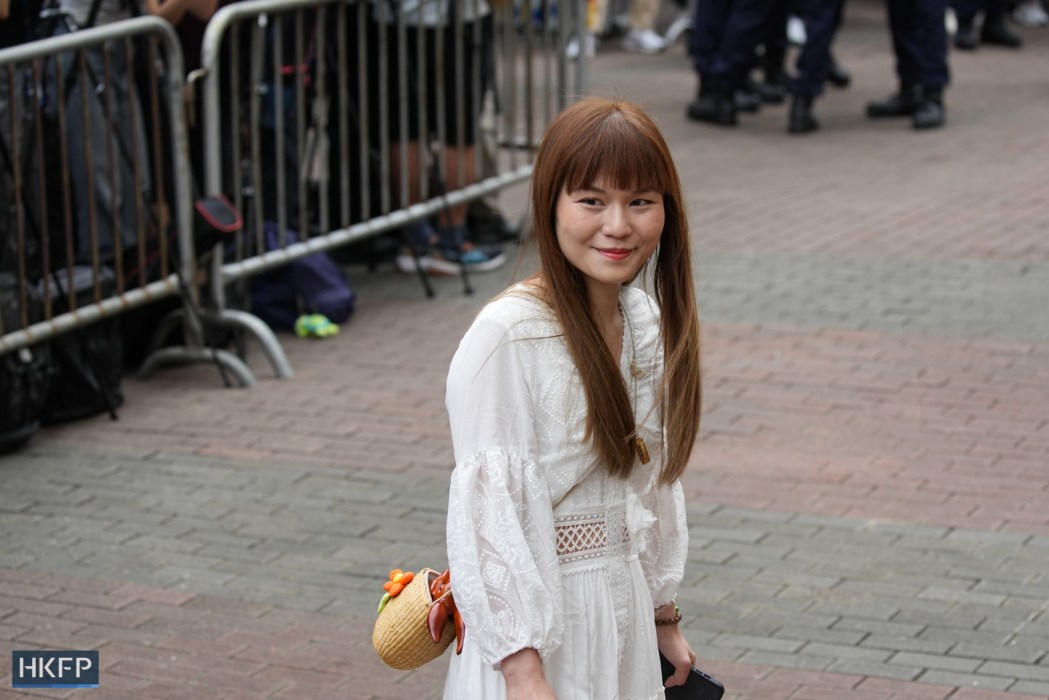
Yeung cast doubt on the ownership of the laptop and who might have put the documents on it.
Cheung also cited the judges’ point that her name appeared on the Inked Without Regret declaration, but the declaration was not posted on her Facebook page like it was on other candidates’.
Her lawyer said her name might have been written by someone else.
10-day hearing
Tuesday marked the second day of the appeal hearings, which are scheduled to last 10 days.
The hearings are taking place more than a year after High Court judges convicted the activists and sentenced them, with the longest sentence of 10 years going to ex-University of Hong Kong law professor Benny Tai.
The prosecution said Tai was the “mastermind” behind the scheme.

On Monday, Michael Pang – one of the defendants found guilty and who was initially appealing his conviction and sentence – announced he was dropping his challenge.
Wednesday’s hearing will continue with arguments by Shum, who represents ex-lawmakers Lam and Wong.
In June 2020, Beijing inserted national security legislation directly into Hong Kong’s mini-constitution – bypassing the local legislature – following a year of pro-democracy protests and unrest. It criminalised subversion, secession, collusion with foreign forces and terrorist acts, which were broadly defined to include disruption to transport and other infrastructure.
The move gave police sweeping new powers, alarming democrats, civil society groups and trade partners, as such laws have been used broadly to silence and punish dissidents in China. However, the authorities say it has restored stability and peace to the city.


