

The Hong Kong public does not want the government to implement the waste charging scheme “for now,” the city’s environment chief has said.

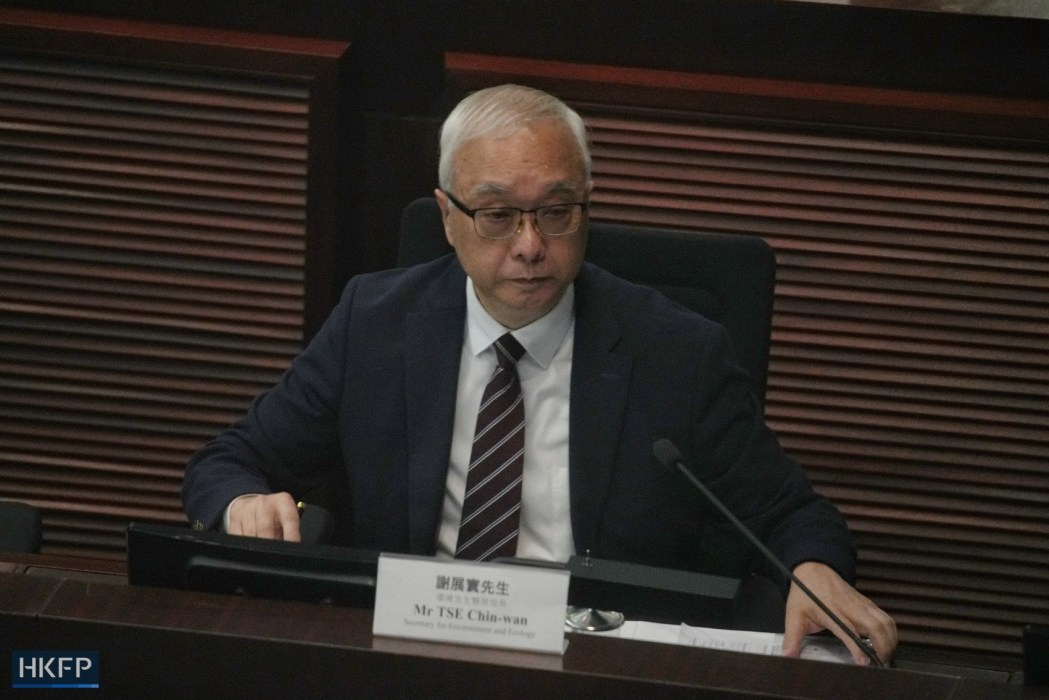
In an interview with the government-funded broadcaster RTHK, aired on Tuesday, Secretary for Environment and Ecology Tse Chin-wan said most residents contacted by the government had expressed opposition to bringing back the waste charging scheme at this point in time.
In April last year, the government indefinitely delayed the enforcement of the Municipal Solid Waste Charging scheme, which was originally planned to come into force last August, following a public backlash and a trial run that saw limited success.
“Our preliminary public opinion research shows that most residents do not want to push forward the scheme again for now,” Tse said in Cantonese.
“But we think it is an important issue, and we hope to gather more opinions before reporting” to the Legislative Council, he added.
The government has set a goal to achieve “zero landfill” by 2035. Two incinerators are being built, which the government says will be the main facilities for waste management in the future.
Tse said the first incinerator – the I·PARK1, located on an artificial island off Shek Kwu Chau in Hong Kong’s southwestern waters – would be gradually put into use towards the end of this year.
I·PARK1 will be capable of processing 3,000 tonnes of waste per day, Tse said. When the second incinerator is completed, the two facilities could process up to 9,000 tonnes of waste each day, he added.
A tender for the second incinerator – located in Tsang Tsui, Tuen Mun, and expected to be completed in the early 2030s – closed last month.
However, even with the two incinerators, Tse said, the city still needs to reduce waste by over 1,000 tonnes per day in order to achieve zero landfill.
The latest official figures show that, in 2023, Hong Kong produced on average of 10,884 tonnes of municipal waste each day.
If the amount of waste could be reduced to under 9,000 tonnes per day, there would be no need to build a third incinerator, Tse said.
Second phase of plastic ban
In the RTHK interview, the environment chief also said authorities would begin the second phase of a plastic ban in the next couple of months to phase out the use of plastic food containers.
Tse said the enforcement would not be strict from the beginning to avoid a public backlash. Instead, authorities would encourage the transition and monitor alternative food containers on the market, he said.
Hong Kong banned single-use plastic tableware in April last year in the first phase of a wider plastic ban. The second phase is expected to come into force this year.
Under the government’s policy, the sale and distribution of multipack rings, tablecloths, and plastic-stemmed dental floss will also be prohibited.


