

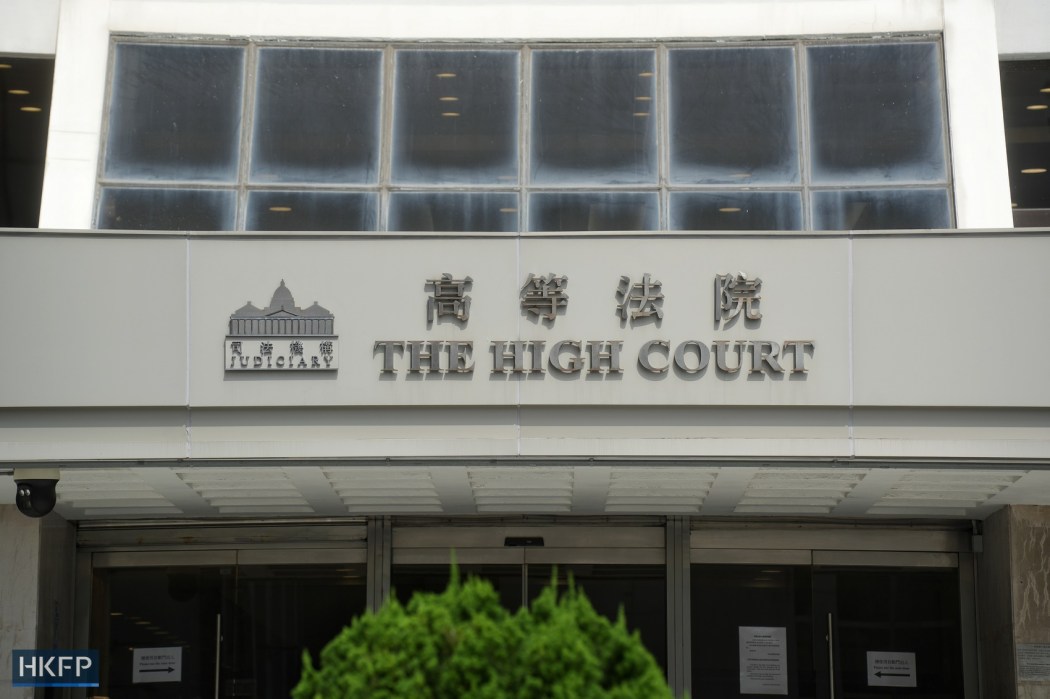
A Hong Kong court has rejected a student’s bid to challenge his disqualification from running in his university’s top council election last year, with a judge saying that the restrictions he allegedly violated were in place to ensure fairness.

In a Friday ruling, High Court Judge Russell Coleman sided with the university, ruling that Isaac Lai, vice chair of the Lingnan University Students’ Union, had “disobeyed” the university’s election rules and was “at least foolish” to do so.
Lai filed the challenge against the university in March. He asked the court to overturn the school’s decision to disqualify him from running in the election for a seat on the university council, the school’s top governing body.
The student councillor “simply disobeyed the instructions, apparently on the basis that he either did not like them or felt that they were unnecessary or improper in the electoral process with which he was engaged,” Coleman said in his judgment.
The judge sided with election officer Margaret Cheung, finding that her interpretation of the election rules was, “at a minimum, a perfectly reasonable and intellectually possible interpretation.”
In November, the university accused Lai of “promoting himself through unofficial channels” and disqualified him from the election one day before the vote.
Lai’s lawyers said the university’s decision was unlawful and had disproportionately restricted his freedom of expression and that the election rules did not explicitly limit candidates to promoting themselves through official means.
The student councillor knew the rule but deliberately posted QR codes linking to his Instagram account on campus, thereby breaking election rules, the university’s lawyers said.
Coleman said on Friday that Lai’s freedom of expression was not absolute, and that restrictions were in place to protect and respect the rights of others, including those of his fellow candidates, electors, and the advisory and governing bodies of the university.
Addressing Lai’s lawyers’ argument that the word “may” in the election rules does not mean “may only,” Coleman also decided that the specific requirements in the election rules were “intended to place a limit on what the candidate may do.”

A level playing field of debate and information should be achieved to “ensure fairness not just to the candidates but also to the electorate,” the judge said. “If candidates can do anything they like to promote their own candidacy, the need for a specific announcement as to what each might do seems rather less.”
Finding that none of the grounds argued were successful, Coleman rejected Lai’s bid for judicial review.
In a reply to HKFP’s enquiry, a spokesperson for Lingnan University welcomed the court’s judgment. “As a responsible higher education institution, the University makes impartial decisions on relevant matters in accordance with established electoral procedures,” it said.


