

More than a year after Hong Kong’s homegrown national security law, commonly known as Article 23, came into effect, the government enacted subsidiary legislation, adding six new offences and declaring six sites linked to Beijing’s national security office as “prohibited places.”

The father of self-exiled activist Anna Kwok became the first family member of a wanted individual to be charged under Article 23. After spending four years and three months behind bars, former district councillors Jimmy Sham, Kinda Li, Roy Tam, and Henry Wong were released.
Another four democrats released
Four more Hong Kong opposition figures were released from prison on May 30 after serving more than four years following their convictions for conspiring to subvert state power in the city’s largest national security case.
Former district councillors Jimmy Sham, Kinda Li, Roy Tam, and Henry Wong left prison early Friday morning in seven-seater vehicles with curtains drawn and went directly to their residences.

Li and Wong were released from Stanley Prison, Sham from Shek Pik Prison, and Tam from Pik Uk Prison, according to local media citing unnamed sources.
The four were the second batch of 45 democrats released from jail after being sentenced to four years and three months behind bars.
Speaking to reporters outside his apartment building in Jordan around two hours after arriving home, Sham said he would have to navigate Hong Kong’s red lines but would not leave the city.

Asked whether he felt he was “free” after being released from prison, he said: “I’m freer than I was yesterday. This is a change that I’m happy with… But there are still many people suffering, which makes me feel like I can’t be too happy, so there are concerns. As for whether I’m free, that’s something I’d like to know as well.”
He added, “My expectation for myself is to remember those who are still suffering.”
The Friday release arrangement was similar to that given to the first group of democrats discharged from prison last month – former lawmakers Claudia Mo, Gary Fan, Jeremy Tam, and Kwok Ka-ki.
Out of 45 democrats convicted and sentenced last year over their role in an unofficial primary election, 37 are still serving prison time – including ex-law professor Benny Tai, who received a 10-year jail term.
Article 23 subsidiary legislation
Hong Kong enacted subsidiary legislation for its homegrown security law – known locally as Article 23 – on May 13 to further facilitate China’s national security office in the city.
The Safeguarding National Security (Office for Safeguarding National Security of the Central People’s Government in the Hong Kong Special Administrative Region) Regulation came into effect just a day after the new legislation was presented in an off-schedule meeting at the Legislative Council (LegCo).
Under the new subsidiary laws, six new offences were created to facilitate the work of Beijing’s Office for Safeguarding National Security (OSNS) in Hong Kong. The offences carry maximum penalties of years-long jail terms and fines of hundreds of thousands of dollars.

The six new offences include failing to comply with the OSNS’s legal instruments, providing false or misleading information or documents, disclosing the OSNS’s measures or investigations, forging OSNS documents, resisting or obstructing OSNS staff in the performance of their duties, and pretending to be an OSNS staff member or pretending to be able to influence them.
The new laws also declared six locations of Beijing’s national security office as “prohibited places,” including four hotels and the office’s future permanent sites in Kowloon.
The changes were enacted under a “negative vetting” procedure, allowing them to be first published in the government’s gazette before being formally brought to the legislature for scrutiny.
A LegCo subcommittee, comprising the same 15 lawmakers who oversaw Article 23’s passage last year, did not raise any amendment proposals as it vetted the new laws for about five hours on May 15.
Journalists stopped from taking photos
Following the enactment of Article 23’s subsidiary legislation, Hong Kong journalists told HKFP that police had stopped them from taking photos and videos of two sites linked to Beijing’s national security office.

Benjamin, a reporter at a local media outlet, said that he and three colleagues arrived near the entrance of the construction site at the junction of Hoi Fan Road and Sham Mong Road on May 14 to photograph and film the site.
The construction site in Tai Kok Tsui is one of six locations occupied by the Office for Safeguarding National Security (OSNS), declared by the Hong Kong government on May 13 as “prohibited places.”
“The police officers said that we could not take any photos or videos, and requested that we delete all footage from our cameras,” Benjamin said.
Ethan, a reporter at a local newspaper, told HKFP on May 14 that police stopped him from taking photos of the Metropark Hotel Causeway Bay, which serves as the temporary headquarters of the OSNS.
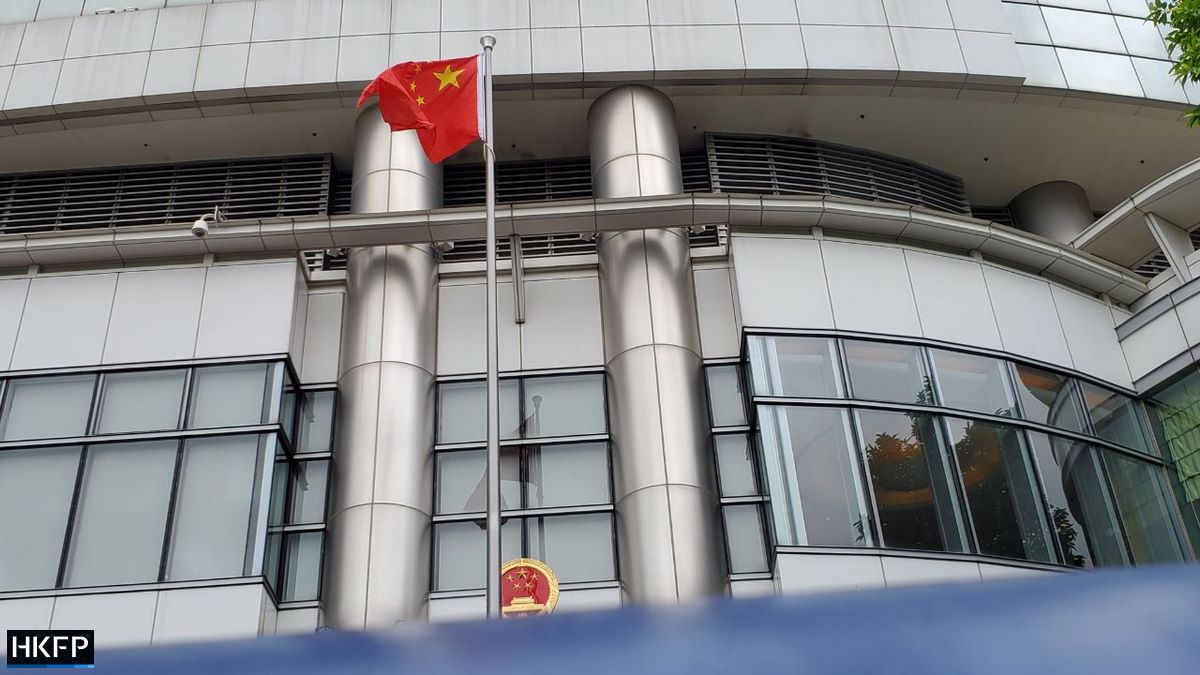
Secretary for Security Chris Tang told the LegCo on May 15 that taking photos of sites designated as “prohibited places” is illegal under the city’s security legislation only if there is “criminal intent.”
Addresses of the prohibited areas are “clearly indicated” with coordinates in the subsidiary legislation, and notices are posted around the premises to ensure public awareness, the Security Bureau told HKFP in an emailed statement.
According to Article 23, espionage activities involving prohibited places, including inspections in person or via electronic devices, carry a maximum jail sentence of 20 years.
Meanwhile, entering prohibited places without lawful authority, disobeying orders made by police or guards of the prohibited places, and obstructing their duties are punishable by up to two years behind bars.
Owen Chow and his lawyers lose appeal
On May 12, jailed Hong Kong activist Owen Chow and his lawyer lost their appeals against convictions for removing a complaint letter from prison without prior approval in 2023.
Chow, one of 45 opposition figures convicted last year of conspiring to subvert state power under the Beijing-imposed national security law, appeared in the High Court alongside assistant solicitor Phyllis Woo.

Last year, a magistrate found the two guilty over a complaint letter that Chow gave to Woo during a prison visit in May 2023. The solicitor took the letter out of the Lai Chi Kok detention centre and sent it to the Ombudsman, a government watchdog.
Independence activist’s appeal bid
A Hong Kong independence activist jailed for five years over conspiring to incite secession under the national security law took his challenge to the city’s top court, appealing for a lighter sentence.
Joseph John, the leader of the now-disbanded UK-based Hong Kong Independence Party, filed a leave application at the Court of Final Appeal, the top court’s website showed on May 15.
The activist – a Portuguese national, also known as Wong Kin-chung – was sentenced in April last year after pleading guilty to conspiring to incite secession between July 1, 2020, and November 1, 2022, by sharing social media posts.
Wanted activist Anna Kwok’s father charged
The father of self-exiled US-based activist Anna Kwok was detained and charged with attempting to handle financial assets of an “absconder.”
Kwok Yin-sang, 68, was brought to the West Kowloon Magistrates’ Courts on May 2 to face one count of “attempting to deal with, directly or indirectly, any funds or other financial assets or economic resources belonging to, or owned or controlled by, a relevant absconder.”
He is the first family member of a wanted activist to be charged under the Safeguarding National Security Ordinance, more commonly known as Article 23.
Chief Magistrate Victor So, a designated national security judge, ordered him to be remanded in custody pending his next court appearance on June 13.
According to the charge sheet, between January 4 and February 27, Kwok Yin-sang allegedly attempted to obtain funds from a life and personal accident insurance policy that belonged to Anna Kwok – who is wanted by Hong Kong authorities for suspected foreign collusion.
The insurance company concerned was AIA International Limited.

The National Security Department of the Hong Kong Police Force said on May 2 that two men – aged 68 and 35 – were arrested in Tseung Kwan O on April 30 on suspicion of breaching Article 23.
Police said investigations revealed that the two suspects assisted Anna Kwok in changing the details of an insurance policy and attempted to withdraw its remaining value.
Citing unnamed sources, local media reported that the 35-year-old man, who was released on police bail and not formally charged, was her brother.
Kwok Yin-sang was denied bail by Magistrate So on May 8 on national security grounds and was remanded to custody pending his June 13 court appearance.
However, he successfully applied for bail at the High Court on May 20 – the first known successful bail application in a case charged under Article 23.
High Court Judge Alex Lee granted him bail on condition of HK$200,000 in cash and another HK$200,000 in surety from his son, according to local media reports.
The bail conditions also include surrendering travel documents, living at the reported residence, reporting to the police every day, not contacting prosecution witnesses, and not getting in touch with Anna Kwok during the bail period.
Wanted activist Joe Tay’s relatives taken away
Hong Kong national security police took relatives of Canada-based activist Joe Tay for questioning on May 8.
Tay’s cousin and the cousin’s wife were brought from their home in Fo Tan to a police station and were reportedly asked to assist in an investigation relating to the 62-year-old activist.
Three weeks later, two other relatives were brought in for questioning.
Another cousin of Tay and her husband were brought to Tsing Yi Police Station for questioning, local media reported. HKFP saw a man and a woman, both wearing caps and face masks, leave the police station in two private vehicles at around 11 am.
Tay, who has a HK$1 million bounty on his head for alleged national security violations, is one of six overseas activists police issued arrest warrants for in December. He left Hong Kong in June 2020.

Tay, a former TVB actor, is accused of inciting secession and foreign collusion linked to operating an advocacy platform called HongKonger Station between July 2020 and June 2024.
Man jailed over ‘seditious’ online posts
A Hong Kong man was jailed for one year after he pleaded guilty to publishing over 100 Facebook posts that the court said incited hatred against police, judges, and the government.

Li Chun-kit, 36, was sentenced on May 28 under Article 23 at the West Kowloon Magistrates’ Courts after he entered a guilty plea before Chief Magistrate So.
The bus technician was arrested and charged in January with “knowingly publishing publications that had a seditious intention” in connection with 117 posts he shared on Facebook between March 29 last year and January 21 this year.
Arrests and prosecution figures
As of May 1, a total of 326 people had been arrested for “cases involving suspected acts or activities that endanger national security” since Beijing’s national security law came into effect, according to the Security Bureau. The number includes those arrested under Article 23, known officially as the Safeguarding National Security Ordinance.
Of the 187 people and five companies that have so far been charged, 164 people and one company have been convicted or are awaiting sentencing.
Among them, 91 people and four companies have been charged under the national security law, with 76 convicted. Seven people have been charged under Article 23, five of whom have been convicted.


