

Four Hong Kong pro-democracy activists have been fined up to HK$6,600 after being found guilty of raising funds and displaying posters in public without a permit in 2023.

League of Social Democrats’ (LSD) chair Chan Po-ying, the group’s vice-chairs Dickson Chau and Yu Wai-pan, and activist Lee Ying-chi were convicted on Thursday at the Eastern Magistrates’ Courts.
They were found guilty of 12 counts of collecting money in a public place without a permit and displaying bills or posters on government land without permission.
Before the judge delivered the verdict, the four activists unfurled a banner outside the courthouse accusing authorities of “suppressing freedom of expression.”
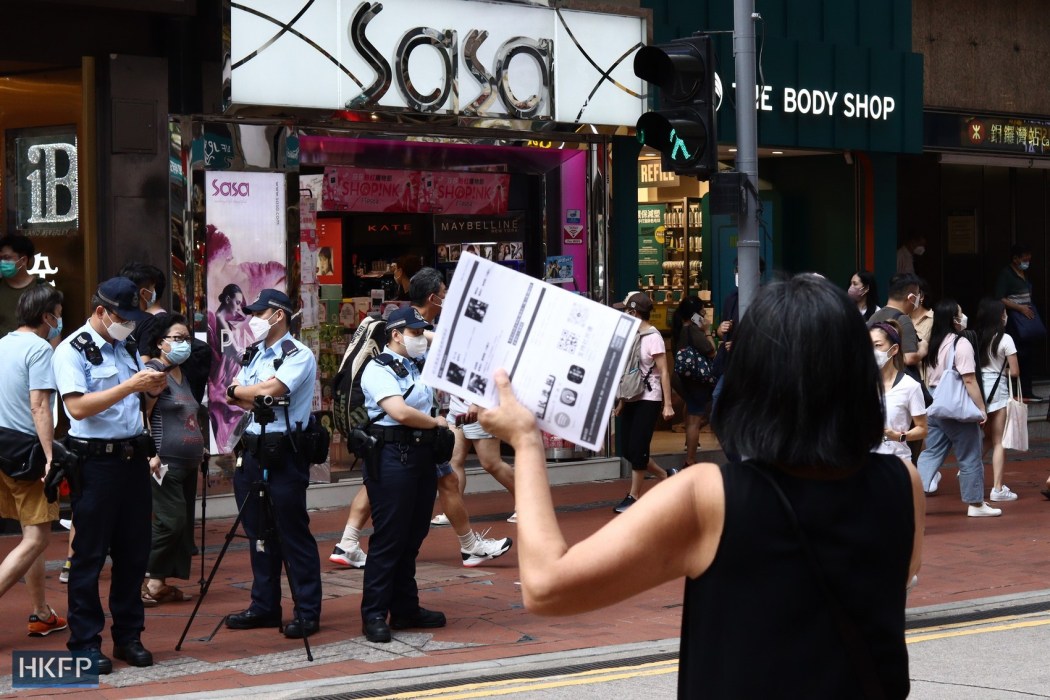
The offences were linked to street booths the LSD set up on April 2, April 30, and May 28, 2023, in Causeway Bay and Wan Chai. According to the prosecution, they displayed a blank black cloth and handed out leaflets with QR codes for the party’s donation link and its PayMe profile.
During the trial earlier this year, the defendants challenged whether the black cloth should be considered a poster and therefore regulated under the Public Health and Municipal Services Ordinance.
Magistrate Minnie Wat ruled on Thursday that the black cloth, approximately two metres long, had been displayed in an “eye-catching spot” at the street booth. Referring to footage recorded by the police, Wat said the defendants had told the public that they hung a blank black cloth because they could be fined if any words were written on the banner.
Wat sided with the prosecution, saying that the definition of a poster was “broad” and that the purpose of the legislation was to impose “appropriate rules to prevent chaos.” As the black cloth was used to “spread ideas in public” and was displayed for around two hours each time at the street booths, it met the definition of a poster, she said.
“Although the black cloth had no words, it was displayed to express the defendants’ political views and opinions about the government,” the magistrate said in Cantonese.
Wat also rejected the defendants’ argument that there was no evidence they were raising funds at the street booths. She said the court should not focus solely on whether the word “fundraising” appeared on the leaflets. Even if the QR code was small, that did not mean the defendants were not soliciting donations.
“They could have removed the QR code and their bank account number if they had no intention of raising funds,” Wat said.

During the trial, the defendants questioned why the police only filmed their street booths without taking any action. Wat responded that the legislation does not require police to issue a warning before enforcement. She added that the absence of a warning did not mean the acts were not in breach of the law.
Chau, who represented himself, said during the trial that the QR code in fact did not work. At the time, the party’s HSBC bank account had already been frozen, he said.
Wat eventually convicted the four activists on all 12 charges and fined them between HK$1,000 and HK$1,200 per summons.
Chan, who had six summonses, received a total fine of HK$6,600, while Chau, with two summonses, was fined HK$2,000. Lee had three summonses and was fined HK$3,000, and Yu was ordered to pay HK$1,000 for one summons.
During mitigation, Chau said the LSD was the last activist group still organising street booths to voice their opinions. In response to the magistrate’s remark that the legislation aimed to prevent people from “fighting for space” to hold street demonstrations, Chau said the magistrate’s “aspiration” was “far from reality.”

“We only want more people in society to express their views to the government. Unfortunately, the government’s response is prosecution,” he said in Cantonese, adding that he had been an activist for over a decade and had not previously been prosecuted for carrying out similar acts.
Yu, on the other hand, called the case “political prosecution” and accused the authorities of “weaponising” laws to suppress civic rights.
“Even if it is not the national security law but just summons, it is eroding our freedoms step by step, until we can no longer even organise a street booth,” he said in Cantonese.
Speaking to reporters after the verdict, Chan said she believed they were innocent but was “not surprised” by the court’s ruling. She said the legislation concerning poster displays used to target banners or posters affixed to street barricades by politicians or political groups, rather than those displayed during a demonstration.
She added the legislation contained many “loopholes” and that their street booth should be regarded as a political activity held sporadically, and therefore should not be subject to regulation.


