

Hong Kong’s security minister Chris Tang has said that taking photos of sites designated as “prohibited places” is illegal under the city’s security legislation only if there is “criminal intent.”

Tang’s remark at a Legislative Council (LegCo) meeting on Thursday was in response to lawmaker Kitson Yang, who asked whether it would be unlawful to take a photo of the prohibited sites.
“I believe that if you just walk past and take a photo at the door, you wouldn’t have criminal intent,” Tang said.
On Tuesday, the government enacted new subsidiary laws under the city’s homegrown security law, also known as Article 23, including designating six sites linked to the Office for Safeguarding National Security (OSNS), Beijing’s national security office in Hong Kong, as “prohibited places” and drawing up related offences.
The six sites are: the Metropark Hotel Causeway Bay, the City Garden Hotel in North Point, the Island Pacific Hotel in Sai Wan, the Metropark Hotel Hung Hom, and two locations along Hoi Fan Road in Tai Kok Tsui.

Speaking to reporters after the meeting, Tang said: “If an ordinary citizen takes a photo, I don’t see the problem with that. But if you are stationed there for an extended period of time, watching the people coming in and out, looking at the windows with a long lens, that might invite suspicions as to whether you are monitoring their work.”
Depending on the situation, police at the sites may have to ask people to leave, he added.
The LegCo meeting was held just hours after the legislature decided to form a subcommittee to oversee updates to the security law, appointing the same roster of lawmakers who oversaw the passage of Article 23 last year. The updates to the legislation were enacted through a “negative vetting” procedure, allowing them to be first published in the gazette before being formally brought to the legislature for scrutiny.
At the same meeting on Thursday, lawmaker Gary Chan, deputy chair of the subcommittee, asked Secretary of Justice Paul Lam how authorities would handle people who inadvertently trespassed, for example, if they were looking for a coin that they had dropped.
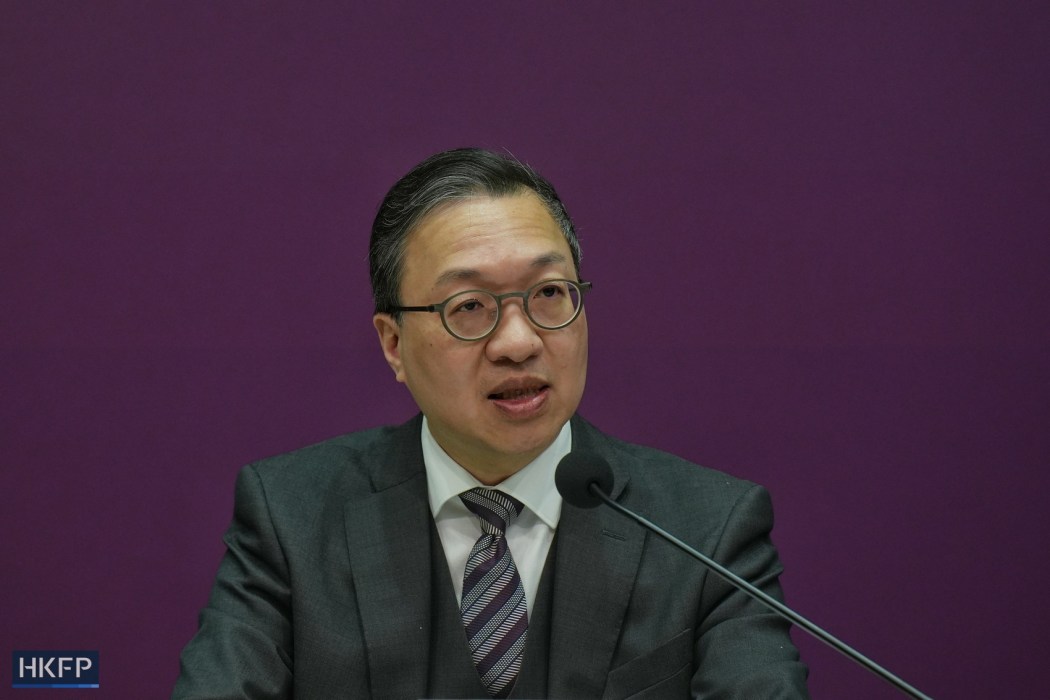
The prohibited sites are guarded by police officers empowered by the security law to ask anyone who has inadvertently trespassed to leave immediately, Lam replied.
“But if you refuse to leave after you’ve been told to, then of course, we would have a problem,” he added.
Addresses of the prohibited areas are “clearly indicated” with coordinates in the subsidiary legislation, and notices are posted around the premises to ensure public awareness, the Security Bureau told HKFP in an emailed statement.
According to Article 23, espionage activities involving prohibited places, including inspections in person or via electronic devices, carry a maximum jail sentence of 20 years.
Meanwhile, entering prohibited places without lawful authority, disobeying orders made by police or guards of the prohibited places, and obstructing their duties are punishable by up to two years behind bars.
Separate from the 2020 Beijing-enacted security law, the homegrown Safeguarding National Security Ordinance targets treason, insurrection, sabotage, external interference, sedition, theft of state secrets and espionage. It allows for pre-charge detention of up to 16 days, and suspects’ access to lawyers may be restricted, with penalties involving up to life in prison. Article 23 was shelved in 2003 amid mass protests, remaining taboo for years. But, on March 23, 2024, it was enacted having been fast-tracked and unanimously approved at the city’s opposition-free legislature.
The law has been criticised by rights NGOs, Western states and the UN as vague, broad and “regressive.” Authorities, however, cited perceived foreign interference and a constitutional duty to “close loopholes” after the 2019 protests and unrest.


