

Hong Kong has enacted new laws under its homegrown security legislation, including the imposition of a maximum jail term of seven years for disclosing investigations by Beijing’s national security office.

The Safeguarding National Security (Office for Safeguarding National Security of the Central People’s Government in the Hong Kong Special Administrative Region) Regulation came into effect on Tuesday, just a day after the new legislation was presented in an off-schedule meeting at the Legislative Council (LegCo).
The subsidiary legislation was enacted through what is called a “negative vetting procedure,” allowing it to be first published in the gazette before being tabled at the LegCo for scrutiny.
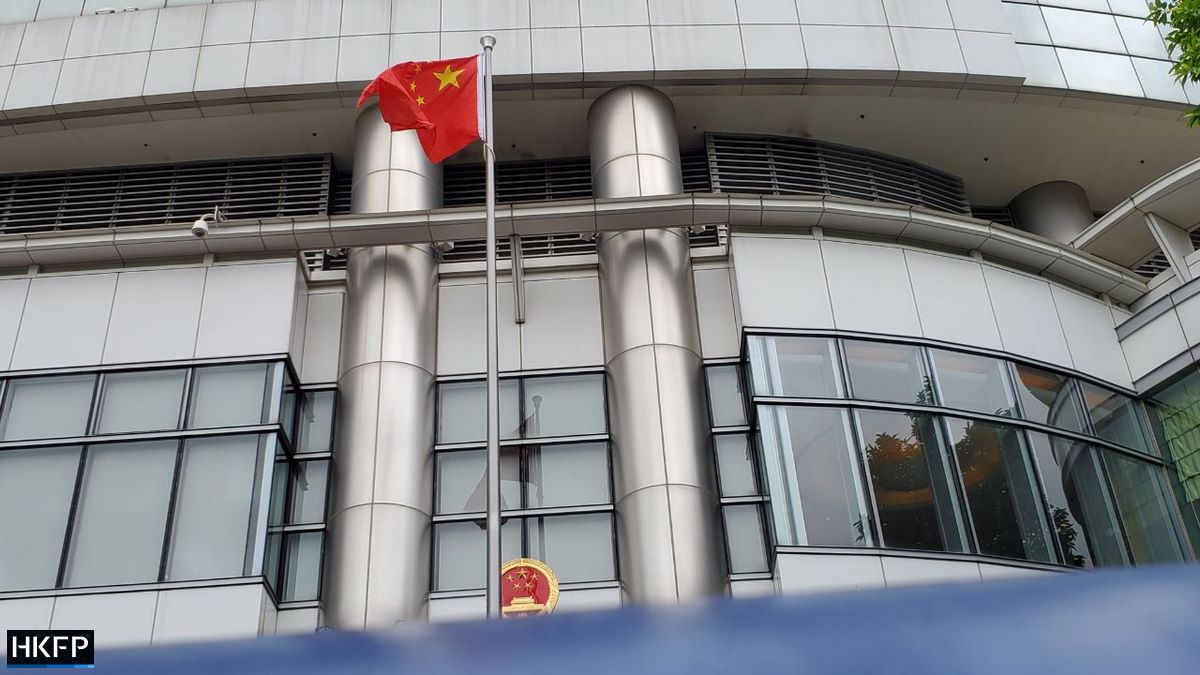
The subsidiary laws include designating premises linked to the Office for Safeguarding National Security (OSNS), Beijing’s national security office in Hong Kong, as “prohibited places” and drawing up related offences, as well as setting up a mechanism allowing mainland China to exercise jurisdiction over national security cases.
The latter builds on an article in the Beijing-imposed national security law, which states that “complex” cases can be prosecuted across the border.
‘Essential’
According to the legislation gazetted on Tuesday, anyone who discloses any information related to the measures and investigation by the OSNS can face a fine of up to HK$500,000 and imprisonment for up to seven years.
Anyone who provides false or misleading information to the OSNS is also liable to conviction and can be punished with a maximum fine of HK$500,000 and a jail sentence of up to seven years.
A government spokesperson said on Tuesday that the subsidiary laws were enacted “against the increasingly turbulent global geopolitical landscape.”
“The two pieces of subsidiary legislation are essential from the perspective of protection in respect of the OSNS’s effective performance of its mandate under the requirements of the HKNSL,” the spokesperson said.
“The subsidiary legislation will not affect the lives of the general public, nor will the normal operation of any institution and organisation be affected.”
The subsidiary legislation stated that any government department or public servant must provide “necessary and reasonable assistance” to the OSNS.
The newly added legislation also stipulates that it is an offence to resist or obstruct the OSNS or its staff in the performance of their duties. Anyone who commits this offence can face a maximum fine of HK$200,000 and up to three years’ imprisonment. Individuals who falsely pretend to be staff of the OSNS face the same fine and prison term.
Another newly added offence is the failure to comply with a legal document. The legislation stipulates that, unless the person has a “reasonable excuse” for not complying with the document, they will be seen as committing an offence and can face a maximum penalty of a HK$500,000 fine and seven years in jail.

The subsidiary legislation also outlaws forging OSNS documents, including a seal or signature, a legal document, and identification documents of the office. Those convicted can be fined up to HK$500,000 and face a maximum imprisonment of seven years.
In early March, the Hong Kong government said it would study how to “improve” national security legislation after the Court of Final Appeal quashed the convictions of three Tiananmen vigil activists.
The top court ruled in favour of Chow Hang-tung, Tang Ngok-kwan, and Tsui Hon-kwong, who were convicted and jailed in March 2023 for failing to comply with a police demand for data under the Beijing-imposed national security law, after authorities alleged that the alliance was a “foreign agent.”
Chow, Tang, and Tsui denied the allegation.
Separate from the 2020 Beijing-enacted security law, the homegrown Safeguarding National Security Ordinance targets treason, insurrection, sabotage, external interference, sedition, theft of state secrets and espionage. It allows for pre-charge detention of up to 16 days, and suspects’ access to lawyers may be restricted, with penalties involving up to life in prison. Article 23 was shelved in 2003 amid mass protests, remaining taboo for years. But, on March 23, 2024, it was enacted having been fast-tracked and unanimously approved at the city’s opposition-free legislature.
The law has been criticised by rights NGOs, Western states and the UN as vague, broad and “regressive.” Authorities, however, cited perceived foreign interference and a constitutional duty to “close loopholes” after the 2019 protests and unrest.


