

Australian justice Robert French has resigned from Hong Kong’s top court, saying the role of overseas non-permanent judges at the Court of Final Appeal (CFA) has become “increasingly anachronistic and arguably cosmetic.”

In a statement released on Friday, a Hong Kong government spokesperson “expressed regret” at French’s resignation from the CFA. His term was originally set to end in May 2026 after it was extended for three years in 2023.
The spokesperson said the government was grateful for his contributions over the years.
French expressed “great respect” for the city’s judicial officers in his resignation letter to Chief Executive John Lee, the spokesperson said, adding the justice praised them for their “independence and integrity.”

French, who was admitted to practice in Western Australia in December 1972, was appointed as a visiting judge on Hong Kong’s apex court in 2017.
He is the sixth foreign judge to depart Hong Kong’s highest court since last year.
In response to media enquiries, French said it was “with regret” that he tendered his resignation on March 31.
The Australian said that he maintained his respect for local and overseas judges who continue to serve on the top court for their integrity and independence.

“I reject the proposition that they are somehow complicit in the application of national security laws by the executive or that they confer any spurious legitimacy upon them,” French said, adding that he would not make any statements on the security legislation which may be brought before the apex court for interpretation in the future.
The retired justice went on to say that the importance of international judges on the Hong Kong bench may be declining.
“I do observe that the role of the non-permanent justices on the Court of Final Appeal has become increasingly anachronistic and arguably cosmetic,” he said, adding that there may still be room for foreign judges in Hong Kong to sit on an international commercial court.
See also: Explainer: Why do foreign judges sit on Hong Kong’s top court?
Since its establishment in 1997, the CFA has sporadically extended invitations to judges from other common law jurisdictions to join its appeal panel.
This practice has been regarded as a testament to the international community’s trust in the city’s judicial system, which has helped Hong Kong maintain its reputation and credibility as a global financial and business hub.
Prior to his appointment to the CFA, French served as a judge of the Australian Federal Court and as the chief justice of the Australian High Court.
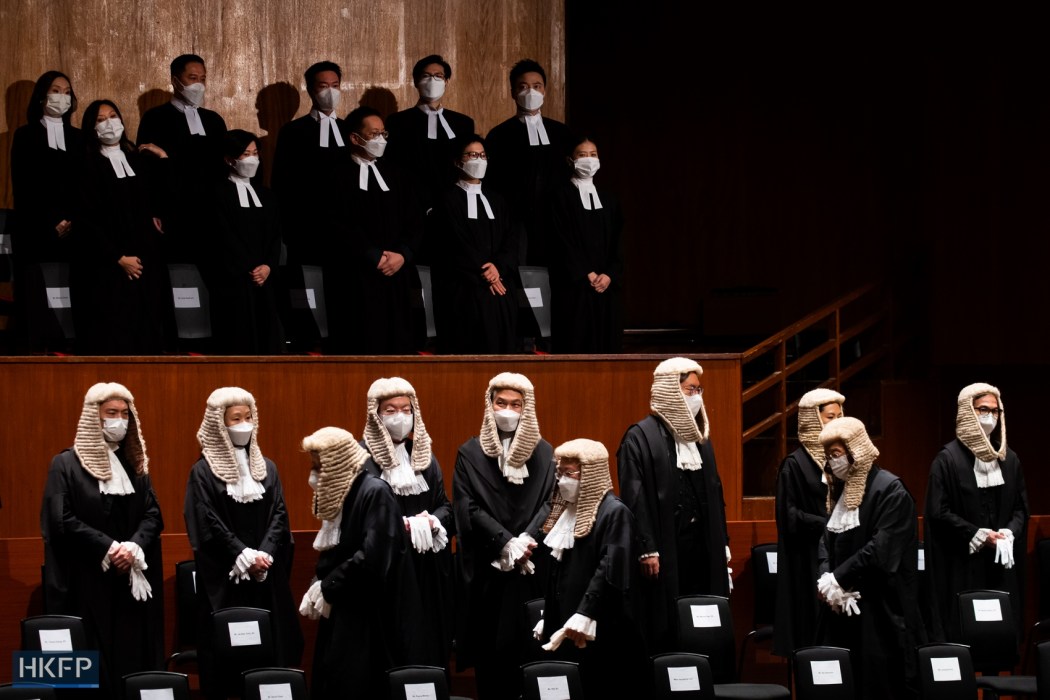
The septuagenarian judge previously defended Hong Kong’s top court amid criticism of the city’s rule of law by overseas activists and former CFA justice Jonathan Sumption, who said the city was “slowly becoming a totalitarian state” following the enactment of the national security law in 2020.
Judges of Hong Kong’s apex court were committed to “maintaining judicial independence,” French told The Australian newspaper in July 2023, around two months after his term at the CFA was renewed.
French’s departure left the CFA with five overseas non-permanent judges: two British justices, Leonard Hoffmann and David Neuberger, and three Australian justices, William Gummow, Patrick Keane, and James Allsop.
In March 2022, the UK withdrew its last two serving judges from Hong Kong’s top court, citing concerns over the Beijing-imposed national security law.
Then UK foreign minister Liz Truss said that the “systematic erosion of liberty and democracy” in Hong Kong had reached a point where it was “no longer tenable” for British judges to sit on the CFA.
In response, Hong Kong’s justice secretary, chief justice and two professional legal bodies issued a statement backing the city’s judicial independence.
Chief Justice Andrew Cheung said at the time that all judges and judicial officers would continue to administer justice “without fear or favour, self-interest or deceit.”
Judges who have retired from the British courts are not affected by the order and can still serve on the CFA.
Beijing inserted national security legislation directly into Hong Kong’s mini-constitution in June 2020 following a year of pro-democracy protests and unrest. It criminalised subversion, secession, collusion with foreign forces and terrorist acts – broadly defined to include disruption to transport and other infrastructure. The move gave police sweeping new powers and led to hundreds of arrests amid new legal precedents, while dozens of civil society groups disappeared. The authorities say it restored stability and peace to the city, rejecting criticism from trade partners, the UN and NGOs.


