

Hong Kong’s commerce chief has turned down an idea floated by a lawmaker to merge the city’s public broadcaster and the government’s public relations department, saying such a move would be “counterproductive” to official communication work.

Speaking during a Legislative Council (LegCo) meeting on Wednesday, Secretary for Commerce and Economic Development Algernon Yau said the government-funded Radio Television Hong Kong (RTHK) and the Information Services Department (ISD), which publishes news for the authorities, were two departments with “no overlapping” functions.
“Although RTHK and the ISD are both government departments and both carry the responsibility of disseminating government information, RTHK, as the public service broadcaster, and the ISD, being responsible for the government’s public relations, perform different duties,” he said in Cantonese.
He added that merging them “may confuse the public… which may be counterproductive to the government’s overall public relations work.”
His remarks were a response to lawmaker Junius Ho, who asked about ways to enhance “compatibility” of the two departments and even a possible merger as the city recorded large fiscal deficits for three consecutive years.
Yau said that RTHK and the ISD were home to 762 and 451 job posts respectively in the current fiscal year, and that the staff in each department required different skills and experience.

RTHK has to “cater for the needs of the mass audience,” including minority groups in Hong Kong, with programmes ranging from public affairs and national education to sports and lifestyle, he said.
Meanwhile, the ISD is responsible for the government’s publicity and news dissemination, he said.
The two departments have “distinctly different” missions, services, and operations, the commerce chief added.
‘Fundamental reform’
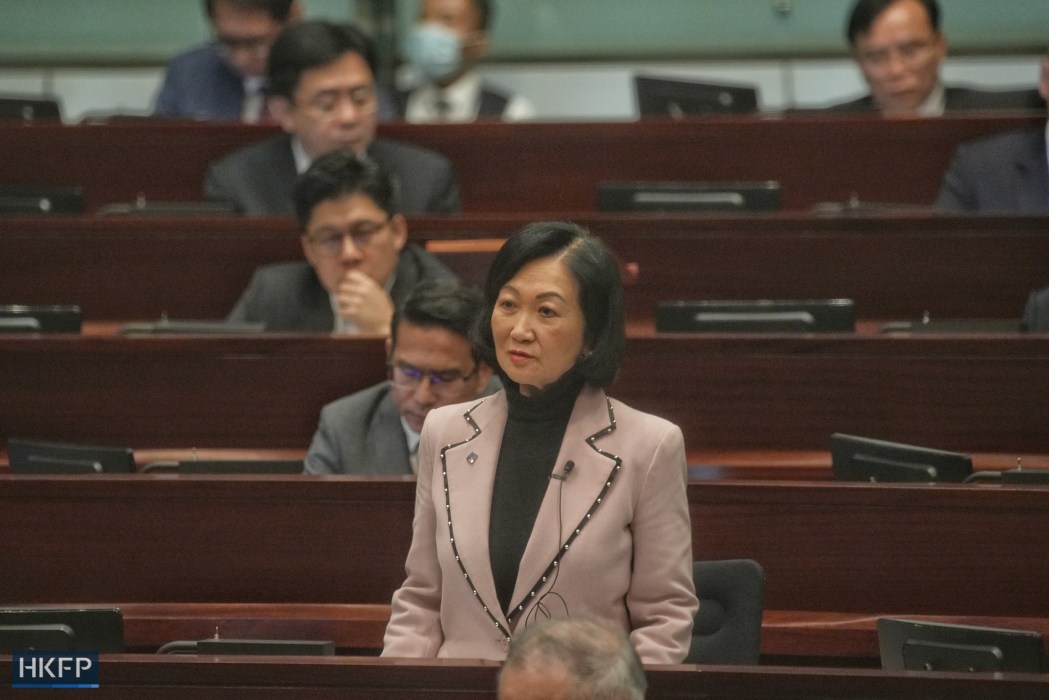
But lawmaker Regina Ip – also the convenor of the Executive Council, Hong Kong’s top advisory body – appeared unconvinced, saying that the two entities lacked “fundamental reform.”
She also claimed RTHK was full of “redundant staff,” citing her experience being interviewed by the broadcaster, which she said brought more crew members to the interview than other media outlets.
“While other broadcasters have one person on the mic and another in charge of the lighting, RTHK may easily show up with four people or even eight,” Ip said in Cantonese.
“Sometimes [RTHK] does not air an interview long after it has been recorded. Those interviews risk being outdated,” she added.
In response, Yau said that RTHK had already explored cost-cutting measures, such as using artificial intelligence in programming, and that the broadcaster would continue to do so.
He added that authorities would “seriously consider” the lawmakers’ comments.
During the same LegCo meeting, Clarence Leung, undersecretary of the Home and Youth Affairs Bureau, which oversees the ISD, also said that the department had been keen to adopt the latest technologies in promoting the government’s work.
HKFP reported last year that RTHK began using AI-generated voices in place of some human presenters.
An RTHK spokesperson told HKFP at that time that the technologies could help “relieve the staff shortage pressures.”
The public broadcaster was caught in the crosshairs of pro-Beijing supporters, who accused it of being sympathetic to the city’s pro-democracy protesters during the protests and unrest in 2019.
Since then, RTHK has undergone a major restructuring that included scrapping its long-standing satirical show Headliner and adopting new editorial guidelines.


