

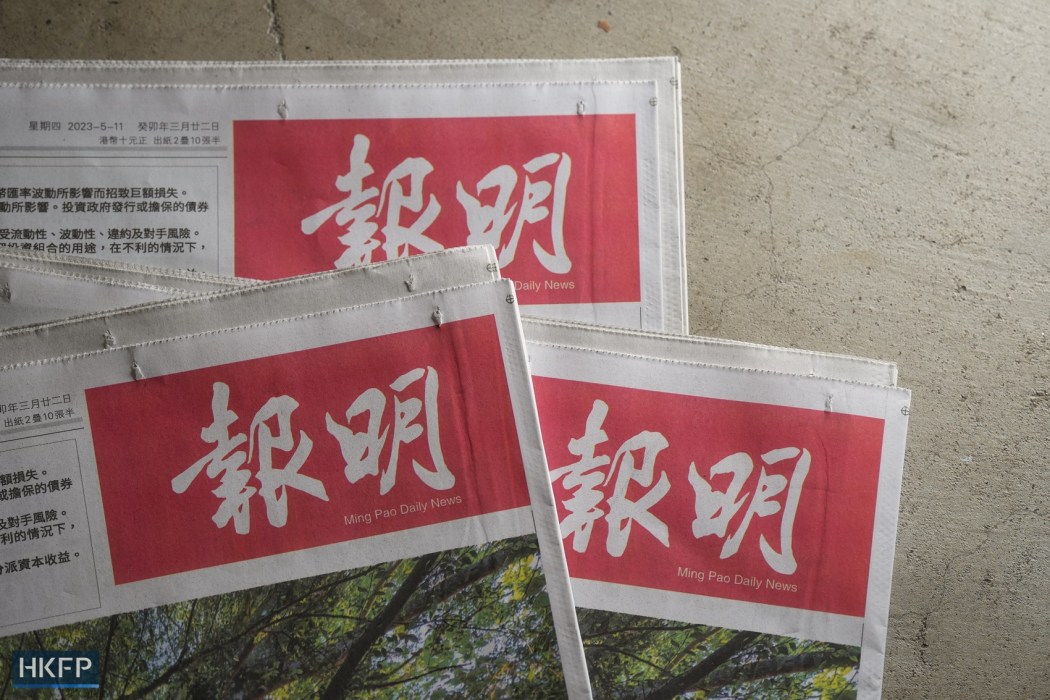
It is nice to know that the secretary for security reads Ming Pao. Think of the alternatives. Sadly, however, the secretary, Chris Tang, often does not appear to enjoy his reading.

The last item to arouse Mr Tang’s ire was law professor Johannes Chan’s op-ed on the latest legal installment of the Yuen Long incident.
“The author, who is a law professor, has once again published a biased article,” Mr Tang complained, “deliberately ignoring the fact that some white-clad people have already been brought to justice, misleading readers with a warped perspective that the court has made an unfair judgment regarding either party, shaking the public’s confidence in the court system, and undermining the rule of law in Hong Kong, which must be condemned.”
Mr Tang went on to say that the afterword, commonly added to opinion pieces these days, saying there was no intention to incite hatred of the government, did not discharge the obligation on the editor to ensure that his publication was “fair, objective, and unbiased.”
He concluded: “It is hoped that Ming Pao will not continue to be exploited by people with ulterior motives to use this platform to spread confusing remarks, to poison the community, and to create conflicts.”
Now I propose ignoring some of this. Opinion pieces are not supposed to be fair, objective, and unbiased. They are expressions of opinion. Moreover, if Mr Tang wishes to campaign with any credibility for unbiased media, he needs to avoid the impression that he has some unique problem with Ming Pao.
I shall also pass by the bit about white-clad people being brought to justice, which strictly speaking is entirely irrelevant. Injustice to one defendant cannot be balanced by justice to another.
More interesting is Mr Tang’s claim that the offending piece misled readers into the “warped perspective” that the court had made an unfair judgment, and that this had “shaken the public’s confidence in the court system,” thereby undermining the rule of law.
This is, alas, nonsense. The rule of law has never required the public to believe that judges are infallible. In 1793, the then chief justice Lord Kenyon said, “In the hurry of business, the most able Judges are liable to err.”
More recently, we can consider the view of Lord Denning: ”We do not fear criticism, nor do we resent it. For there is something far more important at stake. It is no less than freedom of speech itself… Those who comment can deal faithfully with all that is done in a court of justice. They can say that we are mistaken, and our decisions erroneous, whether they are subject to appeal or not.”
Or there is the rather more literary, oft-quoted, opinion of Lord Atkin (more famous as an innovator in business law), which goes in part: “The path of criticism is a public way. The wrong-headed are permitted to err therein… Justice is not a cloistered virtue; she must be allowed to suffer the scrutiny and respectful, even if outspoken, comments of ordinary men.”
I infer that Mr Tang is offering the courts protection, which they have never sought and do not need. If a judge makes a statement about the law, it is open to criticism and comment. Similarly, if the judge is sitting alone and has to make findings of fact, they may also be scrutinised. The rule of law is fortified, not weakened, if the activities of the courts can be discussed and debated.

He may also care to consider that freedom of the press is not furthered by threatening words from officials in the law and order industry, and if the government wishes to offer a running commentary on media output, this might be better left to the information specialists.
It is unnecessary for Mr Tang to repeatedly insist that appending “this piece is not intended to inspire hatred of the government,” or words to that effect, is not an effective bar to prosecution. We all know that. It’s like starting a novel with the usual stuff about “no resemblance to real persons, living or dead.” This will not keep you out of the libel courts if your lead villain is an erratic politician called Ronald Frump.
Mr Tang may be a happier reader if he bears in mind the wise words of the late US judge Robert Jackson: “The price of freedom of religion or of speech or of the press is that we must put up with, and even pay for, a good deal of rubbish.”
And if tempted to rush to the defence of some official masterpiece, he might also bear in mind another observation from the same judge. “Who does not prefer good to ill report of his work? And if fame – a good public name – is, as Milton said, the ‘last infirmity of a noble mind,’ it is frequently the first infirmity of a mediocre one.”
| HKFP is an impartial platform & does not necessarily share the views of opinion writers or advertisers. HKFP presents a diversity of views & regularly invites figures across the political spectrum to write for us. Press freedom is guaranteed under the Basic Law, security law, Bill of Rights and Chinese constitution. Opinion pieces aim to constructively point out errors or defects in the government, law or policies, or aim to suggest ideas or alterations via legal means without an intention of hatred, discontent or hostility against the authorities or other communities. |


