

The Hong Kong government has proposed legislative amendments to permanently bar those convicted of national security offences from serving in labour unions and to require all foreign funding to be vetted by the authorities.

The changes to the Trade Unions Ordinance were proposed on Wednesday “to better fulfil the duty of safeguarding national security” under the city’s two national security laws, the labour authorities said in a statement published the same day.
The amendments would also “strengthen the statutory powers of the Registrar of Trade Unions over the supervision and regulation of trade unions,” the statement said.
To bar funding from an “external force” that would endanger national security, the government proposed that unions must make an application to the registrar declaring the source and usage of the funds provided, according to a document submitted to the Legislative Council. “Trade unions shall not receive such funds unless approved by the Registrar,” it said.
According to the document, the amendments to the ordinance would adopt the same definition of “external force” under the city’s homegrown national security legislation, to cover foreign governments, political parties, and external organisations “that pursue political ends,” as well as their related personnel.

If those funds are approved, the unions will be prohibited from using them for local elections, and the funds will be subject to heightened scrutiny separately from the union’s other funding.
See also: Trade unions must now declare they will not ‘endanger national security’ to register in Hong Kong
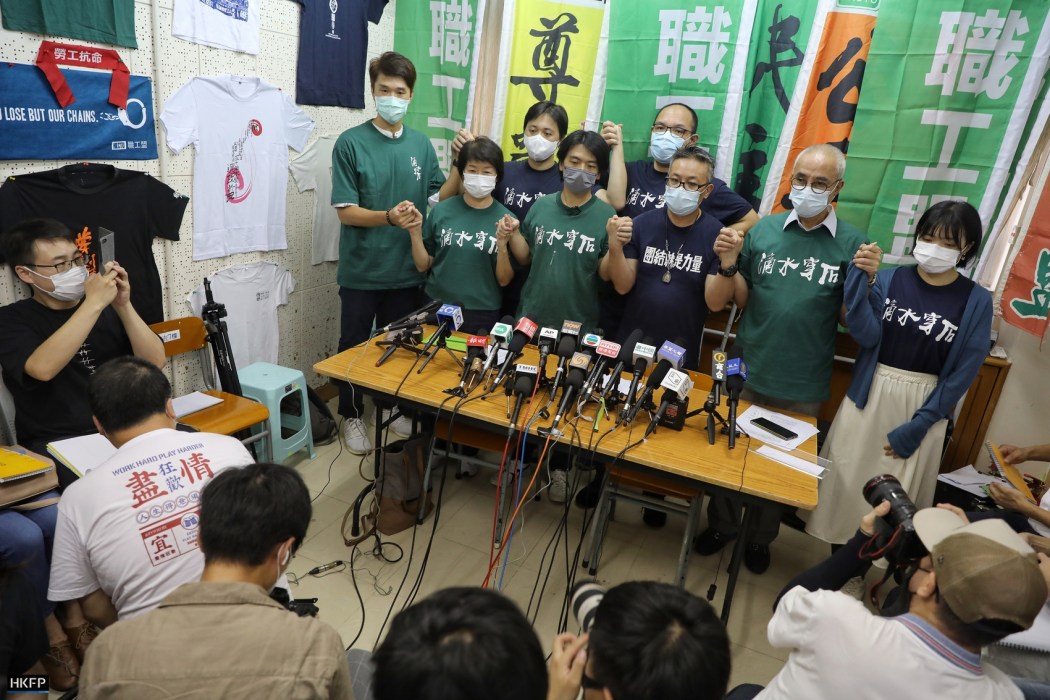
Since Beijing inserted national security legislation directly into Hong Kong’s mini-constitution in June 2020 – after a year of pro-democracy protests and unrest – many labour unions, including the pro-democracy Hong Kong Confederation of Trade Unions, have disbanded, citing political pressure. Union leaders are also among the 45 pro-democracy figures jailed for subversion under the 2020 security law.
Pro-Beijing union coalitions, such as the Hong Kong Federation of Trade Unions and the Federation of Hong Kong and Kowloon Labour Unions, however, are still active.
Hong Kong’s homegrown Safeguarding National Security Ordinance, also known as Article 23, which was enacted in March 2024, already has a mechanism to halt the operations of organisations in the city, including registered unions.
Empowering the registrar
The government also proposed empowering the Registrar of Trade Unions to bar those convicted of national security offences from serving as union officers or promoters for union applications.
As national security offences are “more serious” than existing crimes that would bar one from serving in a union, including fraud, dishonesty, extortion, and triad activities, “we consider that stricter restrictions should be imposed,” the government said in its proposal.
Moreover, under the new proposed legislation, a union officer who has been charged with security offences must declare their charge or risk a notice to cease union activities.
The government also proposed that the registrar should be empowered to refuse applications for registering unions on national security grounds, with no possibility of appeal. The applicants also cannot appeal to the court against the decision.
Secretary for Labour and Welfare Chris Sun said in the statement that the amendments would enhance “the mechanism for safeguarding national security… while giving due regard to the freedom and right of Hong Kong residents to form and join trade unions.”
The proposal will be tabled to the legislature in April.
Support HKFP | Policies & Ethics | Error/typo? | Contact Us | Newsletter | Transparency & Annual Report | Apps
Help safeguard press freedom & keep HKFP free for all readers by supporting our team


















latest national security stories


