

Legislating Hong Kong’s homegrown national security law was the biggest challenge of his career, the city’s security chief has said.

In a Facebook video shared on Sunday, Secretary for Security Chris Tang recapped a year he described as being “filled with challenges and opportunities.”
Tang said he and the team “poured countless effort and time” into their work and overcame “obstacle after obstacle, leaving behind many unforgettable memories,” the most important of which was the passage of the city’s homegrown security law.
In March, the city’s opposition-free legislature unanimously voted to pass the Safeguarding National Security Bill, a security law targeting treason, insurrection, sabotage, external interference, sedition, and theft of state secrets and espionage. It is separate to a Beijing-imposed security law, which was enacted in 2020.

Authorities said the Safeguarding National Security Ordinance, also known as Article 23, was needed to plug “loopholes” in Beijing’s law, citing perceived foreign interference and the 2019 protests and unrest.
Passing Article 23 was a “historical mission,” Tang said in Cantonese, adding that it was the “biggest challenge in [his] career.”
“At the time, I faced slander, attacks and threats from the outside… because I was not getting enough sleep, I suffered inflammation in my eyes and shoulders, and my gout came back,” Tang said.
Still, seeing the law pass unanimously and completing the mission with his “comrades” gave him a feeling of pride, he said, adding that safeguarding national security and promoting patriotic education was the Security Bureau’s responsibility.
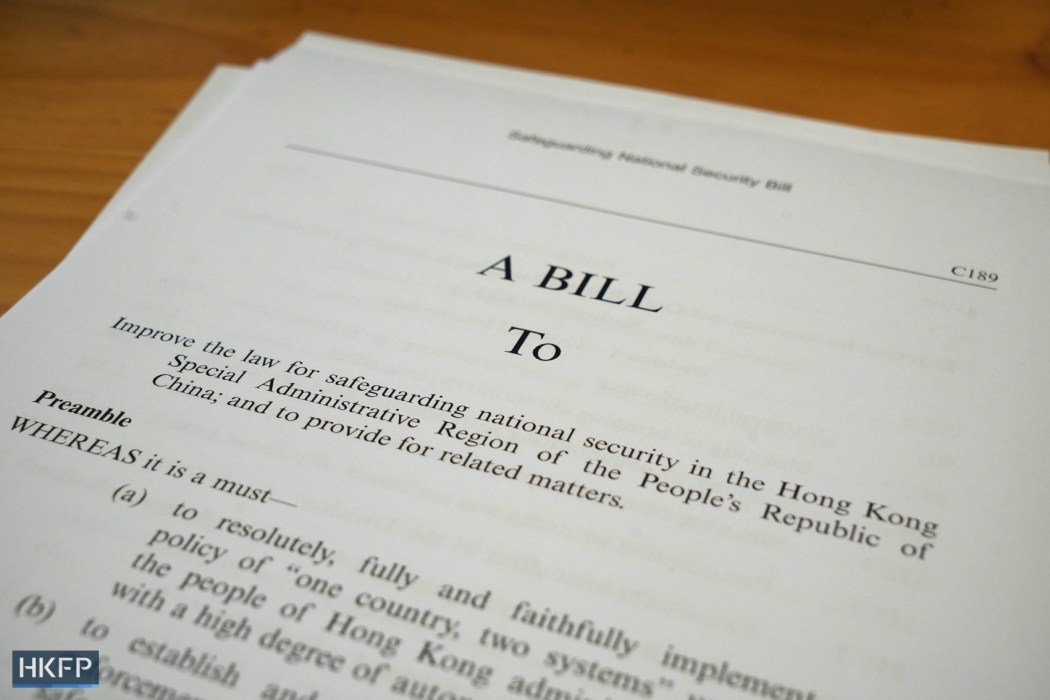
Unlike in 2002 and 2003, when Hong Kong’s first attempt to pass a local security law was met with widespread protests and criticism from opposition lawmakers, there was little local resistance this time.
There have been no large-scale demonstrations since the national security law was imposed in June 2020, after which dozens of civil society groups disbanded. The city’s Legislative Council has no opposition lawmakers following an electoral reform in 2021 that slashed the number of directly elected seats and ensured that only those the authorities deem as “patriots” can run.
Overseas, the law has been criticised by rights NGOs, Western states and the UN as vague, broad, and “regressive.”
Earlier in December, Chinese leader Xi Jinping praised Chief Executive John Lee during a meeting in Beijing for completing the legislation of Article 23.
Support HKFP | Policies & Ethics | Error/typo? | Contact Us | Newsletter | Transparency & Annual Report | Apps
Help safeguard press freedom & keep HKFP free for all readers by supporting our team


















latest national security stories


