

Hong Kong’s Department of Justice (DoJ) may seek longer sentences in a bomb plot case which was the first to be brought in the city under a United Nations anti-terrorism law, a government spokesperson said, after the “mastermind” was sentenced to almost 24 years.

The DoJ will study the reasons for sentencing in detail and consider whether to submit a review application to the appeal court in the case of a thwarted bomb plot during the 2019 extradition bill protests, the government said in a statement on Thursday.
The statement came a few hours after Ng Chi-hung was put behind bars for 23 years and 10 months. Wong Chun-keung, a leader of the radical group “Dragon Slayers,” was jailed for 13 years and six months.
The case concerned offences such as “conspiracy to commit bombing of prescribed object” and “conspiracy to provide or collect property to commit terrorist acts” under the UN anti-terrorism law that was invoked for the first time. Other charges included “conspiracy to commit murder” and “conspiracy to cause explosions of a nature likely to endanger life or to cause serious injury to property.”
Ng’s prison term was the heaviest sentence yet in any case related to the protests and unrest in 2019. Five other defendants received jail terms ranging from five years and 10 months to 12 years.
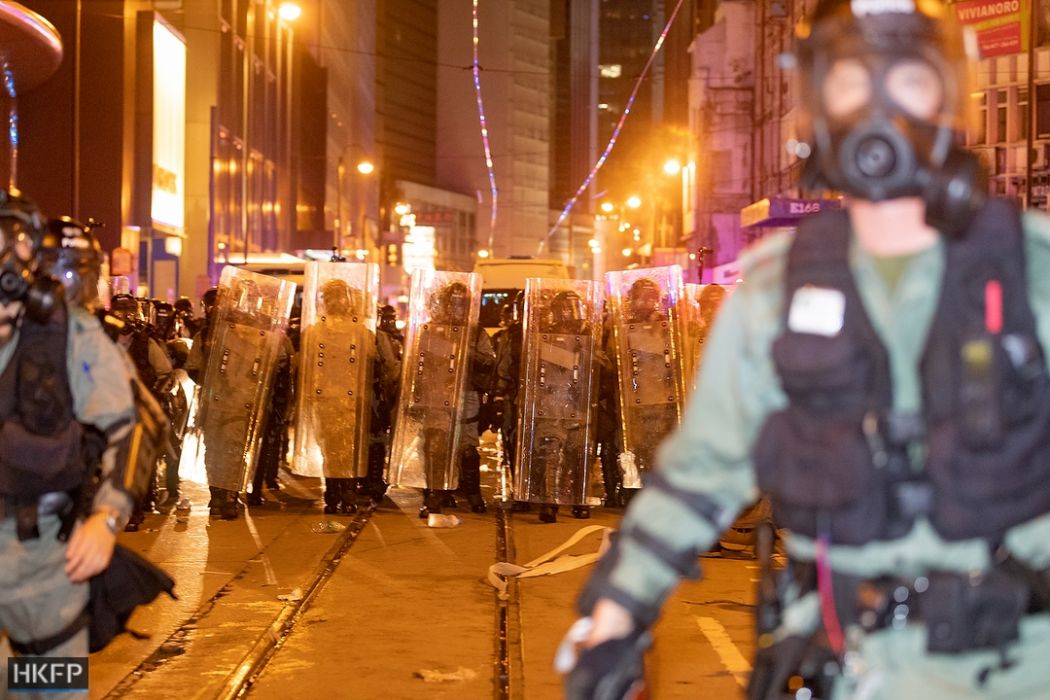
On Thursday evening, the government cited the ruling by Judge Judianna Barnes and described the case as “very vicious.” It had involved the “premeditated luring” of police officers in order to kill them and planned to damage property.
A spokesperson said in the statement the circumstances of the case were “very serious,” with real guns and explosives involved. There would have been serious casualties had the plot not been thwarted by the police in time, and such “malicious acts” must be “duly punished.”
“The facts admitted by the defendants indicate that the case involved plans of extreme terrorist violence and gruesome attacks,” it read.
The statement said both the Beijing-imposed national security law, and the Safeguarding National Security Ordinance, commonly known as Article 23 legislation, outlawed terrorist activities and sabotage endangering national security.
Both laws may be applied in similar cases in the future to prosecute and sanction criminals, the government said. The two laws provide for sentences of up to life imprisonment.

“The HKSAR Government hereby gives a solemn warning to those terrorists and criminals who recklessly attempt to endanger national security or Hong Kong’s public security that they should not defy the law in the hope that they may not be caught,” the statement read.
According to the Prosecution Code, the city’s justice minister may apply to the court in “exceptional cases” for the review of a sentence on the basis that it had proceeded on an error of law or principle, or that it was “manifestly inadequate or excessive.”
In a review, the prosecutor must identify the errors and principles that apply and the authorities which support that position and suggest the correct resolution of the issues.
Separate from the 2020 Beijing-enacted security law, the homegrown Safeguarding National Security Ordinance targets treason, insurrection, sabotage, external interference, sedition, theft of state secrets and espionage. It allows for pre-charge detention of up to 16 days, and suspects’ access to lawyers may be restricted, with penalties involving up to life in prison. Article 23 was shelved in 2003 amid mass protests, remaining taboo for years. But, on March 23, 2024, it was enacted having been fast-tracked and unanimously approved at the city’s opposition-free legislature.
The law has been criticised by rights NGOs, Western states and the UN as vague, broad and “regressive.” Authorities, however, cited perceived foreign interference and a constitutional duty to “close loopholes” after the 2019 protests and unrest.
Support HKFP | Policies & Ethics | Error/typo? | Contact Us | Newsletter | Transparency & Annual Report | Apps
Help safeguard press freedom & keep HKFP free for all readers by supporting our team


















latest national security stories


