

All mitigating factors should be considered when meting out jail sentences in national security cases, the defence team of a Hong Kong man convicted of inciting secession has told the city’s top court.

Lui Sai-yu – who was sentenced to five years in prison last April – appeared before a five-judge panel at the Court of Final Appeal on Wednesday.
Lui, who was a Hong Kong Polytechnic University student at the time of the offence, pleaded guilty to inciting secession but was denied the one-third jail term reduction that is customarily handed when a defendant admits guilt. While delivering Lui’s sentence at a lower court, District Court judge Amanda Woodcock said his offence was of a “serious nature,” therefore warranting a sentence of between five and 10 years per the national security law.
She initially took a starting point of five years and six months, and, considering his plea, took one-third off the jail term to arrive at three years and eight months.
The prosecution then argued that as the offence was “serious,” the sentence should not fall below five years. Woodcock walked back the original sentence reduction to deliver a jail term of five years.
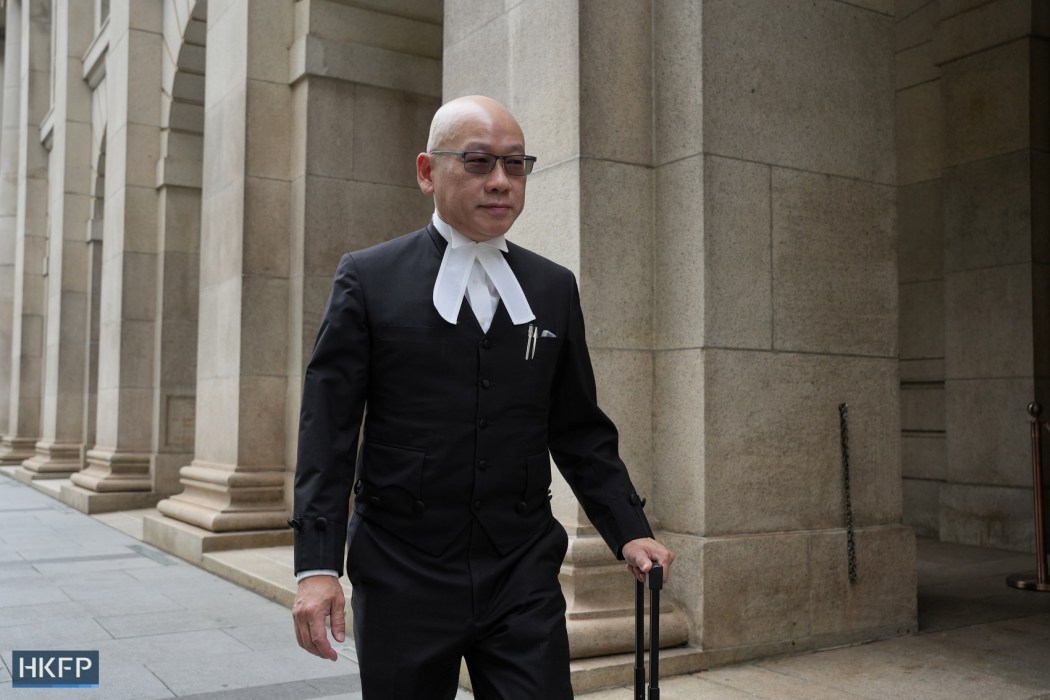
Representing Lui on Tuesday, Senior Counsel Robert Pang referred to Article 33 of the Beijing-imposed national security law, which spells out three conditions under which one could have their penalty reduced. They include voluntarily discontinuing the commission of the offence or forestalling its consequences; voluntarily surrendering and giving a truthful account of the offence; and reporting an offence committed by somebody else.
Pang argued that the conditions are not exhaustive, and that the mitigating effects of a timely guilty plea should be considered.
“We’re saying it’s not exhaustive because it can’t have been the intention of the [Beijing] legislature to remove… [the] mitigation factors which generally apply,” he said.
The article identifies “particular factors of mitigation which will be taken into account,” Pang said. “But it doesn’t remove… long established mitigating factors.”
‘That cannot be right’
Wednesday’s appeal hearing marked the first time the city’s highest court had seen a challenge to a national security sentence.

Pang also discussed Article 21 of the security legislation, which states that a person should be jailed for “not more than five years” if the offence is of a minor nature, and “not less than five years but not more than 10 years” for offences of a serious nature. It was this provision that prompted the lower court judge to revise Lui’s jail sentence upwards.
He said five years was a starting point, not a minimum jail sentence length for someone whose offence is deemed serious.
Pang described a hypothetical scenario in which two defendants are convicted of a crime and sentenced to five years in jail.
“[The first defendant]… pleads guilty, he is remorseful, has been involved in charity volunteer work,” he said. “[The second defendant] shows no remorse at all, says [they] will do the same again if given the chance.”
“According to the construction which is espoused by the respondent, they will be sentenced to exactly the same sentence,” Pang said. “That cannot be right.”

The counsel raised another hypothetical scenario where two defendants plead guilty to incitement. One, whose offence is considered mild as they incited a smaller audience, is sentenced to four years and 11 months, and is then given a one-third sentence reduction due to the guilty plea. The offence of the other, however, is considered serious as they incited a larger audience, and the defendant is sentenced to five years and one month in jail. But they are not allowed a one-third sentence reduction, because that would result in the final sentence falling below five years.
In this case, the former defendant would be given a “substantially lower sentence for basically the same thing.”
“So is that right? How can that be not a capricious sentence?” Pang asked.
When asked by judge Patrick Chan if he was “basically complaining against the tier system,” Pang said he was not.
He said the tiers existed so the public could know what the sentences could be for a particular type of offence.
Prosecution’s case
In response, the prosecution said the court must consider that the aim of the Beijing-imposed law was to counter acts that endangered national security, so it should factor in deterrent, punishment and other elements relating to “penological concern.”

Deputy Director of Public Prosecutions (Special Duties) Anthony Chau argued that offences deemed serious must be punished by jail terms of at least five years. He pointed to the security law’s Article 25, which states that a person who organises or takes charge of a terrorist group “shall be” sentenced to life imprisonment. In the same article, it is stated that “other participants shall be sentenced to fixed-term imprisonment of not more than three years, short-term detention or restriction, and shall be liable to a criminal fine.”
Chau said this showed the national security law tried to draw a distinction between “shall be liable and shall be sentenced.” The former is discretionary, while the latter is mandatory, he said. The text in Article 21 read “shall be sentenced.”
In response to the prosecution’s arguments, Pang said he did not see how considering “well-established mitigating factors” would detract from effectively imposing punishment.
The court did not announce the date of the hearing’s verdict.
In June 2020, Beijing inserted national security legislation directly into Hong Kong’s mini-constitution – bypassing the local legislature – following a year of pro-democracy protests and unrest. It criminalised subversion, secession, collusion with foreign forces and terrorist acts, which were broadly defined to include disruption to transport and other infrastructure. The move gave police sweeping new powers, alarming democrats, civil society groups and trade partners, as such laws have been used broadly to silence and punish dissidents in China. However, the authorities say it has restored stability and peace to the city.
Support HKFP | Policies & Ethics | Error/typo? | Contact Us | Newsletter | Transparency & Annual Report | Apps
Help safeguard press freedom & keep HKFP free for all readers by supporting our team


















latest national security stories


