

Ex-lawmaker Lam Cheuk-ting and six others have been found guilty of rioting during a mob attack in Yuen Long in July 2019, a watershed moment during the 2019 protests that sparked widespread criticism of police over their response to the incident.

Lam was one of seven convicted at the District Court on Thursday after a 51-day trial that began in October last year. They were accused of taking part in a riot at Yuen Long MTR station on July 21, 2019, when men dressed in white stormed the station and attacked passers-by.
The prosecution accused the defendants of provoking the white-shirt men by throwing objects and spraying them with a fire hose.
All seven testified during the trial. Over the course of eight days, Lam said he went to Yuen Long that night after hearing that suspected triad members planned to gather there to “protect their homeland.” The 47-year-old said he hoped to use his role as a lawmaker to pressure police to take action.
Lam said when he arrived at the station that night, he saw someone dressed in black being attacked by a group of people in white. He choked up while testifying, saying he felt helpless as he watched.

The prosecution, however, rejected his argument, saying that Lam had been an instigator of the attacks and was not a credible witness. During the trial’s closing arguments, prosecutor Jasmine Ching claimed that Lam had “abused his power for personal gains,” such as by live-streaming on his Facebook page when he arrived at the scene in an attempt to “attract traffic.”
Judge Stanley Chan on Thursday said he did not believe that Lam had been exercising his role as a lawmaker to mediate the conflict or monitor police enforcement at Yuen Long station. Chan said he was trying to take advantage of the situation for his own political benefit.
Chan cited three Facebook posts Lam made before arriving in Yuen Long, in which he said there were suspected triad members there. Lam did not caution people not to go to Yuen Long or to take other forms of public transport to avoid the area. Instead, his posts created a “magnetic effect,” Chan said.
The judge also referred to a Facebook live video that Lam asked his assistant to film at the station. Chan said the live video was for Lam’s political benefit, and he could have filmed videos on his phone instead.
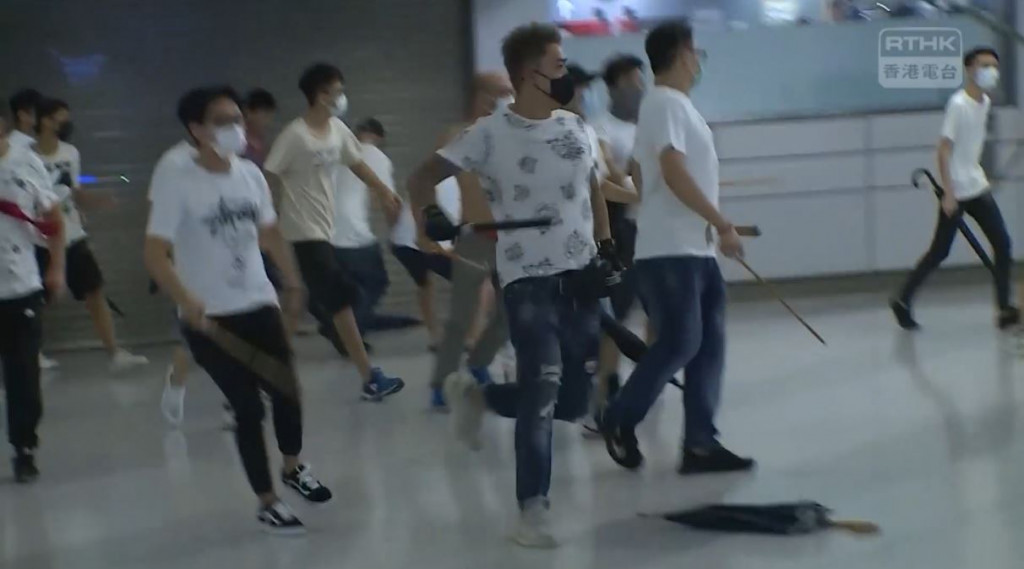
Lam was among those attacked on the station platform. He told the court a man wearing a white shirt – who has since been convicted of rioting – chased him with a rod and hit him, causing his mouth to bleed. The ex-lawmaker said he needed stitches afterwards, and that his head and arms were also injured.
The events of that night, known as the “721 incident,” marked a key moment in the 2019 protests. Police were accused of turning a blind eye to the incident as hundreds of emergency calls went unanswered.
Lam was granted bail in relation to the riot case, but has been detained since 2021 when he was charged in the city’s largest national security case. He pleaded not guilty to conspiring to commit subversion over his role in a primary poll, and was last month sentenced to six years and nine months in jail after being convicted in May.
After announcing the guilty verdicts, Chan said the incident had to be looked at in the context of the 2019 unrest, the protest march on Hong Kong island that day and the violent demonstrations that the protests descended into after.
The violence in the MTR trains caused shock among the public, Chan said, adding to the complexity of the case.
The case was adjourned to January 22 for the court to hear the defendants’ mitigation statements, while sentencing was scheduled for February 27.
The maximum penalty for rioting is a 10-year jail term, although the longest sentence that can be meted out in District Court is seven years.
51-day trial
During the 51-day trial that began in October last year, the prosecution summoned 11 witnesses including police officers and MTR station staff present that night.
A since-retired sergeant surnamed Tang, whose full name was not revealed due to an anonymity order, told the court that Lam had called him at around 10.20 pm that night to ask about police deployment, according to The Witness.
Tang said he had warned Lam not to come to Yuen Long, saying there had already been a violent incident outside the MTR station. If anything happened to Lam inside the station, police would need to come and protect him, which would only “cause more chaos,” Tang recalled telling Lam.
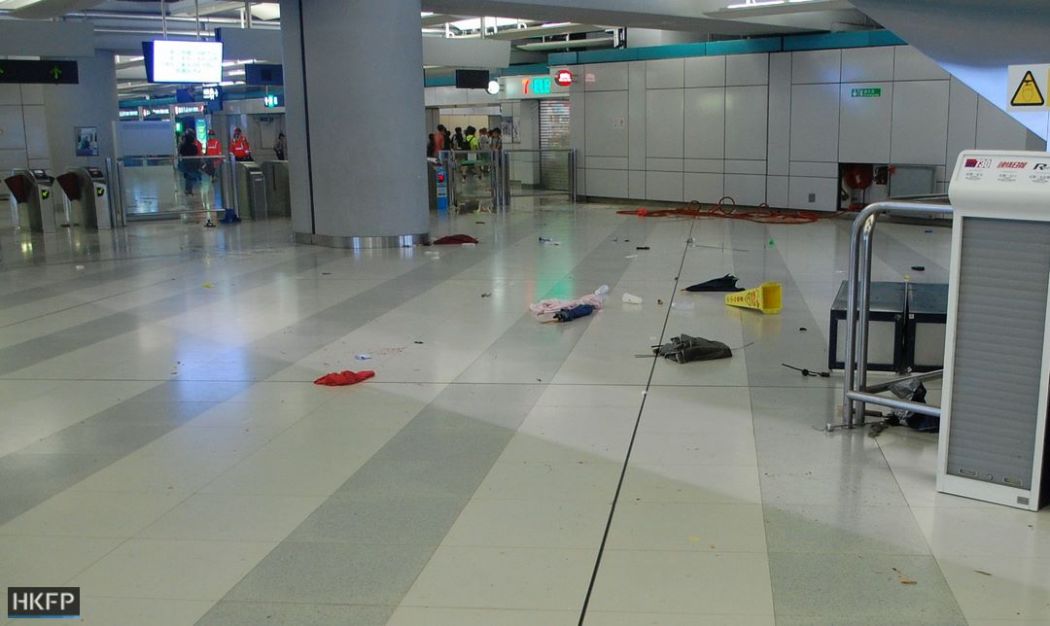
The prosecution also summoned six MTR station staff. The most senior one there that night, known to the court as Mr B due to an anonymity order, said police had arranged to deploy plainclothes officers in the station two days before the incident. He confirmed that two plainclothes officers were there on the night of the attacks.
After the prosecution presented its case, the defendants took turns testifying. The other six defendants were accused of attacking the men wearing white by aiming a fire hose or throwing objects at them.
Yu Ka-ho told the court he had taken part in a protest march organised by the now-defunct Civil Human Rights Front before going to Yuen Long for dessert with his girlfriend. He said he saw bloodstains and broken rods when he arrived, as well as white-shirted men holding weapons and Chinese and Hong Kong flags.
The defendant confirmed that he had sprayed water at the white-shirted men with a fire hose after seeing others do the same. Another defendant, Jason Chan, also said he did the same. Chan told the court he hoped to stop the white-shirted men from coming closer.

Kwong Ho-lam said he had just finished working at a Spanish restaurant in nearby YOHO Mall and was passing through the MTR station on his way home. He said he saw white-shirted men yelling profanities on the concourse.
He admitted to throwing objects at the men in white. While watching CCTV footage of the incident, the judge said it looked like Kwong was holding up a middle finger, but Kwong said it was his index finger and that he was pointing at the white-shirted men while filming a video on his phone. The prosecution said they could not confirm whether it was his index or middle finger.
In total, 22 people have been charged with rioting in relation to the July 21, 2019 incident. Fourteen were white-shirted men, with legal proceedings 11 of whom have been tried, resulting in 10 convictions and one acquittal. One of the men found guilty successfully appealed and was cleared of his charge, while the one who was acquitted is awaiting a retrial following an appeal by the Department of Justice.
The other three had their case adjourned until January. Of the eight charged who were not among those wearing white that night, one was found guilty in April and was jailed for two years and nine months.
Protests erupted in June 2019 over a since-axed extradition bill. They escalated into sometimes violent displays of dissent against police behaviour, amid calls for democracy and anger over Beijing’s encroachment. Demonstrators demanded an independent probe into police conduct, amnesty for those arrested and a halt to the characterisation of protests as “riots.”


