1


Austrian Jugendstil scenography style of Heinrich Lefler (1863–1919): A modernized Viennese Illusionsmalerei (scenic realism) that replaces trompe-l'œil depth with Secessionist planar principles to create narrative ornamentalism. [Gemini Nano Banana Pro]


1
100% Upvoted
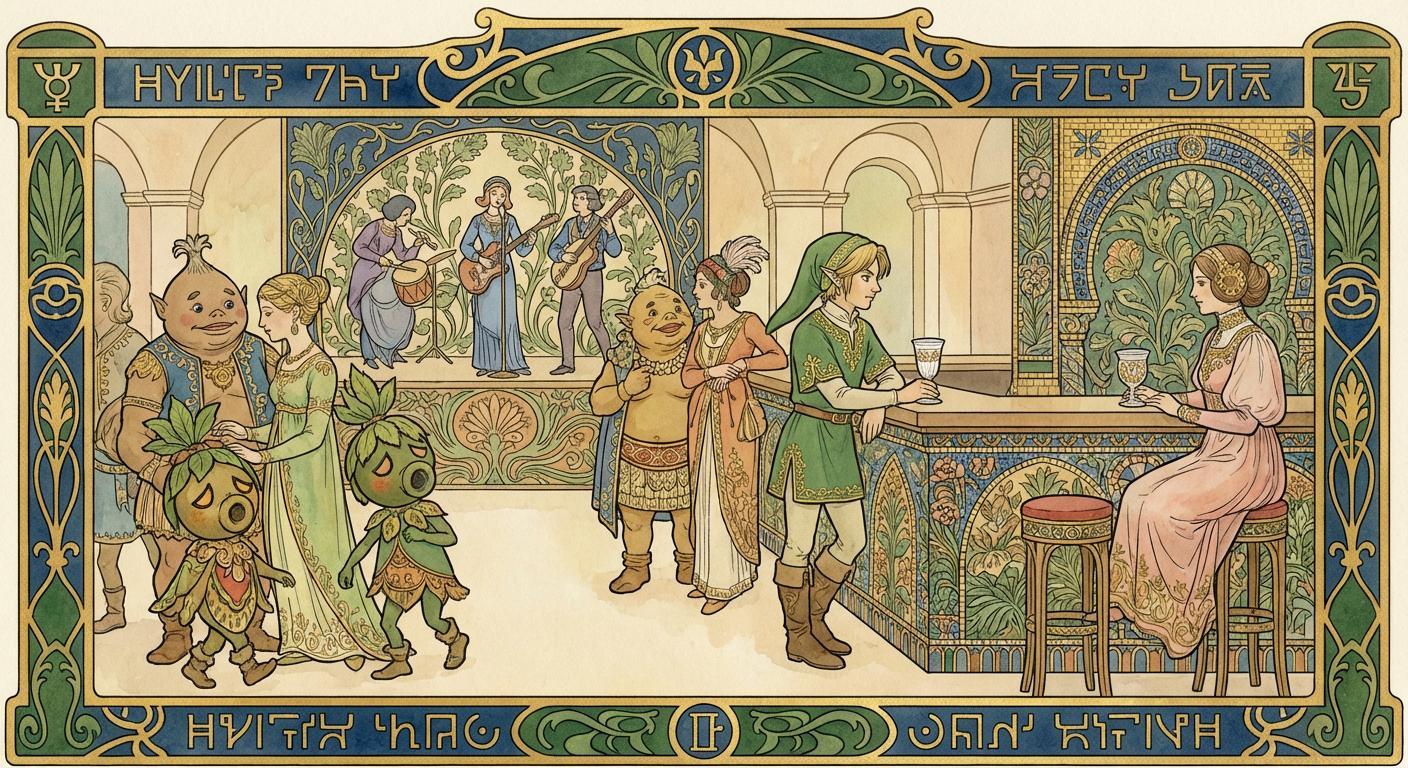
{The Legend of Zelda: Link visiting the Milk Bar in Termina} illustrated in the Austrian Jugendstil scenography style of Heinrich Lefler (1863–1919) and Joseph Urban (1872–1933), as exemplified by their book "Kling-Klang Gloria" (1907): {
Heinrich Lefler (1863–1919) occupied a singular, mediating position in turn-of-the-century Viennese visual culture, bridging the chasm between the monumental Historicism of the Ringstraße era and the emergent, geometric Modernism of the Wiener Werkstätte (1903–1932). His aesthetic identity was forged through a bifurcated education that synthesized two distinct academic traditions: the orchestral grandeur of Vienna and the graphic discipline of Munich. Under Christian Griepenkerl (1839–1916) at the Vienna Academy, Lefler absorbed the "processional" allegorical tradition of Hans Makart (1840–1884), cultivating a taste for dense, theatrical arrangements and atmospheric Stimmung (mood). This was tempered by his subsequent training in Munich under Nikolaus Gysis (1842–1901) and Wilhelm von Diez (1839–1907), where he internalized a contrasting mode of empathetic narrative realism and structural solidity. The resulting synthesis defined his mature signature—the soaring theatrical ambition of the Habsburg Baroque anchored by the precise, architecturally grounded draftsmanship of the German graphic tradition.
This dual heritage found its primary arena in the transformative period of Viennese scenography. Lefler’s career was defined by his position at the intersection of two opposing scenic philosophies: the established illusionistic realism of Anton Brioschi (1855–1920) and the radical atmospheric reduction of Alfred Roller (1864–1935).
Lefler began his scenographic career under Anton Brioschi, the head of the Vienna Court Opera’s scenic studios and the master of nineteenth-century Illusionsmalerei. Brioschi’s aesthetic vision was grounded in material density and trompe-l'œil precision. However, shifting away from this historicist clutter, Lefler modernized scenic realism by flattening it. Reimagining the stage as a shallow, ornamental relief, he employed a decorative planar stratification that prefigured Serge Diaghilev's Ballets Russes (1909–1929) designs. Yet, unlike the character-centric vertical isolation later perfected by Kay Nielsen (1886–1957), where solitary figures stand in sublime contrast to void-like backgrounds, Lefler prioritized environmental storytelling over singular character focus. His compositions favored a horizontal, frieze-like continuity where figures—often arranged in rhythmic crowds or processional groupings—are treated as integral components of the overall staging. In this approach, the characters do not dominate the environment but participate in it, merging into the decorative fabric alongside the Byzantine-inspired framing and lush, botanical surface textures. This created a "storybook" atmosphere that frames the drama within a wide panoramic grandeur, functioning as a vital bridge between nineteenth-century realism and Secessionist decorative principles—a mode where symbolism is applied stylistically through ornamental patterning, yet never compromises the narrative integrity beyond its visual stylization.
The practical engine of this decorative-narrative vision was Lefler's sustained collaboration with the architect and designer Joseph Urban (1872–1933). Their partnership, spanning from the mid-1890s to 1911, encompassed theatrical design for the Vienna Court Opera and Burgtheater, as well as a series of illustrated children's books that became defining monuments of Austrian Jugendstil book arts. This body of work was the result of a symbiotic division of labor that applied the principles of the Gesamtkunstwerk (total work of art) to both the operatic stage and the illustrated page. In major publications like Kling-Klang Gloria (1907), Urban provided the tectonic structure—designing rigid architectural borders and typographic layouts that acted as a container for Lefler’s fluid, watercolor-washed figures. This synthesis translated seamlessly to the stage, where Urban’s built architectural massing was softened by Lefler’s atmospheric surface treatments, producing productions that possessed the structural integrity of architecture and the lyrical quality of a painting.
Joseph Urban’s contribution to this partnership was distinct from the severe structuralism of his Modernist peers. Influenced by his mentor Carl von Hasenauer (1833–1894)—the architect of Vienna’s Neo-Baroque Ringstraße monuments—Urban practiced a form of "Scenic Architecture." He rejected the dogmatic purity of the Secession in favor of a romanticized, atmospheric eclecticism—synthesizing German Renaissance solidity with Art Nouveau fluidity to create environments of convivial grandeur. He approached built space not as a static object, but as an immersive proscenium that set the emotional stage for Lefler’s fluid figures—constructing the tectonic "reality" that allowed Lefler’s decorative fantasies to inhabit the space. Whether designing the Vienna Rathauskeller (1899) or the borders of a fairy tale, Urban treated architecture as a framing device for narrative. This propensity for "built storytelling"—privileging atmospheric historicism over tectonic purity—established the theatrical design vocabulary he would later fully unleash in the opulent, stage-set reality of his American masterpiece, Mar-a-Lago (1927).
During his tenure as a professor at the Vienna Academy (1904–1910), Lefler solidified this aesthetic stance in conscious opposition to the severe rectilinear geometry simultaneously being advanced by Koloman Moser (1868–1918) and his workshop, the Wiener Werkstätte (1903–1932). Technically, Lefler sought to "modernize" the sentimental intimacy of earlier Biedermeier genre painting by translating it into a contemporary graphic idiom. He established a distinctive graphic syntax defined by hairline, monolinear draftsmanship. Eschewing the traditional volumetric modeling of cross-hatching or etched shading, Lefler utilized a continuous, uniform contour to establish structural clarity. In this idiom, depth and form were not carved through shadows, but constructed through ornamental density: the accumulation of minute, decorative details functioned as indirect contouring, guiding the eye across the surface. This linear precision was volumetrically stabilized by a limited, stylized color palette characteristic of the Vienna Secession. Predominantly utilizing light, transparent watercolor washes, Lefler rejected the volumetric illusion of gradients in favor of flat, unmodulated tonalities to differentiate spatial planes. In this approach, tonal depth is conveyed primarily through the intricate linework detailing rather than pigment saturation, with the subtle planar fields serving as a restrained atmospheric backdrop. This luminosity was occasionally accentuated with vivid jewel tones and metallic gold accents to command visual flow. This approach allowed the image to retain the structural integrity of a decorative frieze while achieving a luminous depth—effectively preserving the emotional warmth of Romanticism within the planar constraints required by modern illustration.
Ultimately, Lefler’s career produced a legacy of stylized glamour that prefigured the visual language of the 20th century. His figures—elongated, theatrically costumed, and rhythmically posed—share the haute couture elegance found in the work of Erté (Romain de Tirtoff; 1892–1990) and Georges Augustin Barbier (1882–1932). However, Lefler distinguished himself through his emotional and stylistic register: whereas Kay Nielsen’s figures inhabit a "melancholic" or "haunting" silence, and Erté or Barbier favor a streamlined, geometric coolness, Lefler’s figures radiate a communal, Biedermeier warmth rooted in the lush, organic flora and the Byzantine material richness of the Fin-de-Siècle. By refusing both the rigid academicism of the past and the geometric austerity of his present, Lefler established a rich, narrative-driven Art Nouveau vernacular. Through the conduit of Joseph Urban’s emigration to the United States in 1911, this distinctive Viennese decorative vocabulary outlived the Austro-Hungarian Empire, deeply influencing the trajectory of American theatrical and production design for decades to follow.
}