Advertisement
Advertisement

World

Trump says US will 'run' Venezuela until 'safe' transition

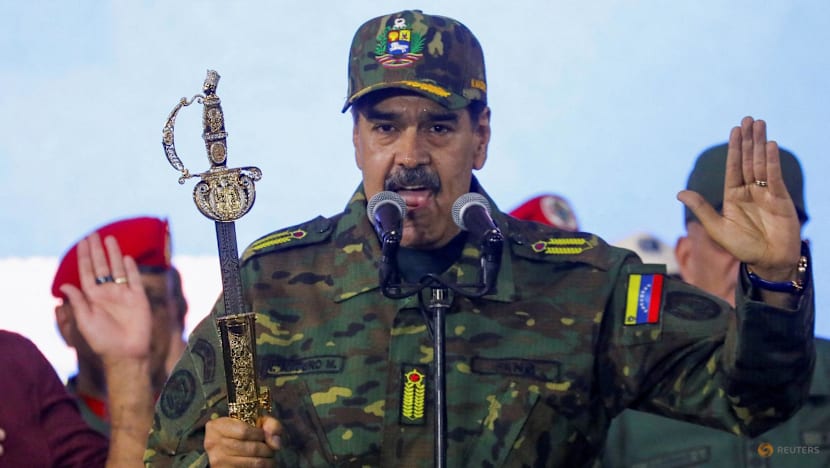
Trump called the operation to capture President Nicolas Maduro and his wife an "assault not seen since World War II", hailing it as "one of the most stunning and effective displays of American power, might and competence" in history.

Trump says US will 'run' Venezuela until 'safe' transition
US President Donald Trump holds a press conference as Secretary of Defense Pete Hegseth and Secretary of State Marco Rubio look on following a US strike on Venezuela where President Nicolas Maduro and his wife, Cilia Flores, were captured,see more
Read a summary of this article on FAST.
FAST

WASHINGTON: Donald Trump on Saturday (Jan 3) said the United States will "run" Venezuela until "such time that we can do a safe, proper, and judicious transition" following the capture of President Nicolas Maduro and his wife.  

At a press conference detailing their capture, the US president said that, amid a power vacuum, Washington did not want a similar situation with another person coming in, only to have the "same situation for the last long period of years".

Trump called the operation to capture Maduro and his wife an "assault not seen since World War II", hailing it as "one of the most stunning and effective displays of American power, might and competence" in history.

Comparing the strikes to Operation Midnight Hammer, which took out Iran's nuclear facilities last July, and the assassination of Iranian General Qasem Soleimani in 2020, Trump said that all Venezuelan military capabilities were "rendered powerless". 

The operation, which involved US air, land and sea forces, was a success, with no American casualties and no equipment lost, he added.

Trump confirmed both Maduro and his wife Cilia Flores will face drug and narco-terrorism charges in New York, having earlier posted on his Truth Social platform a picture of Maduro on board the warship USS Iwo Jima. 

The Trump administration earlier said that the couple will face the "full wrath of American justice" under drug and terrorism charges.

"Nicolas Maduro and his wife, Cilia Flores, have been indicted in the Southern District of New York," Attorney General Pamela Bondi posted on X.

At his press conference Trump blamed Maduro for carrying out a "ceaseless campaign of violence, terror and subversion" against the US, noting that this continued for many years after his term as president had "expired". 

This threatened not only the American people, but the stability of the entire region, he said. He added this was on top of rampant drug smuggling that inflicted "untold suffering and human destruction", particularly in the US. 

Trump also accused Maduro of sending members of the Venezuelan gang Tren de Aragua to the US to "terrorise" communities nationwide, citing how they "took over" apartments in Colorado state and their alleged involvement in the killing of 12-year-old Jocelyn Nungaray in Houston in 2024.

"Maduro again will never be able to threaten an American citizen," he added.

Ahead of the overnight "large scale strike" on Venezuela, which led to Maduro's capture, the US had accused the former bus driver of running a "narco-state" and rigging the 2024 election, which the country's opposition said it won overwhelmingly.

A ⁠US embargo on all Venezuelan oil also remains in full effect, according to Trump.

Trump told ⁠reporters that US military forces would remain in position until its demands had been fully met.

"The ‌American armada remains poised ‍in ‌position, and the United States retains all military options until United ‌States demands have been fully met and fully satisfied," he said, warning that this successful operation should put anyone threatening the sovereignty of Americans or endangering American lives on notice.

Attacks ⁠took place in the early hours of Saturday morning in the capital of Caracas and the states of Miranda, Aragua and La ‌Guaira, ‌prompting Venezuela's government to declare a national emergency and call on ‌social and political forces to "activate mobilisation plans".

At least seven explosions and low-flying aircraft were heard around 2am local time (2pm, Singapore time) on Saturday in Caracas, with Venezuela separately saying that it rejected the "military aggression" by the US and called for an emergency United Nations meeting.

Caracas added that civilians and military personnel died in Saturday's strikes but did not give figures.

QUESTIONS OVER LEGALITY OF STRIKES

It remains unclear under what legal authority the latest US strikes were carried out, although the US does not recognise the jurisdiction of the International Criminal Court

Trump’s move risks a backlash from the Congress, which has the constitutional right to declare war, and from his own political base, which favours an “America first” policy and largely opposes military intervention abroad.

US Secretary of State Marco Rubio told reporters at the same press conference that the Trump administration notified members of Congress about the military operation in Venezuela immediately afterwards. 

"This is not the kind of mission that you can do congressional notification on," Rubio said. "It was a trigger-based mission in which conditions had to be met night after night." 

"Congress has a tendency to leak," Trump added.

Mike Lee, a Republican senator from Utah, said on X that the action "likely falls within the president’s inherent authority under Article II of the Constitution to protect US personnel from an actual or imminent attack".

But some Democrats were more critical.

Democratic Senator Tim Kaine said in a statement: "President Trump’s unauthorised military attack on Venezuela to arrest Maduro - however terrible he is - is a sickening return to a day when the United States asserted the right to dominate the internal political affairs of all nations in the Western Hemisphere."

Republican Representative Marjorie Taylor Greene was also scathing. "If US military action and regime change in Venezuela was really about saving American lives from deadly drugs, then why hasn’t the Trump admin taken action against Mexican cartels?" she said. 

"And if prosecuting narco terrorists is a high priority, then why did President Trump pardon the former Honduran president Juan Orlando Hernandez, who was convicted and sentenced for 45 years for trafficking hundreds of tons of cocaine into America?"

The Trump administration has maintained that Maduro is not the legitimate leader of Venezuela and claims he effectively turned Venezuela into a criminal enterprise at the service of drug traffickers and terrorist groups.

Source: Agencies/dy/sn

Sign up for our newsletters

Get our pick of top stories and thought-provoking articles in your inbox

Subscribe here
Inbox
FAST
Advertisement

Commentary

Snap Insight: US attack on Venezuela further erodes what is left of old world order

If the strike on Venezuela is considered a success, there will be anxiety about where US President Donald Trump’s attention will turn to next, says international security professor Stefan Wolff.

Snap Insight: US attack on Venezuela further erodes what is left of old world order

Fuerte Tiuna, Venezuela's largest military complex, burning after a series of explosions in Caracas on Jan 3, 2026. (Photo: AFP/Luis Jaimes)

New: You can now listen to articles.

This audio is generated by an AI tool.

Read a summary of this article on FAST.
FAST

BIRMINGHAM, England: United States President Donald Trump has not been discreet about wanting regime change in Venezuela. Its president was problematic, without anything remotely like a democratic mandate.

Still, Nicolas Maduro's capture by US special forces, after the “large-scale strike” on the South American country in the early hours of Saturday (Jan 3), is both a demonstration of unconstrained force – and a shocking violation of international law.

It is also the first time that the US has effectively abducted a head of state since 1989. Then, about 20,000 US soldiers descended on Panama and took its de facto leader, General Manuel Noriega, to the US to face charges of drug trafficking.

Mr Trump has similarly accused Maduro of driving narcotics into the US. At his press conference, he announced that the US was going to run Venezuela until a proper transition could take place, but stopped short of committing troops to an actual occupation force.

Mr Trump said the US and the Western Hemisphere were a much safer place to be after the US operation. But no matter the lengths to which he and his supporters go to justify this abduction, it further erodes what is left of a rules-based international order.

A DANGEROUS PRECEDENT

The “president of peace”, as Mr Trump likes to portray himself, and his War Secretary Pete Hegseth were unequivocal about Washington’s determination to reassert absolute dominance in the Western Hemisphere – in word and deed.

It is a return to thinking of the world as spheres of influence, as articulated in the 19th-century Monroe doctrine and in Mr Trump’s new national security strategy released just a few weeks ago. 

Unsurprisingly, several countries in the Western Hemisphere, which the US sees as the core of its sphere of influence, denounced the US operation, as did Russia and China. 

But it is unlikely that the US will face major repercussions beyond some handwringing about the need to respect international law, even from other democratic countries. This sets a dangerous precedent, as United Nations Secretary-General Antonio Guterres put it. 

This will likely further encourage other states with similar pretensions of their own sphere of influence.

Mr Trump has also made no secret about his desire to take over the Panama Canal and Greenland for national security reasons, and Secretary of State Marco Rubio has long taken a hard line on Cuba’s government. 

If the strike on Venezuela is considered a success in the White House, there will be anxiety about where American attention will turn next.

AMERICA FIRST, INSTABILITY BEYOND

The Trump administration is, without doubt, the key player deciding whether the situation will escalate further or not. But much also depends on how Venezuelans will react. 

Maduro was not vastly popular, but he and his circle exercised full control over the armed forces and security apparatus. His government, for now, remains in power, but his capture could set off infighting among the remaining elite and trigger a new wave of mass protests against the regime.

In the immediate aftermath of the operation, Venezuela’s defence minister said that the country will resist the presence of foreign troops and that all of the country’s armed forces will be deployed. 

Whether these forces will ultimately put up a fight during a second wave of US strikes, which Mr Trump threatened in his press conference, is not clear. 

Nor is it obvious how Maduro supporters and opponents will position themselves in the coming days – or what exact plans the White House has in place to deal with widespread unrest in Venezuela should that happen.

Venezuela is at a critical juncture now, but the repercussions of this US operation will be felt well beyond the country. 

If the so-called Trump corollary to the Monroe doctrine gives rise to other similar interventions by the US and others, instability is likely to increase in the Western Hemisphere and well beyond. 

Such an outcome – more likely than not in light of recent US experiences in Afghanistan and Iraq – would be a far cry from being the “common-sense and potent restoration of American power and priorities, consistent with American security interests” that the national security strategy proclaimed.

Stefan Wolff is Professor of International Security at the University of Birmingham and head of the Department of Political Science and International Studies.

Source: CNA/ch

Sign up for our newsletters

Get our pick of top stories and thought-provoking articles in your inbox

Subscribe here
Inbox
FAST
Advertisement

Commentary

Commentary: What to do if you fail at your New Year's resolution

The way you talk about the failure matters for your own motivation and other people’s confidence in your ability to try again, says an academic.

Commentary: What to do if you fail at your New Year's resolution
Understanding the reasons most resolutions don’t work out can help us see it through in the future.(Photo: iStock/ Brian A Jackson)
Read a summary of this article on FAST.
FAST

LONDON: Every year, many of us bravely announce our resolutions for the new year. A glass of champagne on New Year’s Eve might add to our confidence in our ability to do better in the coming year and save more, spend less, eat better, work out more or binge-watch less.

But most of our resolutions fail. Even within the first weeks after New Year’s Eve, the majority of people have given up on them. Yet, not all tales of failure are the same, because the way you talk about the failure matters for your own motivation and other people’s confidence in your ability to try again.

So what can we do after we’ve given up on our resolution? We’ve announced our good intentions to friends and family and now must admit failure. Research has shown the way you word your failed resolution can affect how people view it. And understanding the reasons most resolutions don’t work out can help us see it through in the future.

Indeed, you can talk about your resolutions in a way that will make your failure more understandable and will sustain your motivation to keep going.

FOCUS ON WHAT YOU CAN CONTROL

A constructive way to discuss your failed resolution is to focus on the controllability of the failure. Research shows that most resolutions will require some investment of time and of money.

For example, getting in shape takes time for exercise and also normally requires money for a gym membership or for workout equipment. Because both of these resources are essential for pursuing our goals, many failed resolutions are due to the lack of either time or money, or both.

When talking about a failed resolution in the past, I’ve showed in my own research that we should focus on how lack of money contributed to this failure, rather than lack of time.

In my 2024 study, people read about fictional as well as real panel participants who failed either due to lack of money or lack of time. Most participants felt the person whose failure was caused by lack of money would have more self-control going forward and was going to be more reliable at pursuing their goals.

This effect occurred because lack of money is seen as something that cannot be controlled very easily, so if this caused the failure, there wasn’t very much the person who failed could have done about it.

In this research, most of the failed resolutions were related to weight loss, better eating, or working out in the gym. Participants felt the same whether the person who failed was a man or a woman, presumably because it’s plausible that everyone needs some time and some money to pursue various goals regardless of gender or the specific resolution.

The role of controllability takes a different form when it comes to thinking about how we can do better next time.

THE ROLE OF TIME

Research also shows the way we view time matters when it comes to failure. For the past, it’s better to think about things outside of our control that can help to take the negativity out of failure and bolster the belief that we can do better. This can mean, for example, to consider how our failure was due to lack of money or other resources outside of our control.

For the future, however, take an active perspective on time. Look at your schedule and make active decisions how to allocate time to your goal pursuit, by scheduling gym sessions or blocking time to prepare healthy meals. This can help to give us the motivation to try again because we’re not victims of our busy schedules.

A study published in October 2025 that focused on how a lack of time contributed to failures showed that people can get back a sense of control by talking about “making time”, instead of “having time”. People who discussed their failures as an issue of not having made the time felt like they could do things differently in the future, and were more motivated to do so.

This is because “making time” suggests active control over one’s time and schedule, instead of “having time” that leaves us passive. For example, if you say you didn’t make the time to work out, that means you can make the time in the future if you choose to do so. In contrast, if you say you didn’t have time to work out, it feels like this lack of time is outside of your control and could happen again, preventing you from pursuing your exercise goals.

FIND THE JOY

Another reason so many people struggle to keep to their New Year's resolution may be because they were too ambitious, or they neglected that joy and pleasure keep us going.

We need not only to have a goal in mind. Finding joy in the journey and belief in the ability to change is also important. For example, someone might want to get in better shape and work out more, but when they actually try to go to the gym, they lack the confidence to sign up for a class.

Without some fun, it’s hard to follow through on a resolution even if we really want to pursue the goal. So, try to think of ways you can make the goal more enjoyable to work on and remind yourself you are capable.

The trend for New Year's resolutions isn’t a bad thing in itself. Although it might seem a bit paradoxical to start virtuous habits right after a big night with alcohol and overeating, research shows that we can indeed benefit from the “fresh-start” effect in which a new beginning in the calendar can provide a clean slate to start better habits.

But we don’t have to wait for the calendar to give us a fresh start. We can choose to make our own resolution (maybe a Valentine’s or Easter resolution?) to boost the motivation to pursue our goals.

Janina Steinmetz is Professor in Marketing at Bayes Business School, City St George's, University of London. This commentary first appeared on The Conversation.

Source: Others/el

Sign up for our newsletters

Get our pick of top stories and thought-provoking articles in your inbox

Subscribe here
Inbox
Advertisement

World

US plan for Venezuela – take oil, shun democratic leader

Hours after Maduro was grabbed, Trump brushed aside the prospects of Maria Corina Machado, the opposition leader who won last year's Nobel Peace Prize.

US plan for Venezuela – take oil, shun democratic leader

People hold photographs of Venezuela's late President Hugo Chavez and President Nicolas Maduro outside the Vice-Presidency building, after US President Donald Trump said the US has struck Venezuela and captured Maduro, in Caracas, Venezuela, Jan 3, 2026. (Photo: Reuters/Gaby Oraa)

Read a summary of this article on FAST.
FAST

WASHINGTON: After the United States seized Venezuela's leader, who will run the country?

According to President Donald Trump, the answer is: his own administration, the South American country's vice president, and not Venezuela's democratic opposition.

Trump also made clear that US companies would profit from the oil of Venezuela, which has the world's largest proven reserves, after US forces attacked the capital, Caracas and seized the country's president, Nicolas Maduro, in the dead of night.

Trump, who for years condemned what he called failed US nation-building, said bluntly that the United States will manage Venezuela, a country of nearly 30 million people, at least temporarily.

"We're going to run the country until such time as we can do a safe, proper and judicious transition," Trump told a news conference at his Florida estate.

How Trump would run the country - where the US embassy is shuttered, and no US troops are known to be on the ground - remains unclear.

Trump said that the United States was "designating various people", including an unnamed group.

But he added that for a period of time, Venezuela will be led by "the people that are standing right behind me" - Secretary of State Marco Rubio and US military leaders.

Rubio, a sworn foe of Latin America's leftists, for months has highlighted how not just the United States but most Western countries saw Maduro as illegitimate, following two elections that observers said were riddled with irregularities.

But hours after Maduro was grabbed, Trump brushed aside the prospects of Maria Corina Machado, the opposition leader who won last year's Nobel Peace Prize and had been hailed by Western leaders as representing Venezuelans, as a successor.

"I think it would be very tough for her to be the leader," Trump said.

"She doesn't have the support within or the respect within the country. She's a very nice woman, but she doesn't have the respect," Trump said.
 

WORKING WITH THE VP

Trump said that the United States had not been in touch with Machado, who had hailed the operation as the "hour of freedom".

Instead, Trump said Rubio spoke by telephone to the vice president, Delcy Rodriguez, a stalwart of the leftist movement of Maduro and his late predecessor, Hugo Chavez.

"She's essentially willing to do what we think is necessary to make Venezuela great again. Very simple," Trump said.

Rodriguez, however, did not stick to Trump's script in an address to the nation, saying Maduro was the only president and demanding his return.

Most US allies, who had once lined up to oppose Maduro, quickly distanced themselves from Trump.

French President Emmanuel Macron, while hailing the end of "Maduro's dictatorship", said the will of Venezuelans was represented by Edmundo Gonzalez Urrutia, the opposition figure and Machado ally seen by the international community as the legitimate winner of the 2024 elections.

Kevin Whitaker, a veteran former US diplomat dealing with Latin America, including Venezuela, said he was "extremely surprised" to hear Trump undercut Machado.

"This seems to be a case where the Trump administration, at least by appearance at this point, is making decisions about the democratic future of Venezuela without referring back to the democratic result" of the election, said Whitaker, now at the Atlantic Council think tank.

MORE OF THE SAME FOR VENEZUELANS?

Rodriguez constitutionally would need to call a new election. But analysts said it remains to be seen if Rodriguez, like Maduro, would actually be willing to hand over power.

Rodriguez's elevation may mean better ties with the United States, "but I'm not sure it will be a significant change for Venezuelans", said Iria Puyosa, a Venezuelan scholar also at the Atlantic Council.

Maduro and Chavez, for years, thumbed their nose at the United States, denouncing US imperialism as they pursued a socialist economy, which had fallen into shambles and prompted the flight of millions of people.

Trump's Democratic rivals voiced outrage at the open involvement of oil companies, seeing it as a throwback to imperialism at its most egregious.

"The United States should not be running other countries for any reason," said Senator Brian Schatz, a Democrat.

"We should have learned by now not to get involved in endless wars and regime change missions that carry catastrophic consequences for Americans."

Source: AFP/fs

Sign up for our newsletters

Get our pick of top stories and thought-provoking articles in your inbox

Subscribe here
Inbox
Advertisement

World

'At last': Venezuelans abroad celebrate Maduro ouster

'At last': Venezuelans abroad celebrate Maduro ouster
A firefighter walks past a destroyed anti-aircraft unit at La Carlota military air base, after US President Donald Trump said the US has struck Venezuela and captured its President Nicolas Maduro, in Caracas, Venezuela, Jan 3, 2026. (Photo: REUTERS/Leonardo Fernandez Viloria)
Read a summary of this article on FAST.
FAST

CARACAS: Some of the nearly eight million Venezuelans who fled economic collapse and repression under Nicolas Maduro gathered in their thousands in cities worldwide Saturday (Jan 3) to celebrate the strongman's ouster by US forces.

Thousands massed in the Chilean capital, Santiago, joyfully waving the Venezuelan flag, many decked out in their national colours of yellow, blue and red. 

"At last we'll be able to go back home," street vendor Yurimar Rojas told AFP, straining to make himself heard over the ebullient crowd.

"At last we’re going to have a free country," he exclaimed.

Maduro, whose claims to reelection in 2018 and 2024 were widely dismissed as fraudulent, was snatched by US forces in an early-morning military strike and was to be flown to New York to stand trial on drug trafficking charges.

"This is tremendous for us," celebrated Yasmery Gallardo, 61, who said she planned to return home soon from Chile, where she has lived for eight years.

"I’m already planning my trip...I can’t wait to be back in my country!" she exclaimed.

Venezuelans in Chile have been spooked by the campaign promises of far-right president-elect Jose Antonio Kast to deport nearly 340,000 undocumented migrants he blames for a perceived rise in crime.

"THANK YOU, TRUMP"

In Miami, thousands more gathered, singing and kissing the Venezuelan flag.

One shouted from the crowd: "Thank you, Trump!"

"Today, January 3rd, the dreams of Venezuelans abroad came true," Ana Gonzalez, one of the revellers, told AFP.

Another, Anabela Ramos, said she had been waiting "27 years for this moment and now it's finally happened, it's finally happened!"  

In Spain, home to about 400,000 Venezuelans, thousands massed in Madrid to celebrate.

"He is gone, he is gone!" and "He has fallen, he has fallen!" they shouted, many with the Venezuelan flag draped over their shoulders as they hugged.

"I came to celebrate: at last we’re emerging from this dictatorship!" said Pedro Marcano, 47, who has his heart set on going home after 11 years abroad.

But first, "we’ll need things to be a bit clearer," he said.

The country's future is uncertain, with President Donald Trump saying Saturday the United States will "run" Venezuela until a power transfer can happen.

Venezuelan Vice President Delcy Rodriguez has said she is ready to work with Washington, according to Trump, who said opposition leader Maria Corina Machado "doesn't have the support within or the respect within the country" to be president.

Rodriguez later insisted in a public address that Maduro was Venezuela's "only president" and the government was "ready to defend" the country.

At the Madrid rally, a message from Machado was played over a loudspeaker, and the crowd fell silent.

"Venezuela will be free!" said Machado, and Marcano wiped away a tear.

"DIVINE JUSTICE"

In the capital of Colombia, which hosts nearly three million Venezuelans - more than any other country - hairdresser Kevin Zambrano grinned widely as he told AFP he was "Happy, happy, happy, happy" to see the back of Maduro. 

"The first step is done, and everything else is a gain. (Thanks) to Donald Trump for helping Venezuela," he said at his workplace in Bogota, having left his home country ten years ago.

Yeiner Benitez, who works as a security guard in the Colombian capital, got tears in his eyes as he recalled the hardship and fear that drove him to leave Venezuela in 2022.

During his absence, his uncle died from what Benitez said was a common illness due to a lack of medication - a common occurrence in economic crisis-ravaged Venezuela.

"Venezuela has gone through a very difficult process; these have been very hard years - years of hunger, misery, torture, friends lost, friends who disappeared," Benitez told AFP.

"So, forgive the emotion, but what’s happening today is extraordinary; it’s divine justice."

Not everyone was happy with what they saw as foreign intervention in the affairs of a sovereign country. In Mexico City, dozens gathered at the US embassy to make their protest known, waving banners with slogans such as "No to war".

"Venezuelan brothers, resist...don’t hand over your land, your oil, your gold” to the United States, protest leader Mario Benitez told the crowd.

Source: AFP/fs

Sign up for our newsletters

Get our pick of top stories and thought-provoking articles in your inbox

Subscribe here
Inbox
Advertisement

World

Ukraine's allies in Kyiv for talks on plan to end war

Ukraine's allies in Kyiv for talks on plan to end war

European countries national security advisers attend a security forum in Kyiv, Ukraine, Saturday, Jan. 3, 2026. (AP Photo/Danylo Antoniuk)

Read a summary of this article on FAST.
FAST

KYIV: Security advisers from Ukraine's top allies met in Kyiv on Saturday (Jan 3) for talks on a US-brokered plan to end the war with Russia, days after Kyiv announced a deal was "90 per cent" ready.

Officials from 15 countries, including Britain, France and Germany, as well as representatives from NATO and the European Union, joined the meeting, the first of several planned for the new year.

US special envoy Steve Witkoff also joined virtually, a Ukrainian official told AFP, though the United States' large-scale military attack on Venezuela earlier in the day overshadowed proceedings.

A follow-up summit of European leaders was expected to take place in France on Tuesday, according to Ukraine.

"National security advisers from European countries have arrived in Kyiv," Ukraine's chief negotiator Rustem Umerov said in a post on Telegram. He announced in a later post that the meeting had started.

"The first part of the meeting focused on framework documents, including security guarantees and approaches to the peace plan, as well as the sequence of further joint steps," he said.

Diplomatic efforts to end Europe's deadliest conflict since World War II have gained pace in recent weeks, though both Moscow and Kyiv remain at odds over the key issue of territory in a post-war settlement.

Russia, which occupies around 20 per cent of Ukraine, is pushing for full control of the country's eastern Donbas region as part of a deal.

But Kyiv has warned that ceding ground will embolden Moscow and said it will not sign a peace deal that fails to deter Russia from invading again.

DEADLY STRIKES

Saturday's meeting capped a week marked by deadly strikes, as well as a Russian claim - denied by Ukraine - that Kyiv had launched drones at a residence of President Vladimir Putin in an unsuccessful attack.

Russia accused Kyiv of firing drones at a hotel and cafe in the Moscow-held part of Ukraine's southern Kherson region early Thursday, killing what it said were 28 people celebrating the New Year. Ukraine says it was a military gathering.

A woman and a three-year-old child died in a Russian missile strike on Ukraine's second-largest city of Kharkiv late Friday, according to the region's governor.

And early Saturday, Russian bombardment of a Kyiv-held part of the southern Kherson region left two people dead, according to the region's governor.

Russia made bigger advances on the battlefield last year than in any other year since it launched its invasion in 2022, according to an AFP analysis of data from the Institute for the Study of War.

As the year kicked off, Zelensky announced sweeping changes to his top circle, naming a new chief of staff and defence minister on Friday while announcing plans on Saturday to replace several regional leaders.

Russia launched its invasion of Ukraine in February 2022, describing it as a "special military operation" to prevent the expansion of NATO - a war aim that Kyiv has called a lie. 

Moscow has since fired on Ukrainian towns and cities in daily drone and missile attacks while waging battles that have reduced entire urban areas to rubble.

Source: AFP/fs

Sign up for our newsletters

Get our pick of top stories and thought-provoking articles in your inbox

Subscribe here
Inbox
Advertisement

World

Mock house, CIA source and Special Forces: The US operation to capture Maduro

Planning for one of the most complex US operations in recent memory had been in the works for some time and included detailed rehearsals, sources said.

Mock house, CIA source and Special Forces: The US operation to capture Maduro

US President Donald Trump holds a press conference as Secretary of Defense Pete Hegseth, US Secretary of State Marco Rubio and General Dan Caine, Chairman of the Joint Chiefs of Staff look on, following a US strike on Venezuela where President Nicolas Maduro and his wife, Cilia Flores, were captured, from Trump's Mar-a-Lago club in Palm Beach, Florida, US, on Jan 3, 2026. (Photo: Reuters/Jonathan Ernst)

Read a summary of this article on FAST.
FAST

WASHINGTON: At 4.21am on Saturday morning (Jan 3), President Donald Trump sent a message on his Truth Social platform: the United States had carried out a daring mission to capture Venezuelan President  Nicolas Maduro and his wife.

The action came as a surprise, but according to sources familiar with the matter, planning for one of the most complex US operations in recent memory had been in the works for months and included detailed rehearsals.

Elite US troops, including the Army's Delta Force, created an exact replica of Maduro's safe house and practised how they would enter the strongly fortified residence.

The CIA had a small team on the ground starting in August who were able to provide insight into Maduro's pattern of life that made grabbing him seamless, according to one source familiar with the matter.

Two other sources told Reuters the intelligence agency also had an asset close to Maduro who would monitor his movements and was poised to pinpoint his exact location as the operation unfolded.

A photograph which US President Donald Trump posted on his Truth Social account shows what he describes as Venezuelan President "Nicolas Maduro on board the USS Iwo Jima" amphibious assault ship, currently in the Caribbean Sea on Jan 3, 2026. (Photo: Reuters/@realDonaldTrump/Handout)

With the pieces in place, Trump approved the operation four days ago, but military and intelligence planners suggested he wait for better weather and less cloud cover. 

At 10.46pm EST on Friday, Trump gave the final go-ahead for what would be known as Operation Absolute Resolve, Chairman of the Joint Chiefs of Staff General Dan Caine told reporters.

Trump, surrounded by his advisers at his Mar-a-Lago club in Palm Beach, Florida, watched a live stream of the events.

How the hours-long operation unfolded is based on interviews with four sources familiar with the matter and details Trump himself has revealed.

"I've done some pretty good ones, but I've never seen anything like this," Trump said on Fox News just hours after the mission was completed.

"MASSIVE" OPERATION

The Pentagon has overseen a massive military buildup of forces in the Caribbean, sending an aircraft carrier, 11 warships and more than a dozen F-35 aircraft. In total, more than 15,000 troops have poured into the region for what US officials have long described as anti-drug operations.

According to one of the sources, Trump senior aide Stephen Miller, Secretary of State Marco Rubio, Defense Secretary Pete Hegseth and CIA Director John Ratcliffe formed a core team working on the issue for months with regular - sometimes daily - meetings and phone calls. They often also met with the president.
 

Late on Friday night and into early Saturday, Trump and his advisers huddled as a number of US aircraft took off and carried out strikes against targets inside and close to Caracas, including air defence systems, according to a US military official.

Caine said the operation involved more than 150 aircraft launched from 20 bases around the Western Hemisphere, including F-35 and F-22 jets, and B-1 bombers.

"We had a fighter jet for every possible situation," Trump told Fox News Channel's Fox & Friends.

Sources have told Reuters the Pentagon had also quietly moved into the region, refuelling air tankers, drones and aircraft specialising in electronic jamming.

US officials said the airstrikes hit military targets. Images taken by Reuters at the La Carlota air base in Caracas showed charred military vehicles from a Venezuelan anti-aircraft unit.

With the strikes taking place, US Special Forces made their way into Caracas heavily armed, including with a blowtorch in case they had to cut through steel doors at Maduro's location.

Around 1am EST Saturday, Caine said, the troops arrived at Maduro's compound in downtown Caracas while being fired upon. One of the helicopters was hit, but was still able to fly.

Social media videos posted by residents showed a convoy of helicopters flying over the city at low altitude.

Once they reached Maduro's safe house the troops, along with FBI agents, made their way into the residence, which Trump described as a "very highly guarded...fortress".

"They just broke in, and they broke into places that were not really able to be broke into, you know, steel doors that were put there for just this reason," Trump said. "They got taken out in a matter of seconds."

MADURO IN CUSTODY

Once the troops were inside the safe house, Caine said, Maduro and his wife surrendered. Trump said the Venezuelan leader had tried to reach a safe room but was unable to close the door.

"He got bum rushed so fast that he didn't get into that," Trump said.

Some US forces were hit, Trump said, but none were killed.

As the operation unfolded, Rubio started to inform lawmakers that it was underway. The notifications only began after the operation started and not before, as is customary for key lawmakers who play an oversight role, officials told Reuters.

As the troops left Venezuelan territory, Caine said, they were involved in "multiple self-defence engagements". By 3.20am EST, the helicopters were over water, with Maduro and his wife on board.

Almost exactly seven hours after Trump announced the operation on Truth Social, he made another post.

This time it was a photograph of the captured Venezuelan leader blindfolded, handcuffed and wearing grey sweatpants.

"Nicolas Maduro on board the USS Iwo Jima," Trump wrote, referring to the amphibious assault ship.

Source: Reuters/dy

Sign up for our newsletters

Get our pick of top stories and thought-provoking articles in your inbox

Subscribe here
Inbox
Advertisement

World

Doctors Without Borders says may have to halt Gaza operations in March

Doctors Without Borders says may have to halt Gaza operations in March

Sahar Taroush talks with her brother in her partially collapsed home after returning following the latest ceasefire, Jabaliya, Gaza City, Tuesday, Nov. 11, 2025. Also pictured are her children, Ammar far left; Hassan with his 2-year-old sister, Ahlam; and Bisan, right. (AP Photo/ Jehad Alshrafi)

Read a summary of this article on FAST.
FAST

GAZA STRIP: Banned from the Gaza Strip with 36 aid bodies, medical charity Doctors Without Borders said Saturday (Jan 3) it will have to end its operations there in March if Israel does not reverse its decision.

UN Secretary General Antonio Guterres called on Friday for Israel to end a ban on humanitarian agencies that provided aid in Gaza, saying he was "deeply concerned" at the development.

Israel confirmed on Thursday it is barring 37 major international humanitarian organisations from entering the Gaza Strip, accusing them of failing to provide the list of their employees’ names, which is now officially required for "security" reasons. 

Doctors Without Borders called this demand a "scandalous intrusion", but Israel says it is needed to stop jihadists from infiltrating into humanitarian structures.

"To work in Palestine, in the occupied Palestinian territories, we have to be registered...That registration expired on December 31, 2025,” said Isabelle Defourny, a physician and president of Doctors Without Borders France, on France Inter. 

"Since July 2025, we have been involved in a re-registration process and to date, we have not received a response. We still have 60 days during which we could work without being re-registered, and so we would have to end our activities in March," if Israel maintains its decision, she said. 

Doctors Without Borders has around 40 international staff in the Gaza Strip and works with 800 Palestinian staff across eight hospitals. 

"We are the second-largest distributor of water (in the Gaza Strip). Last year, in 2025, we treated just over 100,000 people who were wounded, burned, or victims of various traumas. We are second in terms of the number of deliveries performed," the president of Doctors Without Borders, France said.

According to her, the Israeli decision is explained by the fact that NGOs "bear witness to the violence committed by the Israeli army" in Gaza.

Source: AFP/fs

Sign up for our newsletters

Get our pick of top stories and thought-provoking articles in your inbox

Subscribe here
Inbox
Advertisement

World

EU urges 'restraint', respect for international law in Venezuela; China and Russia alarmed by Maduro's capture

Countries such as Russia and Iran, which had longstanding ties with Maduro's government, were quick to condemn the US operation.

EU urges 'restraint', respect for international law in Venezuela; China and Russia alarmed by Maduro's capture

A woman waves a Venezuelan flag, as people react to the news in Madrid, Spain on Jan 3, 2026 after US President Donald Trump said the US had struck Venezuela and captured President Nicolas Maduro. (Photo: REUTERS/Violeta Santos Moura)

Read a summary of this article on FAST.
FAST

BRUSSELS: The European Union (EU) called for "restraint" and respect for international law in Venezuela on Saturday (Jan 3) after President Donald Trump announced US forces had captured leader Nicolas Maduro in a large-scale assault.

"The EU has repeatedly stated that Mr Maduro lacks legitimacy and has defended a peaceful transition" in Venezuela, the bloc's top diplomat Kaja Kallas wrote on X after speaking with her US counterpart Marco Rubio.

Advertisement

"Under all circumstances, the principles of international law and the UN Charter must be respected. We call for restraint," she wrote.

European Commission chief Ursula von der Leyen and European Council President Antonio Costa echoed the message.

"We stand by the people of Venezuela and support a peaceful and democratic transition. Any solution must respect international law and the UN Charter," von der Leyen said on social media.

Costa said he was following developments in Venezuela "with great concern", adding that "the EU calls for de-escalation".

Kallas said the EU was closely monitoring the fast-moving situation and that she had spoken to the bloc's envoy to Venezuela, with the safety of EU citizens "our top priority".

Advertisement

The EU has not recognised the results of the disputed 2024 election that handed Maduro a third term in power, and has slapped sanctions on dozens of Venezuelan officials for undermining democracy in the country.

The 27-nation bloc has stopped short, however, of formally recognising opposition candidate Edmundo Gonzalez Urrutia as Venezuela's rightful leader, as the US has done. 

France separately said the operation undermined international law and no solution to Venezuela's crisis can be imposed from the outside, while British Prime Minister Keir Starmer urged patience in order to "establish the facts".

But in a rare expression of support for the US operation by a major European country, far-right Italian Prime Minister Giorgia Meloni - a Trump ally - argued the US military action in Venezuela was "legitimate" and "defensive".

Israel also hailed the operation, saying Washington acted as the "leader of the free world".

Advertisement

Ukraine - dependent on US support in its war against invading Russia - did not address the legality of a big country like America using military force against a much smaller one like Venezuela.

Trump said Maduro and his wife would be taken to New York to face federal charges after military strikes and an operation which he described as looking like a "television show".

Countries such as Russia and Iran, which had longstanding ties with Maduro's government, were quick to condemn the operation.

Russia demanded the US leadership "reconsider its position and release the legally elected president of the sovereign country and his wife".

China said it is "deeply shocked and strongly condemns the US's blatant use of force against a sovereign state and its action against its president".

Advertisement

Iran, which Trump bombed last year, said it "strongly condemns the US military attack on Venezuela and a flagrant violation of the country's national sovereignty and territorial integrity".

Foreign minister Andriy Sybiga instead focused on Maduro's lack of legitimacy and the Venezuelan government's repression, while backing "democracy, human rights, and the interests of Venezuelans".

Condemnation of the US intervention in Venezuela was also strong across Latin America. Mexico, which Trump has also threatened with military force over drug trafficking, strongly condemned the US military action in Venezuela, saying it "seriously jeopardises regional stability".

Colombian President Gustavo Petro - whose country neighbours Venezuela - called the US action an "assault on the sovereignty" of Latin America, which would lead to a humanitarian crisis.

Brazilian President Luiz Inacio Lula da Silva slammed the US attacks as a "serious affront" to Venezuela's sovereignty, while Cuba, a strong ally of Venezuela's, denounced "state terrorism against the brave Venezuelan people".

UN Secretary-General Antonio Guterres added that he was "deeply alarmed" by the US strikes, with his spokesman quoting him as saying it could "constitute a dangerous precedent".

Source: Agencies/sn/dy

Sign up for our newsletters

Get our pick of top stories and thought-provoking articles in your inbox

Subscribe here
Inbox
Advertisement

Also worth reading

Advertisement