Editorial-ready illustrations in the 'slick' narrative-realism style of Elbert McGran Jackson (1896–1962): using structural mastery of architectural design to support emotional warmth in gestural figural tableaux. [Gemini Nano Pro]
{The Legend of Zelda}, composed as a magazine cover/feature layout illustration with selective perspectival rendering for integrated white space, in the “slick” narrative‑realism style of Elbert McGran Jackson (1896–1962): {
Working within the lineage of the "Grand Manner" exemplified by Howard Pyle (1853–1911) and Dean Cornwell (1892–1960), Elbert McGran Jackson's work stands as a quintessential example of mid-century commercial illustration at its most aspirational. His Art Deco-influenced "slick" illustrations of the 1930s and his mature narrative realism of the 1940s and 1950s are best characterized as "movie-poster realism"—a fusion of polished naturalism with the mythopoetic tenor of Arthurian romance. This approach yields allegorical tableaux in which beauty, honor, and dramatic tension converge around archetypal figures as idealized role models, grounding modern high society in a sense of ancient, chivalric grandeur.
This thematic character sharply distinguishes Jackson from his contemporaries. Unlike J.C. Leyendecker (1874–1951), whose work emphasized sharp graphic stylization and the detached, fashion-forward allure of the "Arrow Collar Man," Jackson prioritized psychological engagement, focusing on narrative warmth and the emotional gravity between subjects. And while Jackson shared the clear, legible communicative messaging of James Montgomery Flagg (1877–1960), he distinguished his approach through a themed, cinematic color palette of luminous flesh tones, jewel-tone accents, and dramatic split-temperature lighting. He delivered this through immersive lifestyle allure rather than Flagg's confrontational, fourth-wall-breaking humor—inviting the viewer into an aspirational world rather than addressing them directly. To support this atmospheric depth, Jackson employed low-key "noir" lighting to define massing, sharing strong affinities with the streamlined chiaroscuro of Robert Riggs (1896–1970) through dense shadow silhouetting that unifies figures into cohesive shapes. However, Jackson refined Riggs' visceral, lithographic heaviness into a "velvety" sophistication; where Riggs used shadow to abstract figures into raw, pugilistic power, Jackson used it to sculpt them into polished elegance. This grounded, architectural chiaroscuro contrasts with the theatrical high-key lighting of Edwin Georgi (1896–1964) or the magical glow of Haddon Sundblom (1899–1976). Furthermore, Jackson produced frozen, photogenic tableaux that privilege stability and resonant atmosphere—avoiding the anecdotal naturalism of Norman Rockwell (1894–1978), the spontaneous gestures of Ray Prohaska (1901–1981), the modernist flattened depth of Fred Ludekens (1900–1982), or the vigorous impressionistic brushwork of Mead Schaeffer (1898–1980).
These aesthetic choices stem directly from Jackson's dual education: he studied architecture at Georgia Tech and received formal figure training grounded in the Beaux-Arts tradition. From architecture came a structural aesthetic sensibility for monumental grandeur—aligned with Neoclassical design principles and achieved through precise perspective based on geometric scaffolding and grid-based layouts; from the Beaux-Arts came the insistence on working from life to master the expressive capacity of body language. Consequently, Jackson approached illustration not as "sketching" a scene, but as constructing a composition, using layout-aware cropped figural compositions with propped environments and flexible groupings for editorial utility, a versatility reminiscent of Andrew Loomis (1892–1959), Al Parker (1906–1985), with the negative space often aligned with the epic widescreen cinematography of Tom Lovell (1909–1997). He prioritized the illusion of deep, traversable space, integrating load-bearing structural sensibilities with smooth, tonal modeling. While he rejected modernist rendering techniques, he would occasionally adopt minimalist background strategies when required to secure the narrative focus.
This training manifests technically in the structural integrity of Jackson's execution. His reliance on posed studio models was essential for capturing the "seductive" poses that became his specialty; by observing the natural tension in a pose—how a figure leans against a mantelpiece or rests a hand on a chair—he ensured his subjects possessed a "lived-in" quality rather than resembling the static "paper cutouts" common in commercial art. Jackson employed a technique of "selective perspectival rendering" akin to Andrew Loomis (1892–1959) and Henry Patrick Raleigh (1880–1944). He utilized specific framing strategies—clean cropping for hard edges or gradual fading to streamline large, potentially distracting elements—to heighten narrative focus and figural intimacy. This approach creates a "perspectival vignette," similar to "Saturday Evening Post" covers and editorial spreads, where the composition remains structurally sound yet typographically open. This anchors the visual weight on the figures while providing expansive, non-explicit reserved zones for mastheads and copy.


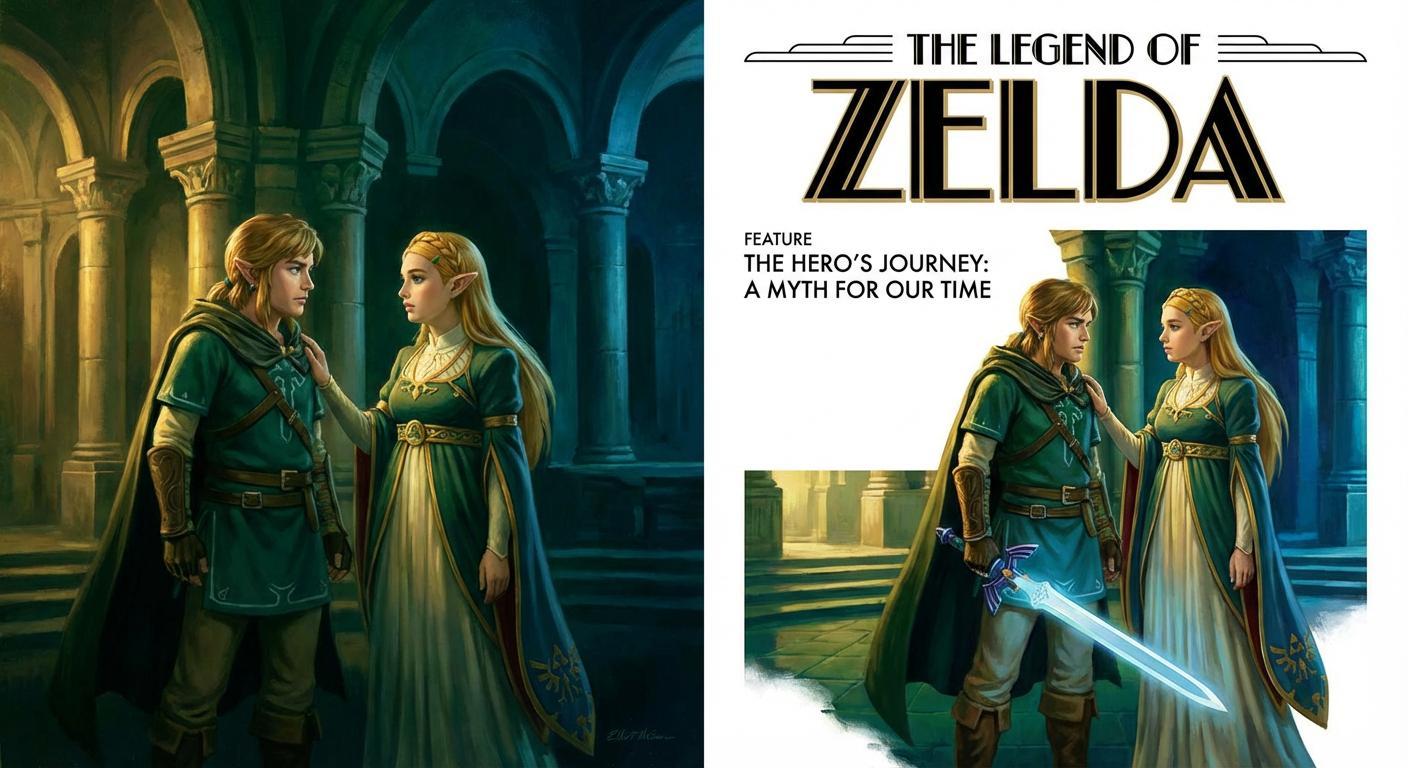
{The Legend of Zelda}, composed as a magazine cover/feature layout illustration with selective perspectival rendering for integrated white space, in the “slick” narrative‑realism style of Elbert McGran Jackson (1896–1962): {
Working within the lineage of the "Grand Manner" exemplified by Howard Pyle (1853–1911) and Dean Cornwell (1892–1960), Elbert McGran Jackson's work stands as a quintessential example of mid-century commercial illustration at its most aspirational. His Art Deco-influenced "slick" illustrations of the 1930s and his mature narrative realism of the 1940s and 1950s are best characterized as "movie-poster realism"—a fusion of polished naturalism with the mythopoetic tenor of Arthurian romance. This approach yields allegorical tableaux in which beauty, honor, and dramatic tension converge around archetypal figures as idealized role models, grounding modern high society in a sense of ancient, chivalric grandeur.
This thematic character sharply distinguishes Jackson from his contemporaries. Unlike J.C. Leyendecker (1874–1951), whose work emphasized sharp graphic stylization and the detached, fashion-forward allure of the "Arrow Collar Man," Jackson prioritized psychological engagement, focusing on narrative warmth and the emotional gravity between subjects. And while Jackson shared the clear, legible communicative messaging of James Montgomery Flagg (1877–1960), he distinguished his approach through a themed, cinematic color palette of luminous flesh tones, jewel-tone accents, and dramatic split-temperature lighting. He delivered this through immersive lifestyle allure rather than Flagg's confrontational, fourth-wall-breaking humor—inviting the viewer into an aspirational world rather than addressing them directly. To support this atmospheric depth, Jackson employed low-key "noir" lighting to define massing, sharing strong affinities with the streamlined chiaroscuro of Robert Riggs (1896–1970) through dense shadow silhouetting that unifies figures into cohesive shapes. However, Jackson refined Riggs' visceral, lithographic heaviness into a "velvety" sophistication; where Riggs used shadow to abstract figures into raw, pugilistic power, Jackson used it to sculpt them into polished elegance. This grounded, architectural chiaroscuro contrasts with the theatrical high-key lighting of Edwin Georgi (1896–1964) or the magical glow of Haddon Sundblom (1899–1976). Furthermore, Jackson produced frozen, photogenic tableaux that privilege stability and resonant atmosphere—avoiding the anecdotal naturalism of Norman Rockwell (1894–1978), the spontaneous gestures of Ray Prohaska (1901–1981), the modernist flattened depth of Fred Ludekens (1900–1982), or the vigorous impressionistic brushwork of Mead Schaeffer (1898–1980).
These aesthetic choices stem directly from Jackson's dual education: he studied architecture at Georgia Tech and received formal figure training grounded in the Beaux-Arts tradition. From architecture came a structural aesthetic sensibility for monumental grandeur—aligned with Neoclassical design principles and achieved through precise perspective based on geometric scaffolding and grid-based layouts; from the Beaux-Arts came the insistence on working from life to master the expressive capacity of body language. Consequently, Jackson approached illustration not as "sketching" a scene, but as constructing a composition, using layout-aware cropped figural compositions with propped environments and flexible groupings for editorial utility, a versatility reminiscent of Andrew Loomis (1892–1959), Al Parker (1906–1985), with the negative space often aligned with the epic widescreen cinematography of Tom Lovell (1909–1997). He prioritized the illusion of deep, traversable space, integrating load-bearing structural sensibilities with smooth, tonal modeling. While he rejected modernist rendering techniques, he would occasionally adopt minimalist background strategies when required to secure the narrative focus.
This training manifests technically in the structural integrity of Jackson's execution. His reliance on posed studio models was essential for capturing the "seductive" poses that became his specialty; by observing the natural tension in a pose—how a figure leans against a mantelpiece or rests a hand on a chair—he ensured his subjects possessed a "lived-in" quality rather than resembling the static "paper cutouts" common in commercial art. Jackson employed a technique of "selective perspectival rendering" akin to Andrew Loomis (1892–1959) and Henry Patrick Raleigh (1880–1944). He utilized specific framing strategies—clean cropping for hard edges or gradual fading to streamline large, potentially distracting elements—to heighten narrative focus and figural intimacy. This approach creates a "perspectival vignette," similar to "Saturday Evening Post" covers and editorial spreads, where the composition remains structurally sound yet typographically open. This anchors the visual weight on the figures while providing expansive, non-explicit reserved zones for mastheads and copy.
}