

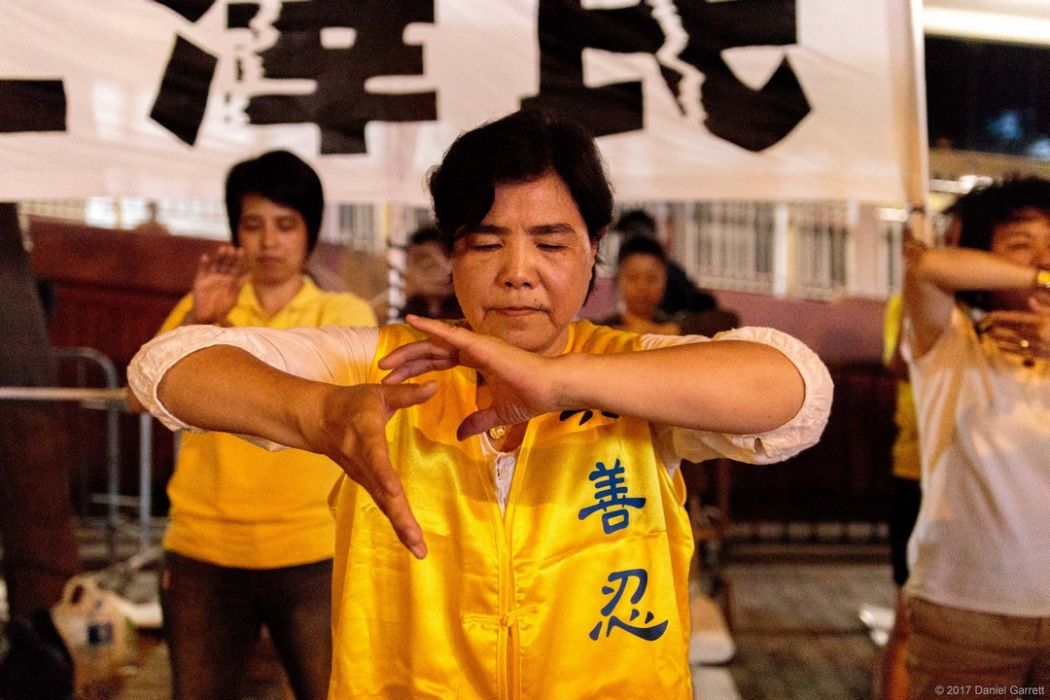
The Hong Kong branch of the Falun Gong spiritual movement has condemned a Facebook post which claimed it would quit the city as “fake news,” saying the group – which is banned in mainland China – had not set up any official social media accounts.

The movement, which opposes the Chinese Communist Party, clarified on Thursday that it had no intention of leaving Hong Kong. It came after a Facebook page named “The Hong Kong Association of Falun Dafa,” an alternative name for the group, announced on Wednesday night that its members would withdraw from the city and that the page would stop posting updates.
Sarah Liang, head of the Hong Kong Falun Gong, told HKFP that the page was fake. The reporter for the movement’s newspaper the Epoch Times said the organisation had issued a statement back in February warning against social media accounts which purported to be from the group by using exclusive photos published by affiliated media.
Falun Gong said it reserved the right to take legal action against the fraudulent posts.

“[The Hong Kong Falun Gong] condemns people for stirring things up, using a fraudulent account to produce ‘fake news’,” the group said, adding it is legally registered in the city.
“[The organisation] enjoys the freedom of religion and freedom of speech protected under the Basic Law. Hong Kong Falun Gong has no intention to quit Hong Kong.”
A woman surnamed Hui, whose mobile phone number was listed on the fraudulent Facebook page, told HKFP that she is a member of Falun Gong but that her personal details were posted without her consent. Facebook had not taken down those details even though she had complained to it, she said.
Several news outlets ran reports based on the sham Facebook post, including Beijing’s Global Times, Hong Kong’s Beijing-owned Wen Wei Po, Headline Daily, Oriental Daily, HK01 and Stand News.
The offending post had been deleted by Thursday lunchtime.
Falun Gong is a spiritual practice combining exercises, meditation and moral philosophy. In 1999, it was declared an “evil cult” by mainland Chinese authorities after Beijing became wary of its popularity and capacity to organise members. Practitioners have accused the government of torture and organ harvesting.
Last Saturday, Hong Kong’s newly-appointed Secretary for Security Chris Tang, who formerly led the city’s police force, vowed to launch a probe into the spiritual group to investigate whether it is in breach of the Beijing-imposed national security law.

It came after complaints from pro-Beijing lawmakers, including Elizabeth Quat of the DAB party, who said the organisation disseminated “subversive opinion” through street booths and public gatherings. She also cited a livestream video of the July 1 knife attack on a policeman, posted by a platform linked to Falun Gong.
The security chief said he would not comment on an individual case, but law enforcement agencies would invoke their powers to freeze the funds of illicit groups if there was enough evidence.
In May, Liang was attacked outside her home by a man wielding a baseball bat, leaving bruises to her legs. The Epoch Times printing press was damaged by a group of masked men in April, who smashed equipment with sledgehammers.
In June 2020, Beijing inserted national security legislation directly into Hong Kong’s mini-constitution – bypassing the local legislature – following a year of pro-democracy protests and unrest. It criminalised subversion, secession, collusion with foreign forces and terrorist acts, which were broadly defined to include disruption to transport and other infrastructure. The move gave police sweeping new powers, alarming democrats, civil society groups and trade partners, as such laws have been used broadly to silence and punish dissidents in China. However, the authorities say it has restored stability and peace to the city.
Support HKFP | Policies & Ethics | Error/typo? | Contact Us | Newsletter | Transparency & Annual Report | Apps
Help safeguard press freedom & keep HKFP free for all readers by supporting our team


















latest national security stories


