

Some lawmakers in Hong Kong have urged the government to review existing laws to address concerns about the emergence of “covert” organisations. Their remarks came as around 50 civil society groups disbanded this year under the pressure of the Beijing-imposed national security law.
Secretary for Security Chris Tang was questioned in the legislature on Wednesday about law enforcement action against the Civil Human Rights Front, a protest coalition which folded last month citing “unprecedented challenges.”

The group had organised some of the largest pro-democracy demonstrations in the city, and was probed by police in April for allegedly breaching the Societies Ordinance after it cancelled its registration in 2006. The authorities had, nevertheless, assisted it to stage huge annual rallies, often attracting millions of participants.

Tang confirmed with the Legislative Council (LegCo) that the CHRF was not a legally registered society, saying the authorities will take action against the group. He could not disclose further details, however, as the investigation was still ongoing, he said.
“Their legal liabilities will not be wiped out by the group’s disbandment or the resignation of its members,” Tang said, adding that the group had organised and taken part in unauthorised assemblies during the months-long citywide unrest.
The CHRF was among dozens of pro-democracy civil society groups that disbanded in recent months following pressure from the authorities and repeated attacks from Beijing-backed media.

Lawmaker Wong Ting-kwong claimed some disbanded groups may “break up into smaller units” and “operate covertly” to promote what he saw as anti-China political activities. The DAB party politician said those new groups may also “stir distrust” against the Hong Kong and Chinese governments.
Similar concerns were raised by fellow DAB lawmaker Steven Ho Chun-yin, who cited an internet parody song which mocked a marine police officer who drowned in a clash with smugglers. He said there were anonymous groups online that “incited hatred against police and provoked conflicts” in society.
“There are many online organisations, not the ones that have names or registered ones. They may break up into parts… can the national security address this? How does the government plan to combat this problem of inciting hatred against the police and the HKSAR?” Ho asked.
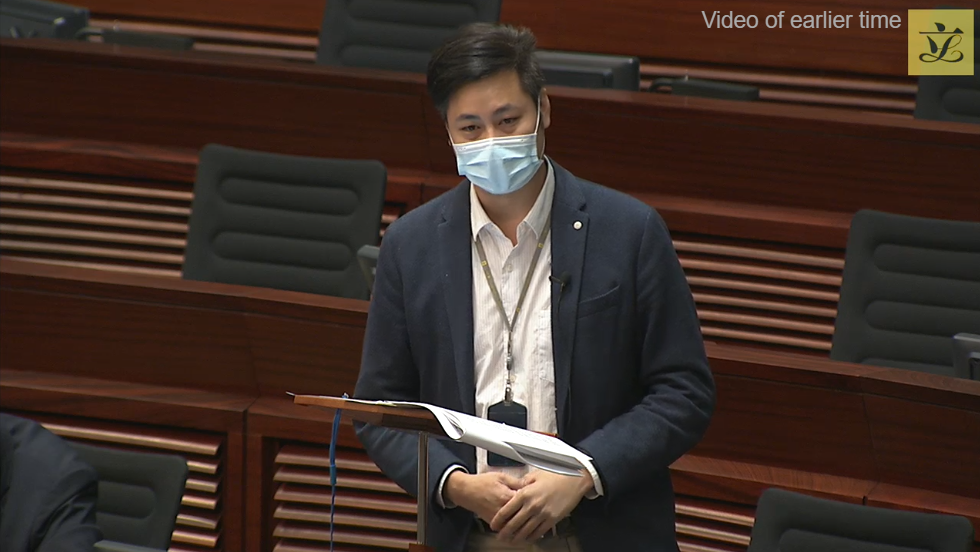
In response, Tang said individuals from disbanded groups may find other ways to break the law or endanger national security. The security chief said the government will review provisions in the Companies Ordinance and Societies Ordinance, as well as study provisions that cover foreign political organisations and those based in Taiwan.
Tang added the government was preparing for the enactment of a law implementing Article 23 of the Basic Law, which he sought to complete in the upcoming legislative term.
“Given the geopolitical situation, some foreign forces are targeting the development of our country and use Hong Kong as a tool to endanger the country and Hong Kong. I believe this will continue to happen,” Tang said.
Article 23 of the Basic Law stipulates that the government shall enact laws on its own to prohibit acts of treason, secession, sedition and subversion against Beijing. Its legislation failed in 2003 following mass protests and it remained taboo until after the onset of the separate, Beijing-imposed security law in 2020. Pro-democracy advocates fear it could have a negative effect on civil liberties but the authorities say there is a constitutional duty to ratify it.
Support HKFP | Policies & Ethics | Error/typo? | Contact Us | Newsletter | Transparency & Annual Report | Apps
Help safeguard press freedom & keep HKFP free for all readers by supporting our team


















latest national security stories


