

Loyalty to China’s Communist Party will be key to deciding if a Hong Konger is a “patriot”, a senior Chinese official said Tuesday, as Beijing draws up new laws to vet the finance hub’s politicians.
China has acted to quash dissent in semi-autonomous Hong Kong after huge and sometimes violent pro-democracy demonstrations swept the city for months in 2019.

Its latest plan is to impose sweeping changes to Hong Kong’s already limited election system, barring anyone not deemed loyal enough and reducing the influence of the small number of directly elected positions.
Dubbed “patriots governing Hong Kong”, Beijing says the changes are needed to restore stability and to plug loopholes that accommodate “anti-China” forces.
Critics see it as another nail in the coffin for Hong Kong’s democracy movement as Beijing presses ahead with a widespread campaign against dissent.

China’s rubber-stamp parliament is expected to give first assent to the new proposals on Thursday.
As Hong Kongers wait to hear details, a senior Chinese diplomat was asked whether patriotism would be defined as loyalty to the Communist Party, like it is on the mainland.
“When we talk about patriotism, we are not talking about the abstraction of loving a cultural or historical China, but rather loving the currently existing People’s Republic of China under the leadership of the Chinese Communist Party,” Song Ru’an, the Deputy Commissioner of China’s Ministry of Foreign Affairs in Hong Kong, told reporters.
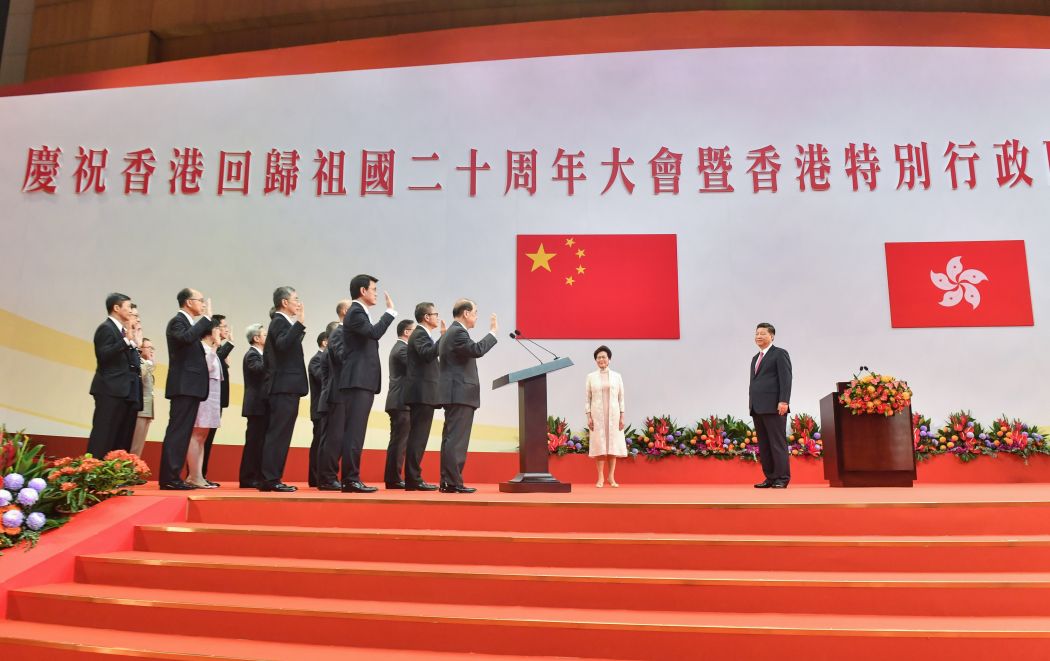
“Patriots should respect the Chinese Communist Party,” he said.
“We’ll review whether candidates meet that criteria.”
What is a patriot?
China promised Hong Kong could maintain some autonomy and freedoms under a “One Country, Two Systems” model ahead of its handover from British rule in 1997.
The city has its own partially elected legislature, independent courts and free speech protections — democratic elements not seen on the authoritarian mainland.

When they are allowed to vote, Hong Kongers tend to cast ballots for candidates pushing greater democracy or who are critical of Beijing.
Song’s comments reflect a shift in how China expects Hong Kong politicians to act.
The term “patriots governing Hong Kong” was coined in 1984 by China’s then reformist leader Deng Xiaoping as a way to calm fears ahead of the handover that the city’s political pluralism would be quashed.
Patriots, Deng argued, must accept Hong Kong is part of China and support its future prosperity — but they need not be party loyalists.
“Those who meet these requirements are patriots, whether they believe in capitalism or feudalism or even slavery,” Deng said. “We don’t demand that they be in favour of China’s socialist system; we only ask them to love the motherland and Hong Kong.”

But under President Xi Jinping, China has taken a markedly authoritarian turn and adopted a much less flexible definition of the term “patriots”.
After Beijing imposed a sweeping security law on the city last year, many of Hong Kong’s most prominent dissidents are in jail, face prosecution or have fled overseas.
Song said China was not trying to create a “monolithic government” in Hong Kong.
“Hong Kong is a pluralistic society where there is a blend of Chinese and Western culture,” he said.
“But anyone who challenges the fundamental system of the state and undermines Hong Kong’s constitutional order does not count as a true patriot,” he added.
Support HKFP | Policies & Ethics | Error/typo? | Contact Us | Newsletter | Transparency & Annual Report | Apps
Help safeguard press freedom & keep HKFP free for all readers by supporting our team


















latest national security stories


