

Hong Kong police have refuted claims that a service dog died or felt unwell after inhaling tear gas at a protest.
A police dog was deployed in Yuen Long on Monday during a clearance operation of a demonstration to mark the three-month anniversary of a violent mob attack. Multiple rounds of tear gas were fired, and the police came under fire for failing to protect their dogs from the chemical agent.

A rumour widely circulated on social media claimed that the dog deployed on Monday had died, but the police refuted the accusation.
“Please rest assured that no police dog has passed away or felt unwell as a result of handling protests since June,” the force wrote in a Facebook post. “We understand [the public’s] concern about police dogs’ health so every handler takes good care of his or her ‘partner.’ Never believe in unverified rumour! Let’s take a look at the video that was taken today.”
Police dogs have been deployed multiple times at street protests since June. The unrest was sparked by a now-withdrawn extradition bill which would have enabled fugitive transfers to jurisdictions with poor human rights records, namely mainland China. However, the movement has evolved into calls for universal suffrage, police accountability, among other demands.

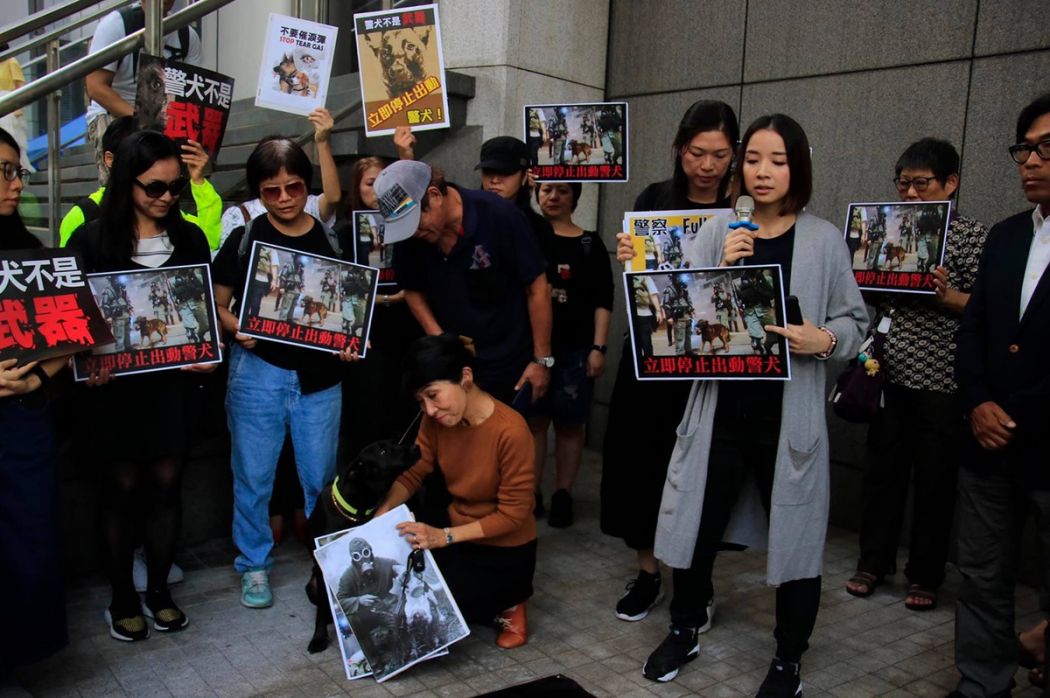
Pro-democracy legislators Claudia Mo, Jeremy Tam, Roy Kwong and animal rights activists filed a complaint at Wan Chai police headquarters on Wednesday afternoon against the use of police dogs at protests.
“Dogs are not weapons, stop deploying dogs, condemn the police for abusing animals”, they chanted.
Mo said that tear gas affects dogs more than humans because their sense of smell is better.
“[Police] are wearing gas masks, and dogs should have them too,” she said.
Mark Mak, executive chairman of the Non-Profit Making Veterinary Services Society, said the police dog deployed on Monday was filmed shaking and had its tail tensed between its hind legs, indicating that it was scared.
“We should not place innocent animals in sites of conflict,” he said.
Animal rights activist Roni Wong of the Hong Kong Wild Boar Concern Group said the use of police dogs at protests caused them unnecessary harm and could be in violation of the Prevention of Cruelty to Animals Ordinance. Offenders may face a maximum HK$200,000 fine and three years in prison if found guilty.
Hong Kong Free Press relies on direct reader support. Help safeguard independent journalism and press freedom as we invest more in freelancers, overtime, safety gear & insurance during this summer’s protests. 10 ways to support us.


