

Chinese President Xi Jinping has arrived in Panama — which broke ties with Taiwan last year and switched its allegiance to Beijing — for a visit aimed at extending his country’s political and economic influence in Latin America.
Xi is set to meet Monday with Panamanian President Juan Carlos Varela, and sign an array of cooperation agreements. He will also meet with business leaders and visit the Panama Canal’s new Cocoli Locks.

In a column written for the Estrella de Panama, a local newspaper, Xi said he had “high expectations” for the visit, the first ever by a Chinese leader to the country.
“We must be cooperative partners of mutual benefit and shared profits,” wrote Xi, who arrived in Panama late Sunday from Argentina, where he attended the G20 summit.
Beijing hopes that Panama can be a logistics hub for the expansion of trade in Latin America and the Caribbean — an idea that the business community here has fully embraced.

“Panama usually generates a lot of interest because of its strategic location in the region and because of the canal,” Severo Sousa, president of the National Business Council (Conep), told AFP.
These factors — along with Panama’s political stability, growing economy and deep financial network — are “very attractive” to China, Sousa added.
China is the second-biggest user of the Panama Canal after the United States.
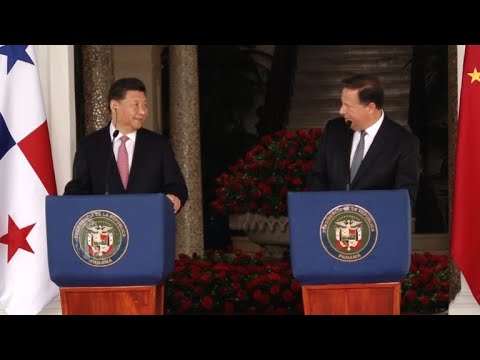
Varela’s government is hoping that Beijing will make multi-million-dollar investments in infrastructure projects. The two countries are negotiating a free trade agreement.
In June 2017, Panama established diplomatic relations with China, breaking off ties with Taiwan.
China and Taiwan have been governed separately since the end of a civil war on the mainland in 1949, but Beijing sees the island as part of its territory awaiting reunification.
Beijing and Taipei have been engaged for years in a diplomatic tug-of-war in developing countries, with aid and economic support often used as bargaining chips to gain diplomatic recognition.

Washington, which has accused the Chinese of trying to use aid to drive a wedge between Taipei and its Western Hemisphere partners, recalled its envoy to Panama City in September this year.
Varela, who visited China last year, promptly asked the US to respect his country’s sovereignty.


