1


The objets d'art style of the House of Fabergé: Cutting-edge jewelry craft presented as luxurious utility or intellectual toys, framing diplomatic gifts as intellectual praise as opposed to materialistic bribery. [Gemini Nano Banana Pro]


1
100% Upvoted
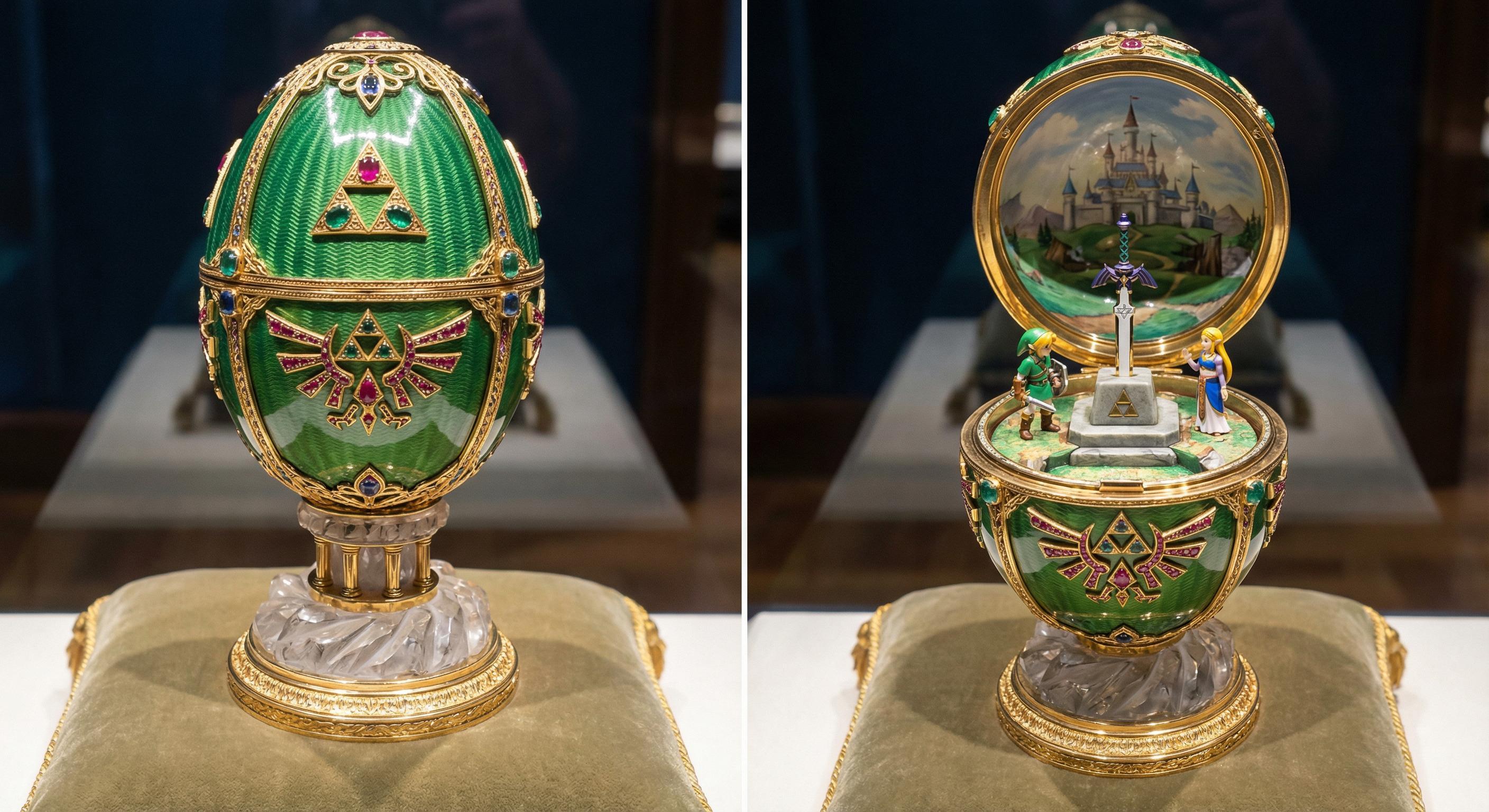
{"The Legend of Zelda"-themed Fabergé Egg}, designed in the objets d'art style by the House of Fabergé: {
The House of Fabergé, led by Peter Carl Fabergé (1846–1920), redefined luxury by championing the concept of the artist-jeweller. Under this ethos, precious materials served not as displays of raw wealth, but as a medium for perfectionist artistry. This unique hierarchy—where inventive wit and virtuosity took precedence over the ostentatious display of gemstones—was built upon a tripartite foundation of metallurgical science, structural discipline, and vernacular tradition.
The House’s technical soul was rooted in the scholarship of head workmaster Erik August Kollin (1836–1901), whose restoration of Scythian gold at the Imperial Hermitage recovered the lost arts of ancient granulation and gold-alloying. This metallurgical expertise was complemented by the architectural discipline of Johann Gottlieb Hesse, a Court Cabinet Maker and Fabergé’s father-in-law. Drawing from his work in the Russian Empire and Biedermeier styles, Hesse provided the blueprint for the structural miniaturization of monumental forms; by applying ébéniste joinery and multi-layered veneering to handheld objects, he instilled an 'Empire' vocabulary of strict symmetry that gave even the smallest piece a sense of architectural gravity. The third pillar emerged from the Neo-Russian revival—specifically the arched geometry of the kokoshnik and the tapered profiles of traditional Slavic silverwork—which contributed vernacular silhouettes that tempered Western formalism with indigenous character.
By distilling this expansive visual vocabulary of grand architecture, imperial interiors, and national tradition into handheld forms, Fabergé transformed functional objects into vessels for miniaturization—portable monuments that operated as evocative symbols of status and fantasy. This philosophy positioned lifestyle-defining objects not merely as accessories, but as architectural microcosms: condensed environments that accommodated and showcased the user's intellectual depth. Designed to elicit initial surprise from the recipient while remaining incidentally perceivable by a third party, each piece functioned as a private theater of taste made momentarily public.
The application of this philosophy required strategic intervention into the secular rituals of the era. Fabergé identified "mundane essentials"—utilities and accessories deeply embedded in lifestyle context—as insertion points for design affectation. Cigarette cases, desk clocks, bell-pushes, and parasol handles became sites where utility was camouflaged by artistry, their practical function subordinated to aesthetic presence. The selection of objects for both objets d’art and objets de luxe thus followed a deliberate calculus, targeting those possessions most intimately woven into daily ritual.
As the House expanded into an ecosystem of over 500 craftsmen, this "camouflage of utility" evolved from experiment into refined science. The acquisition of specialized workshops allowed technical boundaries to be pushed further than ever before, while the combined machinery and talent of these firms enabled a standardized perfection—signatures of quality reproducible across an unprecedented scale. In this industrial dynamic, utilitarian requirements were entirely subsumed by a narrative of eclectic taste, transforming common vanity objects into a curated gallery of "tactile utilities" that indirectly editorialized their possessors.
To sustain this illusion at the level of surface and ornament, the House prioritized narrative storytelling through stylized symbolism, where every decorative element served a distinct allegorical function. Rather than mere embellishment, motifs were curated to convey specific themes, creating a "readable" surface where aesthetics prioritized meaning. This symbolic program was physically manifested through a "lighting architecture" in which light did not simply reflect off the surface but penetrated vitreous layers to glow from within. This effect was perfected through the House’s mastery of the rose-engine lathe, which introduced complex moiré and sunburst patterns. By merging engine-turned metal with a proprietary library of over 145 translucent enamel shades, the House produced a luminous, almost holographic depth that transformed static objects into vessels of captured radiance.
Central to this visual architecture was an aesthetic egalitarianism regarding gemstones. The House embraced the intrinsic beauty of minerals beyond their market value, selecting stones for chromatic resonance rather than carat weight. Cabochon moonstones, mecca stones, and olivines joined diamonds and rubies as equals in the compositional hierarchy—a quiet revolution against the gemological orthodoxies of the period.
This material philosophy was deepened by the acquisition of *Carl Werfel’s workshop, which allowed the House to master "Object-oriented Lapidary." Design language shifted toward naturalistic and ethnographic hardstone sculptures—specifically the signature boyar and muzhik figurines. This era saw the rise of master lapidaries like Peter Derbychev and Peter Kremlev, whose execution of pietra dura techniques achieved such sophistication that metalwork became subservient to carved stone. These sculptural objects represented a parallel aesthetic trajectory: opaque, weighty, and rooted in Russian folk tradition.
Simultaneously, international expansion necessitated divergence toward a distinct "London Aesthetic." To appeal to Edwardian sensibilities, the House adopted a Pastel Minimalism—soft pinks, mauves, and oyster whites—that prioritized ethereal grace over imperial muscularity. This refinement was exemplified by the celebrated Flower Studies: botanically precise blossoms rendered in enamel and hardstone, set in rock-crystal vases that simulated water with uncanny translucence. Where the Russian workshops deepened their commitment to sculptural opacity, the London branch cultivated a competing vocabulary of lightness and chromatic restraint.
These aesthetic trajectories are inextricably linked to the distinct eras of the House’s two primary head workmasters. The "Golden Age" was defined by Michael Perkhin (head workmaster 1886–1903), whose workshop established the definitive Fabergé aesthetic—an opulent fusion of Neo-Rococo and Renaissance elements characterizing "Structured Organicism." Under Perkhin, ornamentation proliferated with disciplined exuberance: scrollwork, acanthus, and polychrome enamel achieved maximum density while maintaining compositional coherence.
His successor, Henrik Wigström (head workmaster 1903–1917), guided the House toward a more restrained, architectural elegance. Drawing upon the "Hessian" inheritance of cabinet-making logic, Wigström favored Neoclassical severity: laurel wreaths replaced Rococo scrolls, and geometric order superseded organic profusion. The middle years of his tenure (circa 1908–1914) acted as a catalyst for horizontal integration, fundamentally shifting the House from handcrafted jewelry toward an industrialized art form. This transformation was reinforced by the acquisition of Feodor Lorié’s workshop, which infused the brand with a monumental Neoclassicism, producing silver centerpieces and presentation pieces defined by Louis XVI ribbons and heavy swags.
The Romanov Tercentenary of 1913, however, mandated a temporary pivot back to Imperial Patriotism, during which the Neo-Russian style reached its zenith. Heraldic signatures such as the Double-Headed Eagle and Romanov Griffins were integrated into even the most mundane essentials, while masterpieces like the Mosaic Egg (1914) utilized high-technology platinum mesh and petit-point enamel to narrate dynastic continuity.
Ultimately, the House of Fabergé subordinated practical utility to aesthetic expression, creating objects where function became incidental to artistic presence. Whether through a mechanical "surprise" hidden within an Imperial Egg or the shimmering surface of a desktop clock, these pieces served as portable dreams. They condensed the splendor of imperial salons and the chromatic richness of Byzantine cathedrals into objects that could rest in the palm of a hand—offering their possessors a tangible connection to an idealized world shaped entirely by beauty and historical grandeur. }