

Chinese President Xi Jinping’s pledge to build a “world-class army” by 2050 is making his neighbours nervous, but analysts say Beijing’s military ambitions do not constitute a strategic threat — for now.
With purchases and construction of fighter jets, ships and hi-tech weaponry, China’s military budget has grown steadily for 30 years, but remains three times smaller than that of the United States.
Now, Beijing wants to catch up.

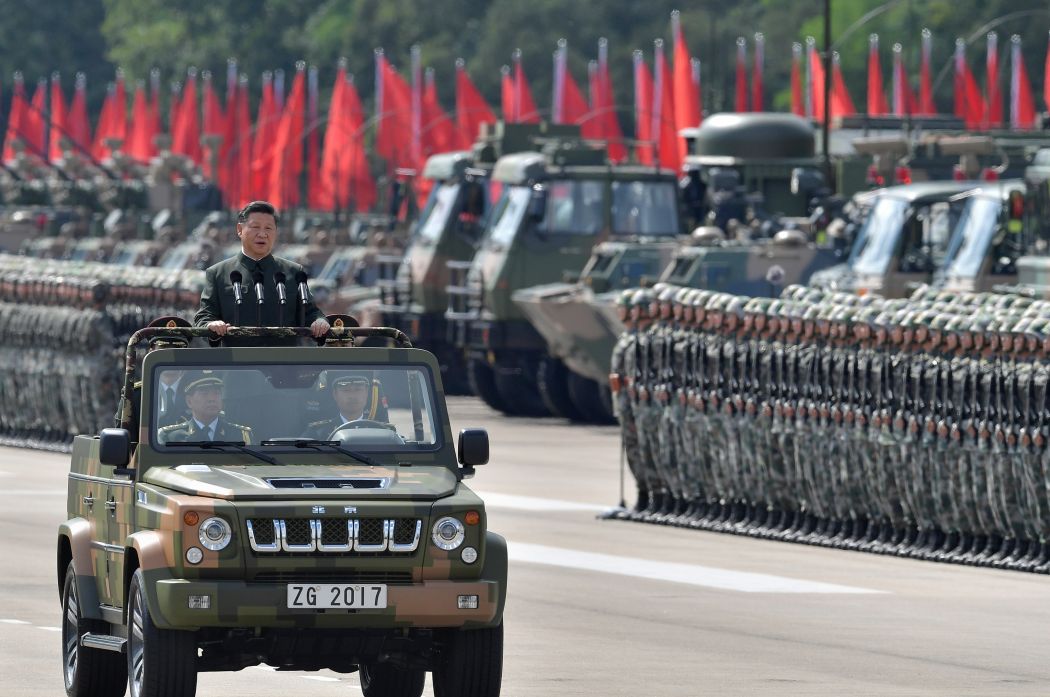
“We should strive to fully transform the people’s armed forces into a world-classmilitary by the mid-21st century,” Xi told 2,300 delegates of the Chinese Communist Party, which he heads and which controls the army.
The comments, made during the party’s twice-a-decade congress, were aimed in part at domestic nationalists, but also intended to show other countries “China’s desire to be strong economically as well as militarily,” said James Char, a military analyst at Singapore’s Nanyang Technological University.
During China’s so-called Century of Humiliation, starting around the mid-19th century, the country lost almost every war it fought, and was often forced to give major concessions in subsequent treaties.
“That’s why China, more than any other country, dreams of a strong army. Not to bully other countries, but to defend ourselves,” said Ni Lexiong from Shanghai University of Political Science and Law.
Worried neighbours
But Xi’s call to build a military that can “fight and win” has alarmed China’s neighbours, several of whom are embroiled in tense border disputes with the superpower.
This summer India and China engaged in a bitter, weeks-long military confrontation over a disputed area in the Himalayas.
Japan regularly faces off with Chinese maritime patrols close to the Senkaku islands, which are called the Diaoyu in Mandarin and claimed by Beijing.
And Beijing asserts sovereignty over almost the entire South China Sea, despite rival claims from countries including Vietnam, the Philippines and Malaysia.
Beijing has reclaimed islands it controls in the sea in order to cement its claims and installed military aircraft and missile systems on them, causing tensions to spiral in recent years.
“Chinese activities are a security concern for the region encompassing Japan and for the international community,” said a recent Japanese defence report.
“It is incontestable that the country’s rise as a military power is setting off an arms race in Asia,” said Juliette Genevaz, China researcher at the France-based Military School Strategic Research Institute.
“This arms race in Asia has several causes,” she said, noting North Korea’s nuclear weapons programme as one of the contributors.
But, “China’s military build-up and reclaiming activities in the South China Sea is a major factor.”
China’s military expenditure in 2016 was an estimated $215 billion, according to the Stockholm International Peace Research Institute, putting it in first place in Asia, well ahead of India ($56 billion), Japan ($46 billion) and South Korea ($37 billion).
The country has not participated in any conflict since a month-long border war against Vietnam in 1979 that killed tens of thousands of people and a 1988 skirmish, also with Hanoi, over the Spratly Islands in the South China Sea, that left 64 dead.
But it has been busy boosting its military activities abroad.

This year, Beijing opened its first foreign military base, in Djibouti. Since 2008, its navy has participated in anti-piracy operations off the coast of Somalia and in the Gulf of Aden.
The country is the largest contributor to United Nations peacekeeping operations among the permanent members of the security council, with some 2,500 soldiers and military experts deployed.
The moves are all part of a larger, decades-long effort to modernise the country’s military, which had become riddled with corruption, incompetence and waste.
‘Absolute control’
But while Xi flexed his muscles at the head of China’s central military commission during his first term, he is likely to observe more caution in future, having consolidated his power base by bringing down two of the country’s highest-ranking army officers for corruption, said James Char.
He also reaffirmed the party’s “absolute control” over the army during the recently concluded congress.
“Now that it’s done, he does not need to risk an external crisis any more. Therefore, we can reasonably expect Beijing will conduct less coercive diplomacy in the near- to medium-term,” Char said.
“The Chinese military will continue to operate further and further away from China’s shores, and probably also establish more overseas bases,” he added.
But, while it will continue to aggressively defend its own territorial claims, “it will likely act cautiously abroad and will not engage in overseas constabulary missions such as those carried out by the US military in Iraq or Afghanistan for example.”


