1


Mid-Century Graphic Folk-Modernism children's book illustration style by Richard Erdoes (1912–2008): Utilizing a teleological, cartographic landscape of micro-narratives to distill and narrate complex cultural ecosystems. [Gemini Nano Banana Pro]


1
100% Upvoted
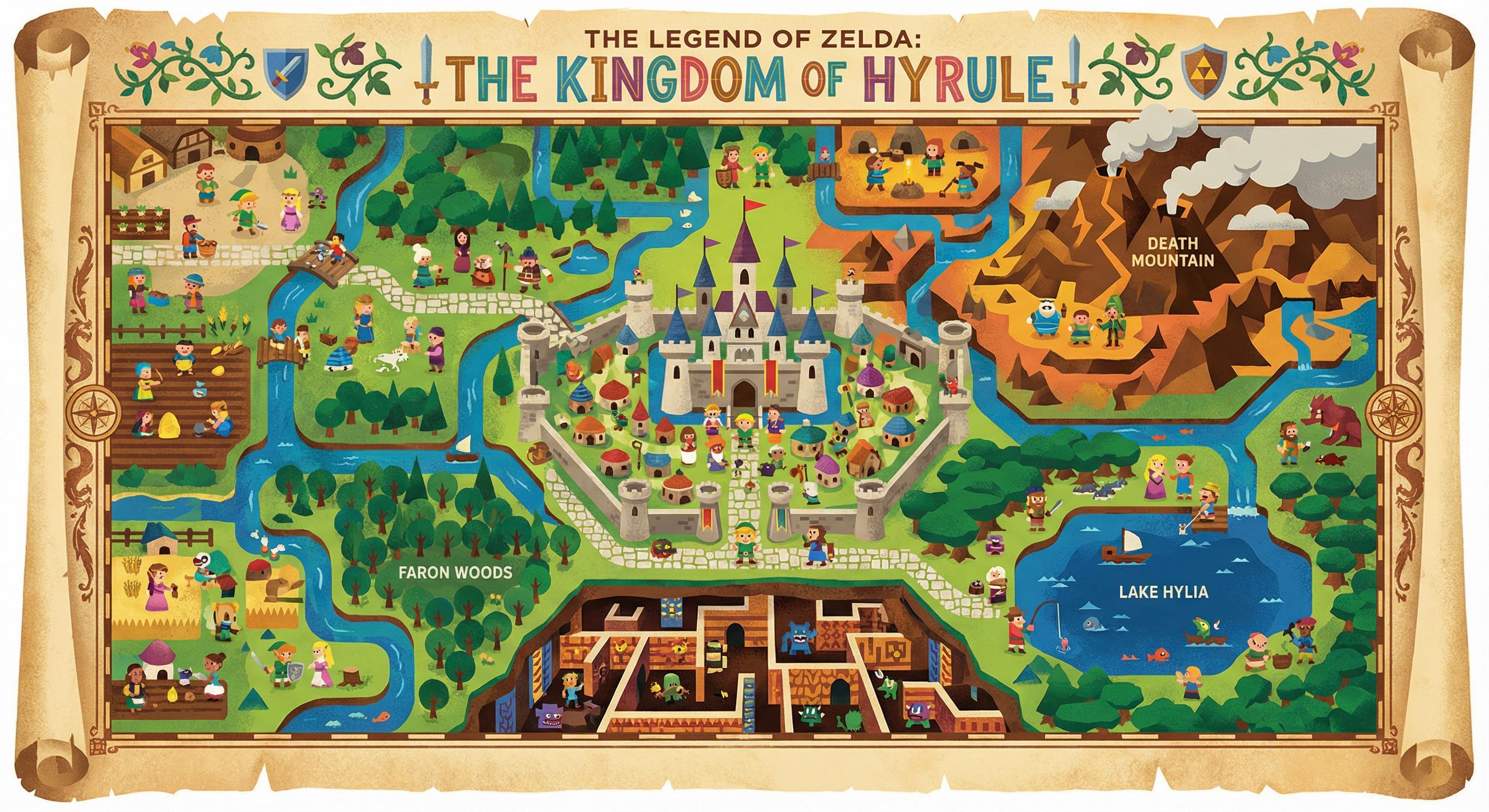
{The Legend of Zelda: The Kingdom of Hyrule} illustrated in Richard Erdoes' (1912–2008) Mid-Century Graphic Folk-Modernism children's book illustration style: {
Richard Erdoes's signature illustration style is a masterclass in "micro-narrative density." While Martin Handford's Where's Wally? focuses on the hunt for a single needle in a haystack, Erdoes focuses on the interconnectedness of the hay itself. His work creates a gamified, dynamic visual reading experience where the viewer deciphers an entire social or historical ecosystem through a "nested narrative" composition—layers of story embedded within story, where each detail is both self-contained and essential to the whole. This structural framework acts as a cultural bridge, skillfully adapting the intricate geometries and flat perspectives of Asian and global folk arts into an accessible Western visual idiom.
This approach embodies a "Graphic Folk-Modernism" aesthetic—one that parallels the tactile whimsy and assembled nature of a piñata. Each small element contributes to a sense of additive joy, creating the impression of a festive object built with a papercraft logic of vibrant, overlapping layers and streamlined, iconic forms. Visual puns and deliberate anachronisms imbue this complexity with warmth, while the underlying structure delivers social commentary through whimsical charm. The result promotes a vision of harmonious diversity, representing distinct communities to Western audiences through an appreciative lens of global wanderlust and cultural affinity—celebrating customs and idiosyncrasies entirely free of heavy-handed preachiness.
This grandeur, however, is achieved through a "Mythic Naivety," wherein Erdoes employs utopian distillation to omit historical abrasions in favor of celebratory pageantry. Through benevolent caricatures and hyperbolized stereotypes functioning as visual shorthand, he distills complex social ecosystems into what might be termed graphic propaganda of joy. This approach prioritizes a curated "spirit" of culture—delivering an idealized, theatrical grandeur that invites Western audiences into a sanitized yet vibrant world of historical romanticism.
The structural foundation of Erdoes's work is a "cartographic narrative" envelope, where the environment functions as both stage and script. By framing his compositions within stylized, board-game-inspired containers—map scrolls, geometric planetary orbs, or intricate subterranean labyrinths—he creates contained universes that balance epic thematic scope with intimate, tactile accessibility. These map-like frames signal that each illustration is a geographic and historical document rather than a mere snapshot; they tell the viewer, "This is the story of a whole civilization," not "This is the story of one person."
Erdoes reinforces this structural logic through "architectural sectioning," utilizing environmental elements as both framing devices and cutaway structures. This dollhouse-like partitioning showcases both macrocosm and microcosm, revealing organic activities across simultaneous focal planes—a spatial logic reminiscent of Matryoshka dolls, where the telescoping modulation of scale creates a sense of nested discovery. Decorative borders—vines, scrolls, or architectural motifs—frame the illustration's perimeter, acting as visual "appetizers" for the density within.
This "total-world" narrative is achieved through an omniscient bird's-eye view utilizing isometric or planimetric projection. By eliminating the atmospheric and scale limitations of traditional vanishing-point perspective, Erdoes removes the hierarchy of the horizon line, creating a democratic visual plane where every corner receives equal graphic importance. Without the distortion of distance, the viewer traverses the landscape as an explorer, free to chart their own course—whether meandering organically or scanning systematically, every element rewards equal attention
To accommodate this density without chaos, Erdoes employs a decentralized layout that breaks each scene into dozens of "islands" of communal activity. This approach shares a lineage with the work of Grandma Moses (1860–1961), yet Erdoes shifts the focus; where Moses prioritizes a tapestry-like unity for an overall pastoral atmosphere, Erdoes balances that atmospheric harmony with localized storytelling richness. By infusing the scene with a "cartoony chaos" of diverse characters, gestures, and emotions, he ensures that the Gesamtkunstwerk (total work of art) is built from distinct, readable human dramas rather than a singular static impression. The result is an "ant-colony dynamism" driven by entropic ornamentalism: the composition subdivides into organic chambers where the frantic movement of individual micro-narratives is bound by a singular, overarching pulse. Distinguishing itself from a suffocating horror vacui, this approach achieves a purposeful density where every element is integral to its narrative cluster, ensuring the composition remains aesthetically rich yet cognitively legible.
Rather than using traditional comic-strip panels, Erdoes guides the eye through spatial flow—most prominently via the "coil technique" exemplified in his 1969 LIFE Magazine piece, "Homo Sapiens R.I.P." This serpentine trajectory allows environmental and cultural stories to emerge through a fluid, meandering thread, with the spiral structure conveying cyclicality and inevitability—the sense that the environment is evolving (or devolving) before your eyes. His work echoes the fluid visual flow of Virginia Lee Burton (1909–1968); however, while Burton often prioritized an impressionistic, rhythmic fluidity, Erdoes ensures that this motion never comes at the expense of narrative readability. This structure imparts a teleological momentum to the work; much like a board game, the "coil" establishes a perceptual trajectory that transforms the viewer into an explorer with a clear narrative destination. The result is a goal-oriented visual journey implicitly evoking the active, quest-like wayfinding of child's play, where the "finish line" is not merely the edge of the page but the final synthesis of the historical or social "puzzle" into a singular, satirical graphic punchline.
With an organically flowing structure established, Erdoes turns to chromatic intensity. The rendering employs confetti-like, geometric color-blocking that merges the surreal, high-saturation palette of Dr. Seuss (Theodor Seuss Geisel; 1904–1991) with the rhythmic, lacquered intensity and decorative ornamentalism of Khokhloma (Russian folk wood-painting). The synthesis of "floating" shapes and folk-art warmth transforms the composition into a jewel-like mosaic, where every saturated hue anchors characters within a larger, celebratory landscape. This organic density is elevated through a Klimt-esque sensibility, wherein the clustering of figures transcends mere storytelling to become a mesmerizing decorative field—much like the jewel-toned patterns in The Kiss; Erdoes's crowds function as a crystalline mosaic where the repetition of form and color creates a hypnotic, flat-planed beauty.
This chromatic vibrancy is complemented by strategic textural materiality that functions as a thematic guide. Erdoes employs pristine, unblemished, softened chiaroscuro to convey the sleekness of modernity or the delicacy of femininity, using smooth light-to-dark transitions to suggest "newness." Conversely, he utilizes subtle directional textures to establish a serene, atmospheric flow, while granular, earthy textures are reserved for traditionalist elements—bestowing indigenous cultures and historical artifacts with a tactile sense of ancestral weight. This contrast in surface quality ensures that the viewer can instinctively distinguish between the "pristine" future and the "textured" past within a single, unified composition.
The narrative logic of these compositions is anchored by expressive, iconic caricatures engaged in specific, often parodic micro-tasks. These figures are rendered as energetic silhouettes with pronounced facial and bodily exaggerations, utilizing bold, flat color-blocking that bridges the animated cartoons of United Productions of America (UPA) with a contemporized folk-art sensibility. Crucially, forms are defined not through explicit outlines but through the strategic adjacency of color fields and subtle tonal modulations—edges emerge where hues meet, creating soft yet definite boundaries that maintain graphic clarity without the rigidity of hard contours. Each figure balances individual expression against uniformity—a camouflage-like repetition that reinforces the collective nature of the narrative.
This synthesis draws from an economic, planar visual lexicon reminiscent of Ben Shahn (1898–1969) and the modernist folk forms of André François (1915–2005), while prioritizing the "faraway legibility" of Leonard Baskin (1922–2000). This emphasis on graphic immediacy ensures that the image remains digestible at a glance, preventing the dense composition from becoming a visually alienating burden. Motion is implied through dynamic gestures and crisp, calligraphic linework recalling the wiry irony of the "New York School" of editorial illustration. The style further incorporates a modular, geometrically streamlined quality reminiscent of the clean silhouettes found in traditional printmaking—such as woodblock prints or rubber stamps—and commercial icon design; this precision ensures each figure remains distinct within a crowded field. The seemingly lighthearted caricature thus serves as an enlightening graphic distillation: a satirical compression of critical themes where Erdoes's illustrations function as the primary narrative vehicle, leaving the accompanying narrative text, if any, to act as a secondary complement. The result is a congruent, interconnected narrative "puzzle" where every stylized figure serves as a vital data point within the larger visual map. }