2


Russian contemporary surrealism style of Andrey Remnev (b. 1962): A synthesis of Italian Quattrocento classicism and Russian Orthodox iconography, contemporized through Gothic theatricality and minimalist graphic restraint. [Gemini Nano Banana Pro]


2
100% Upvoted
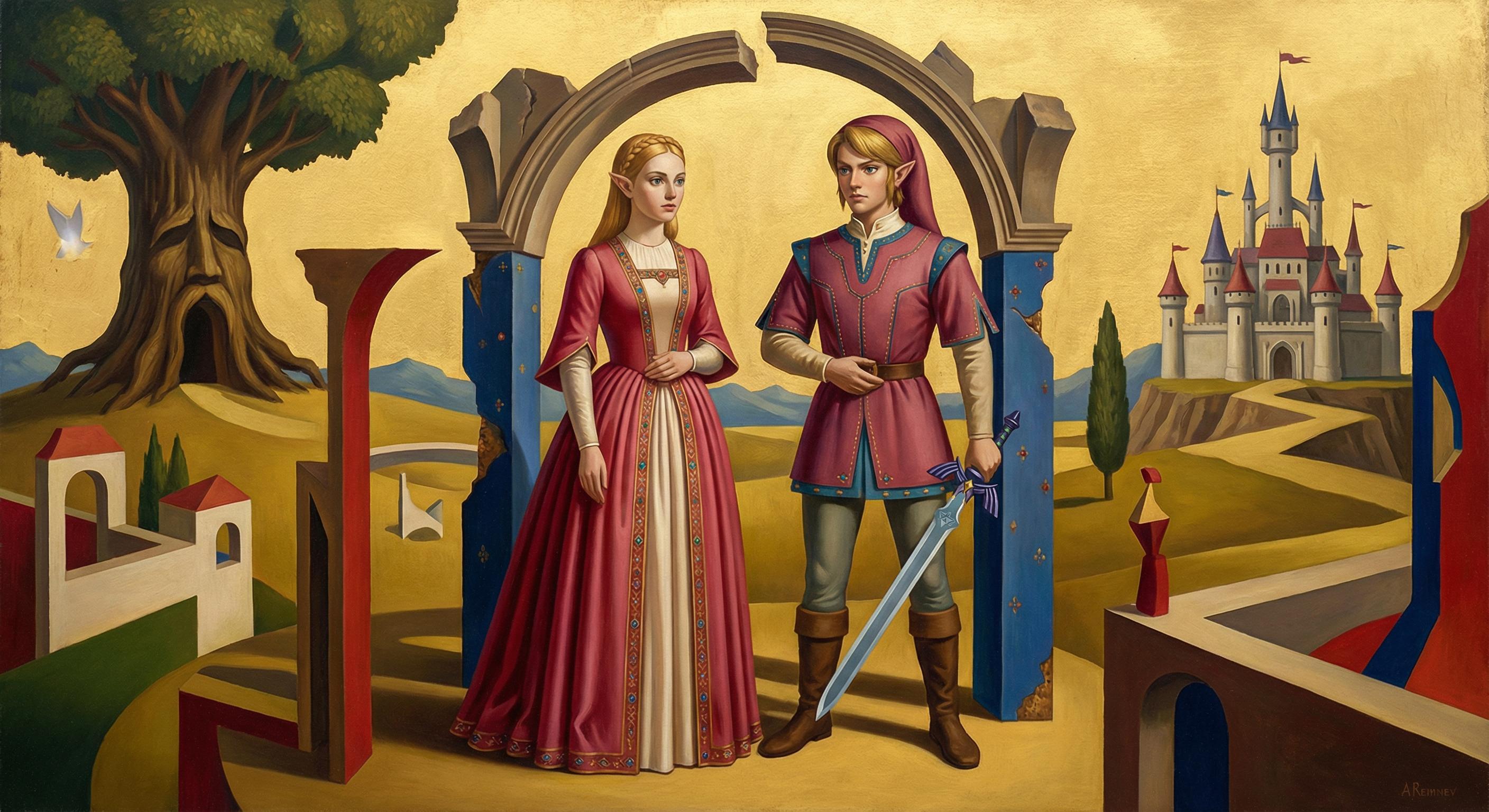
{The Legend of Zelda} illustrated in the Russian contemporary surrealism style of Andrey Remnev (Андрей Владимирович Ремнёв; born 1962, Yakhroma, Russia): {
The artistic identity of Andrey Remnev is defined by a pictorial idiom that functions as a synthetic bridge between Eastern Orthodox sacred tradition and Western art-historical lineages. His formation encompasses two distinct pedagogical streams: the rigorous discipline of Russian Orthodox iconographic technique acquired under Archpriest Vyacheslav Savinykh, and the balanced classicism of Italian Quattrocento masters such as Benozzo Gozzoli (c. 1421–1497) and Piero della Francesca (c. 1415–1492). From this dual inheritance, Remnev has forged a distinctive contemporary practice characterized by serene psychological depth, the staged formality of couture tableaux fitting for high-fashion editorial, and a delicate, naturalistic humanism enhanced with theatrical, pristine chiaroscuro that softens the architectural rigidity of his historical sources.
Crucially, Remnev’s synthesis is governed by a curatorial sensibility attuned to contemporary visual culture. Rather than reproducing historical sources with antiquarian literalism, he filters traditional iconography through a modernizing editorial lens. He retains visually compelling elements while deliberately excising clichéd symbolism, overly programmatic narrative devices, and densely repetitive traditional patterning that might render the work inaccessible to modern viewers. In their place, he favors bold, unmodulated chromatic fields and sparse micro-patterning—a discriminating approach that ensures his historical eclecticism registers not as nostalgic pastiche, but as a living visual language. This synthesis achieves a cinematic grandeur through four interrelated modes—iconographic structure, hygienic Surrealist method, Gothic-like dilemmatic theatrical staging, and Renaissance perceptual-optical technique—each reinforcing the others to produce images of mysteriously irrational, Medieval-inflected beauty.
At its conceptual base, the work draws from the Byzantine chromatic vocabulary and the emblematic visual language of the Russian iconographic canon. This inheritance establishes a register of sacral solemnity and meditative stillness, providing the spiritual ground for the artist's pursuit of formal perfection. However, where medieval icon painters employed elaborate systems of conventional motifs laden with doctrinal significance, Remnev substitutes a streamlined contemporary theatricality. Vivid, unmodulated hues evoke the gilded flatness of devotional panels while channeling modernist graphic sensibility; restrained, sparse patterning suggests material sumptuousness without sacrificing legibility or impeding visual flow. This foundational stratum anchors even his most elaborately staged compositions in a stylized contemplative interiority, ensuring that spiritual gravity persists beneath the surrealist perspectival estrangement of a fashion-editorial tableau.
Upon this sacred foundation, Remnev layers a psychological dimension situated at the intersection of Surrealist practice and magical realism. Employing a strategy akin to Salvador Dalí's (1904–1989) paranoiac-critical method, he uses oneiric imagery to externalize psychological states through elaborately orchestrated memory-tableaux. Crucially, however, Remnev diverges from the historical Surrealist tendency toward biomorphic distortion or the grotesque. He strictly omits somatic disfigurement, ensuring his figures remain physically idealized and intact. In place of visceral warping, he channels the surrealist impulse into stylish, rhythmic ornamentation and spatial paradox. By subverting Euclidean spatial coherence and naturalistic scale relationships, he generates dreamscape compositions marked by pictorial enigma and the suspended temporal stillness characteristic of René Magritte (1898–1967). His figures, frequently positioned against compressed, deliberately flattened backgrounds, appear akin to sculptural reliefs poised to transcend the picture plane.
This psychological depth is enriched by a performative sensibility derived from the early twentieth-century Ballets Russes. Translating the visual spectacle of Sergei Diaghilev's (1872–1929) productions and Igor Stravinsky's (1882–1971) orchestrations into pictorial terms, Remnev treats contour and silhouette as choreographic notation. This theatrical register finds its fullest expression in the presentation of the female figure, whom the artist regards as the purest expression of nature's generative strength. Rendered with processional dignity, these figures embody a ceremonial dynamism that acts as a vessel for a serene, delicate humanism. Unlike the frozen, stony postures of strict Quattrocento fresco or the impersonal flatness of vector-like graphic styles, Remnev’s protagonists radiate a soft, breathing interiority. This approach synthesizes the ritual gravity of Slavic traditions with a gentle, accessible emotional warmth, creating an atmosphere of aristocratic spectacle that remains fundamentally humane.
Central to this theatrical presentation is a conception of costume as architectural form. Garments are rendered as strong, geometric silhouettes—stiff collars, bell skirts, columnar robes—that read as constructed volumes even where fabric falls in draped folds, lending each figure the monumental presence of a sculptural edifice. This architectonic approach extends to tailoring conceived as topology: visible seams, paneling, and edge articulation function as compositional lines organizing the picture plane. Within this framework, headdresses and ceremonial props operate as identity markers, lending each figure the symbolic legibility of a heraldic device.
This compositional logic extends to a distinctive scale modulation in which small, intricate details coexist with bold, oversized elements. The resulting tension between intimacy and monumentality amplifies the surreal displacement of rational proportion, generating a couture sensibility in which the uncanny emerges not from grotesque distortion, but from the precise, hypnotic rhythm of exquisite detail. Importantly, this dimension is calibrated for contemporary reception: Remnev avoids the heavy-handed Freudian symbolism and overtly morbid imagery that can render historical Surrealism alienating. Instead, he cultivates an atmosphere of elegant mystery, relying on the mesmerizing visual cadence of staged tableaux that juxtapose hieratic stillness with arrested balletic motion within a decorative surrealist perspective. The effect depends on hypnotic formal patterning rather than visceral shock, ensuring the psychological undercurrents remain stylishly suggestive rather than didactic.
The resulting hybrid historicism yields a "neo-couture" vocabulary where historical costume is abstracted into timeless, surreal geometric beauty. Meticulous attention to material preciousness resonates with the jeweled craftsmanship of the House of Fabergé, particularly the objects produced under Peter Carl Fabergé (1846–1920), yet is updated with a minimalist graphic sensibility. Unlike traditional folk costume where ornament is distributed uniformly, Remnev employs sparse micro-patterning strategically concentrated at focal areas. This selective placement allows decorative detail to function as visual punctuation, directing the eye without overwhelming the composition’s graphic clarity.
Technically, Remnev's spatial architecture integrates the codified single-point perspective of the Central Italian schools (Florence, Arezzo, Urbino) with formal devices characteristic of M.C. Escher (1898–1972): mathematically precise tessellation, crisp contour delineation, and interlocking figure-ground relationships. This structural logic often extends to bilateral symmetrical configurations evocative of Rorschach inkblot patterning, generating compositions whose apparent spontaneity belies rigorous geometric control. Costumes are occasionally accentuated by passages of metallic texture—gold, silver, and bronze leaf—that evoke the sumptuous materiality of brocade while reinforcing the artist's iconographic inheritance.
The chromatic and optical execution demonstrates equal sophistication, uniting the material properties of traditional media with the perceptual discoveries of the Old Masters. Remnev employs a stratified application of egg tempera underpainting and oil overglazing, combining the matte precision of the former with the textural impasto and glazed translucency characteristic of Venetian colorito. This technique produces a tactile verisimilitude in which painted fabric acquires the dimensional presence of actual textile. His jewel-like palette favors recurring passages of carmine red, rose pink, and lapis lazuli blue—the latter heir to a chromatic lineage extending from Giotto di Bondone (c. 1267–1337) through Tiziano Vecellio (Titian; c. 1488/1490–1576)—lending figures contemporary vibrancy alongside sacramental dignity.
Finally, Remnev anchors these figures in the dramatic-but-pristine tenebrism of European Old Master portraiture. Evoking the sculptural polish of Agnolo Bronzino (1503–1572) and the candlelit illumination of Georges de La Tour (1593–1652), he utilizes high-contrast chiaroscuro to carve figures with ceramic precision. This is refined by Leonardo da Vinci’s empirical command of sfumato and atmospheric perspective, unified by an ambient luminosity reminiscent of Maxfield Parrish’s (1870–1966) "golden hour." The resulting effect creates a pop-up illusion where ornament appears to project from the picture plane like sculptural relief, synthesizing Byzantine sacral gravitas with a surrealism of aesthetic estrangement rather than disfigurement. This balance ensures that despite the bold graphic context, the work retains a gentle, voluminous humanism, defining Remnev’s singular contribution to contemporary figurative painting. }