1


The figurative, abstract contour drawing style of Jean Cocteau (1889–1963): Using contour mastery from costume, stage, and film set designs to therapeutically express wishful escapism born out of internal dilemma. [Gemini Nano Banana Pro via LM Arena]


1
100% Upvoted
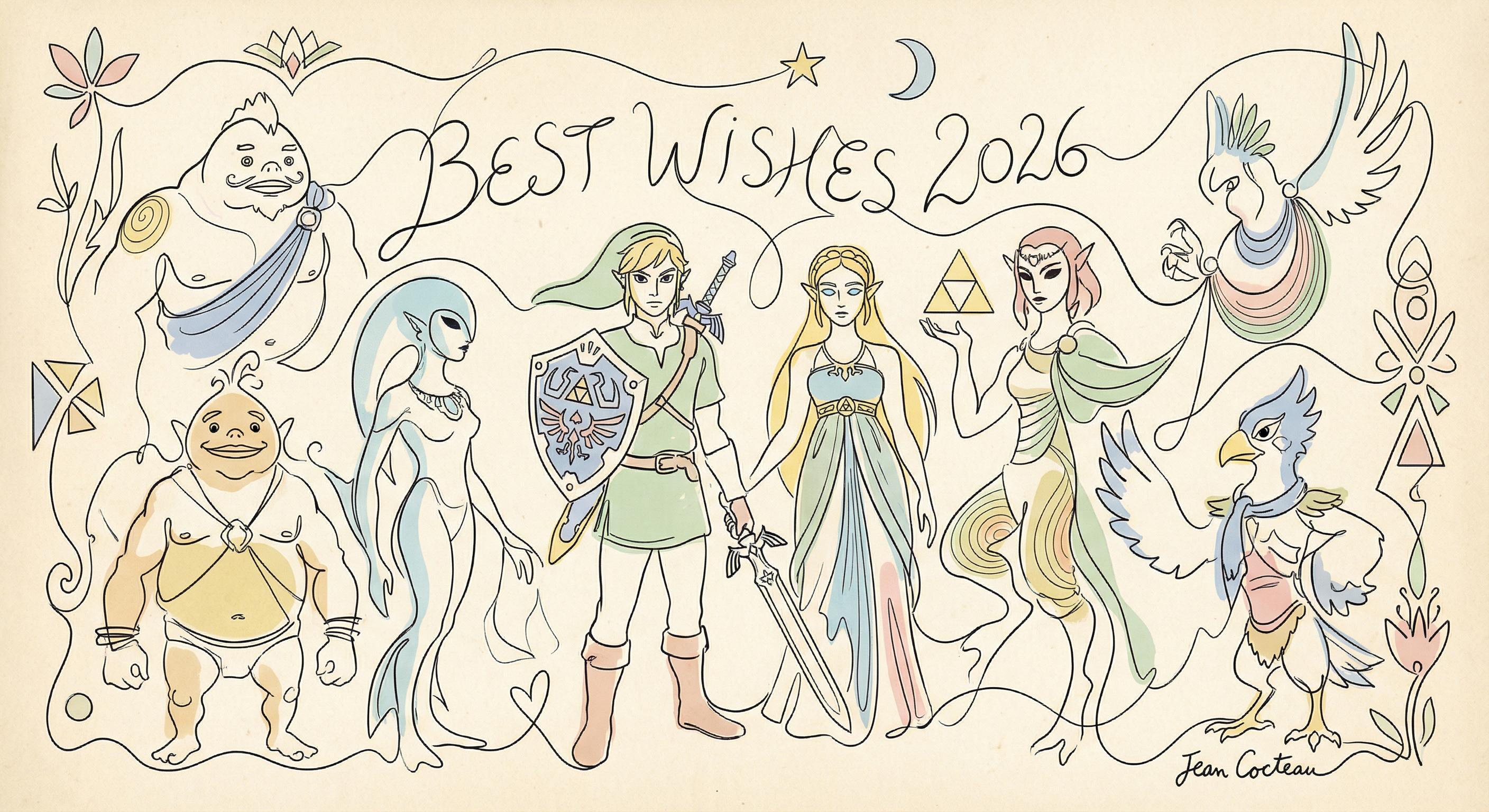
{The Legend of Zelda: Link and friends send best wishes for New Year 2026} illustrated in the figurative abstract contour drawing style of Jean Cocteau (1889–1963): {
Jean Cocteau's drawing style is defined by a predominantly continuous, calligraphic line that distills complex figuration into a rhythmically connected visual language. This unbroken stroke functions as both a structural armature and an expressive gesture, producing figures that read as emblematic silhouettes rather than volumetric studies. By synthesizing the immediacy of gestural drawing with the legibility of a graphic sign, Cocteau privileges narrative suggestion and symbolic resonance over naturalistic description. The resulting compositions evoke a "hieroglyphic" quality—a personalized visual alphabet that transforms intimate memory into a series of signature-like, continuously handwritten pictographs. These works function as highly opinionated views of their subjects, often veering into the satirical or the lightheartedly humorous, yet always maintaining a decorative motif charged with semantic richness.
Cocteau's imagery is deeply rooted in an autobiographical landscape of privilege and tragedy, where personal experience blends with a surreal "wishful thinking" born of psychological trauma. This affective charge recalls the "Proustian moment"—the involuntary surge of emotionally charged memory triggered by sensory experience, as conveyed in the novels of Marcel Proust (1871–1922)—framing his work as an instinctual search for life's meaning. His exploration of duality, the supernatural, and fluid sexuality mirrors the internal dilemmas of authentic self-expression found in the novels of André Gide (1869–1951). This autobiographical foundation—reflecting his sustained creative practice across theatre, ballet, and film—imbues his figures with a nostalgic melancholy, capturing fleeting impressionistic memories and poetic fantasies through abstract linework that functions as a monumentally decorative, layered collage of photographic references, theatrically accentuated to bridge the gap between quotidian detail and mythic archetype.
This distinctive style emerged through high-profile collaborations and a sustained dialogue with the vanguard of modernism. Freed from the rigid dogmas of Symbolism and Surrealism, Cocteau followed Guillaume Apollinaire's (1880–1918) call for intuitive imagination to spark new artistic directions. From Henri Matisse (1869–1954), he absorbed the model of expressive fluid contours, iconic economical mark-making, symbolic ornamentation, and lively organic linework; from Pablo Picasso (1881–1973) and Juan Gris (José Victoriano González-Pérez; 1887–1927), he adopted a multi-perspectival approach to form and a gestural calligraphic quality, utilizing anatomical distortion to heighten expression over representation. Marie Laurencin's (1883–1956) influence is felt in the empathetic sensibility and "digestible melancholy" pervading his captured poses and visages, while also exhibiting a caricatural yet refined characterization reminiscent of Picasso and Amedeo Modigliani (1884–1920). His work further echoes the geometric simplification, mask-like faces, sparse concentric linear rendering, and totemic power of African folk art—a symbolic use of form that privileges contour and sign over naturalistic modeling. These diverse inputs are further refined by the graceful, restrained gestural contours of fashion and interior illustration—honed through collaborations with Coco Chanel (1883–1971) and Christian Bérard (1902–1949)—and the kinetic energy of Sergei Diaghilev's (1872–1929) Ballets Russes.
Cocteau's contour drawings function as "costume sketches in motion," mapping theatrical archetypes through economical strokes that translate stagecraft—pose, drape, and performative identity—into a static yet cinematic vocabulary. This approach, reminiscent of Léon Bakst's (1866–1924) design sensibilities, treats the human form as a vessel for drama. Whether employing "Herculean" linework to signify monumental strength, powerful muscularity, and kinetic gesture, or a subtly psychedelic, kinetic visual flow akin to the abstract and nature paintings of E. E. Cummings (Edward Estlin Cummings; 1894–1962), Cocteau endearingly allegorizes life experiences as handcrafted decorative motifs. His compositions often feel like woven threads, where the movement of the pen mimics the choreography of a dancer or the flicker of a film strip.
The physical execution of Cocteau's work relies on a sophisticated mixed-media approach, primarily utilizing continuous strokes of pen and ink occasionally reinforced by pencil or brush. To achieve expressive clarity, he employs a reductive yet empathetic color palette—lighthearted and whimsical, ranging from varied single-line colors to minimalist, powdered flat-color gradients to alternating vivid blocks of watercolor, gouache, or pastel. Depth is rarely achieved through tonal modeling; instead, Cocteau utilizes a sparse, "onion-like" concentric rendering technique, creating volume through layered contours, complemented by the tonal intensity of essential flat planar colors. This technical economy is punctuated by symbolic ornamentation and the strategic interplay of positive and negative space. Sparse use of symmetrical "double-meaning" compositions and semantically charged optical illusions further enriches the visual complexity, ensuring that each mark serves the overarching goal of hybrid primitivist-modernist clarity. }