The whimsical children’s book illustration style of Nancy Ekholm Burkert (b. 1933): A research‑driven approach whose studio refinement fuses archival detail with quiet, fairy‑tale imagination. [Gemini Nano Banana Pro via LM Arena]
{The Legend of Zelda: Link and Zelda celebrate Christmas in Hyrule} illustrated in the whimsical romantic fantasy illustration style of Nancy Ekholm Burkert (b. 1933): {
Nancy Ekholm Burkert's work elevates illustration from mere accompaniment to an equal narrative partner—functioning not as secondary decoration but as a primary, integral element of the literary experience. This approach frames the world through the romanticized, hazy lens of a naïve yet hopeful observer, poetically portraying nature and society as congenial and welcoming. By inviting adventurous curiosity and an intimate voyage of self-discovery, the work suggests a whimsical, feminine melancholy that colors the narrative without obscuring its meaning. The resulting illustrations convey a liberating sense of intimacy and wonder, transforming the act of looking from discipline into delight.
This vision finds its philosophical anchor in the Flemish tradition of particularization—the rendering of specific, individualized forms in nature and character. Embracing the belief that particularization is the key to portraying the universal, the approach utilizes specific forms—their geographical uniqueness, cultural specificity, and identity markers—to evoke a resonating sense of place. Grounded in the artist's lived experience of each narrative's root culture, the methodology employs a psychoanalytical visual vocabulary distilled from years of research and on-location source materials. This pursuit of authenticity over assumption yields tableaux that etherealize immersive experience while remaining culturally anchored.
The approach adapts the tableau tradition of medieval art—specifically devotional panels and illuminated manuscripts—where narrative and symbol fuse within a single, unified pictorial field. This structural inheritance provides the armature upon which Burkert's modern sensibility builds.
Against the history of children's book illustration, Burkert's work offers dramatic relief from the tense, moralizing precision of Victorian imagery exemplified by John Tenniel (1820–1914). Where Tenniel's linework enforces rigid hierarchies and allegorical control, Burkert's softened palettes, compressed yet lyrical spatiality, and empathetic rendering invite readers into a world of curiosity and gentle discovery. The work emerges from a deliberate counterbalance to its historical foundations, pulling away from the heavy atmosphere of male-centric traditions toward a modern graphic playfulness rooted in technical mastery.
The work's structural lightness reimagines the 15th- and 16th-century Northern Renaissance by inverting its density. It adopts the compositional miniaturism of Rogier van der Weyden (1399–1464) and Hugo van der Goes (c. 1440–1482) but renders it airy; it employs the precision of Jan van Eyck (c. 1390–1441) but keeps it buoyant; and it expands upon the sprawling narratives of Pieter Bruegel the Elder (c. 1525–1569) with a breathy delicacy. Although the work departs from the stark chiaroscuro of Albrecht Dürer (1471–1528) toward a lighthearted modernism with surrealist translucency, it inherits from Dürer a symbolic concreteness that translates abstract ideas into seamlessly integrated visuals.
Against this gravity, the artist draws on the Golden Age of Illustration, channeling an Art Nouveau–inflected vertical elegance in the manner of Kay Nielsen (1886–1957). This provides a bridge to a more modern, evocative whimsy—one that departs from the frantic, boyish energy of Quentin Blake (b. 1932) in favor of lush, psychological escapism. Within this modern lineage, the work finds its emotional pulse through a synthesis of key influences: Eyvind Earle's (1916–2000) vivid, romantic atmosphere; Beatrix Potter's (1866–1943) feminine perspective of melancholic longing; and Maurice Sendak's (1928–2012) dreamlike, interior depth. It further echoes the inner-world turbulence of Arthur Rackham (1867–1939) while adopting the atmospheric, fluid compositions and nostalgic spatial qualities of E.H. Shepard (1879–1976).
This conceptual grounding in meticulous draftsmanship manifests through escapist daydreams and playhouse-like experimentation, yielding compositions reminiscent of theatrical stage sets. The narrative unfolds through surrealist arrangements and a melancholic, whimsical visual poetry that colors, rather than sacrifices, the integrity of the pictorial space—the tableau emerging as a vibrant crystallization of the playful creative process itself.
The composition conveys a flattened depth with a tapestry-like, narratively rich density, reminiscent of the spatial stacking and rhythmic ornamentalism found in Kay Nielsen, Japanese Ukiyo-e, and Gustav Klimt (1862–1918). It eschews deep, receding vistas in favor of a shallow stage that synthesizes the logic of Renaissance chiaroscuro with East Asian–influenced spatial articulation. This visual tension is balanced through static relief—intricate-but-soft patterning or large, airy negative spaces recalling the "breathing" characteristics of William Morris (1834–1896).
Beneath the dreamlike surface imagery, expressive strokes and abstract volumetric forms construct a modernist underdrawing that anchors each composition and frames the story. This structural scaffolding of planar logic establishes story tones at a glance—reminiscent of the abstract graphic compositions of British designer Paul Huxley RA (b. 1938). These foundational layers ensure that even the most complex surrealist arrangements remain grounded in legible, rhythmic clarity.
The illustration employs mixed media techniques combining colored pencil's fine linework and translucent layering with watercolor's soft washes and tonal depth. This pairing conveys luminosity, subtle color shifts, and atmospheric depth through a breezy, limited pastel palette. Layered through scumbling and broken-tone hatching—cross-hatching and stippling—the medium creates a haze-like tonal modulation that suggests stylish effortlessness and lost-in-thought intimacy.
These techniques produce crepe-paper–like tactile textures and soft gradients reminiscent of the lithographic work of Harold Altman (1924–2011), dissolving into a fog-like translucency akin to Arthur Rackham—but smoother. Fine, hairline linework and precise outlines lend delicate definition to the romanticized rendering.
}
Sources
Before Quentin Blake, there was Nancy Ekholm Burkert – Dahl's forgotten illustrator — The Spectator Australia
Art, Math and Set Design: Calculating Circumference by Karel Sloane-Boekbinder — Wayback Machine


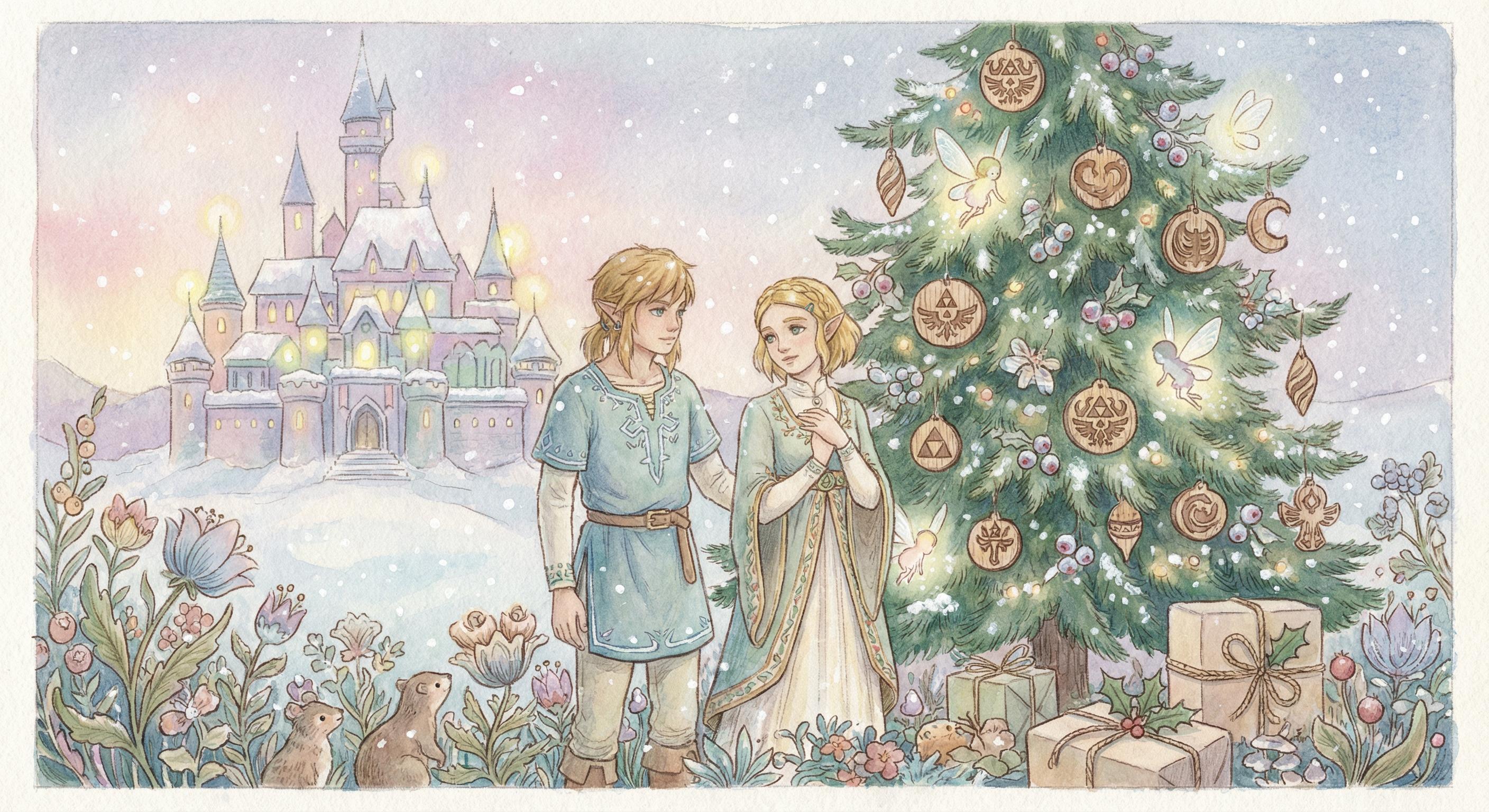
{The Legend of Zelda: Link and Zelda celebrate Christmas in Hyrule} illustrated in the whimsical romantic fantasy illustration style of Nancy Ekholm Burkert (b. 1933): {
Nancy Ekholm Burkert's work elevates illustration from mere accompaniment to an equal narrative partner—functioning not as secondary decoration but as a primary, integral element of the literary experience. This approach frames the world through the romanticized, hazy lens of a naïve yet hopeful observer, poetically portraying nature and society as congenial and welcoming. By inviting adventurous curiosity and an intimate voyage of self-discovery, the work suggests a whimsical, feminine melancholy that colors the narrative without obscuring its meaning. The resulting illustrations convey a liberating sense of intimacy and wonder, transforming the act of looking from discipline into delight.
This vision finds its philosophical anchor in the Flemish tradition of particularization—the rendering of specific, individualized forms in nature and character. Embracing the belief that particularization is the key to portraying the universal, the approach utilizes specific forms—their geographical uniqueness, cultural specificity, and identity markers—to evoke a resonating sense of place. Grounded in the artist's lived experience of each narrative's root culture, the methodology employs a psychoanalytical visual vocabulary distilled from years of research and on-location source materials. This pursuit of authenticity over assumption yields tableaux that etherealize immersive experience while remaining culturally anchored.
The approach adapts the tableau tradition of medieval art—specifically devotional panels and illuminated manuscripts—where narrative and symbol fuse within a single, unified pictorial field. This structural inheritance provides the armature upon which Burkert's modern sensibility builds.
Against the history of children's book illustration, Burkert's work offers dramatic relief from the tense, moralizing precision of Victorian imagery exemplified by John Tenniel (1820–1914). Where Tenniel's linework enforces rigid hierarchies and allegorical control, Burkert's softened palettes, compressed yet lyrical spatiality, and empathetic rendering invite readers into a world of curiosity and gentle discovery. The work emerges from a deliberate counterbalance to its historical foundations, pulling away from the heavy atmosphere of male-centric traditions toward a modern graphic playfulness rooted in technical mastery.
The work's structural lightness reimagines the 15th- and 16th-century Northern Renaissance by inverting its density. It adopts the compositional miniaturism of Rogier van der Weyden (1399–1464) and Hugo van der Goes (c. 1440–1482) but renders it airy; it employs the precision of Jan van Eyck (c. 1390–1441) but keeps it buoyant; and it expands upon the sprawling narratives of Pieter Bruegel the Elder (c. 1525–1569) with a breathy delicacy. Although the work departs from the stark chiaroscuro of Albrecht Dürer (1471–1528) toward a lighthearted modernism with surrealist translucency, it inherits from Dürer a symbolic concreteness that translates abstract ideas into seamlessly integrated visuals.
Against this gravity, the artist draws on the Golden Age of Illustration, channeling an Art Nouveau–inflected vertical elegance in the manner of Kay Nielsen (1886–1957). This provides a bridge to a more modern, evocative whimsy—one that departs from the frantic, boyish energy of Quentin Blake (b. 1932) in favor of lush, psychological escapism. Within this modern lineage, the work finds its emotional pulse through a synthesis of key influences: Eyvind Earle's (1916–2000) vivid, romantic atmosphere; Beatrix Potter's (1866–1943) feminine perspective of melancholic longing; and Maurice Sendak's (1928–2012) dreamlike, interior depth. It further echoes the inner-world turbulence of Arthur Rackham (1867–1939) while adopting the atmospheric, fluid compositions and nostalgic spatial qualities of E.H. Shepard (1879–1976).
This conceptual grounding in meticulous draftsmanship manifests through escapist daydreams and playhouse-like experimentation, yielding compositions reminiscent of theatrical stage sets. The narrative unfolds through surrealist arrangements and a melancholic, whimsical visual poetry that colors, rather than sacrifices, the integrity of the pictorial space—the tableau emerging as a vibrant crystallization of the playful creative process itself.
The composition conveys a flattened depth with a tapestry-like, narratively rich density, reminiscent of the spatial stacking and rhythmic ornamentalism found in Kay Nielsen, Japanese Ukiyo-e, and Gustav Klimt (1862–1918). It eschews deep, receding vistas in favor of a shallow stage that synthesizes the logic of Renaissance chiaroscuro with East Asian–influenced spatial articulation. This visual tension is balanced through static relief—intricate-but-soft patterning or large, airy negative spaces recalling the "breathing" characteristics of William Morris (1834–1896).
Beneath the dreamlike surface imagery, expressive strokes and abstract volumetric forms construct a modernist underdrawing that anchors each composition and frames the story. This structural scaffolding of planar logic establishes story tones at a glance—reminiscent of the abstract graphic compositions of British designer Paul Huxley RA (b. 1938). These foundational layers ensure that even the most complex surrealist arrangements remain grounded in legible, rhythmic clarity.
The illustration employs mixed media techniques combining colored pencil's fine linework and translucent layering with watercolor's soft washes and tonal depth. This pairing conveys luminosity, subtle color shifts, and atmospheric depth through a breezy, limited pastel palette. Layered through scumbling and broken-tone hatching—cross-hatching and stippling—the medium creates a haze-like tonal modulation that suggests stylish effortlessness and lost-in-thought intimacy.
These techniques produce crepe-paper–like tactile textures and soft gradients reminiscent of the lithographic work of Harold Altman (1924–2011), dissolving into a fog-like translucency akin to Arthur Rackham—but smoother. Fine, hairline linework and precise outlines lend delicate definition to the romanticized rendering. }