The Venetian Renaissance "Il Furioso" grand-vista style of Tintoretto (1518/19–1594): A monumental religion propaganda painting, and a humble artistic flex toward his peers. [Gemini Nano Banana Pro via LM Arena]
{The Legend of Zelda} illustrated in the Venetian Renaissance "Il Furioso" grand-vista style of Tintoretto (Jacopo Robusti; 1518/19–1594), specifically the monumental and complex series of fifty canvases painted between 1565 and 1587 for the meeting rooms of the Scuola Grande di San Rocco: {
More than humble craftsmanship, this work represents a deliberate artistic assertion against Tintoretto's chief rivals, Veronese (Paolo Caliari; 1528–1588) and Titian (c. 1488/1490–1576). To fully appreciate its significance, one must trace the conceptual foundations that inform its creation, examine the technical methods through which these ideas materialize, and finally observe how theory and technique converge in practical application.
Rooted in the rich tradition of Venetian colorism and oil painting, this work presents a monumental composite view infused with Mannerist dynamism and proto-Baroque theatricality—breaking away from the values of moderation and self-restraint prized by earlier generations of Venetians. At its philosophical core, the image embodies the essential "Feeling versus Reason" dialectic that defines the era's artistic discourse: a productive tension between Venetian colorito (emotional, painterly, gestural expression) and Florentine disegno (rational, planned, linear design). Where High Renaissance art emphasizes proportion, balance, and ideal beauty, Mannerism exaggerates these qualities to their extremes, resulting in compositions that are unnaturally elegant and charged with intellectual sophistication. This theoretical foundation, in turn, enables a synthesis of multiple artistic lineages: the dramatic, hyperbolic expressiveness (terribilità) and gestural intensity characteristic of Leonardo da Vinci (1452–1519); the anatomic rigor and bold, energetic design of Michelangelo's (1475–1564) Florentine disegno; and the painterly sensuality of Titian's Venetian colorito—where color and light serve as the primary vehicles of meaning. The synthesis further incorporates the atmospheric influence of Jacopo Bassano (Jacopo dal Ponte; c. 1510–1592) while anticipating the vivid tonal depth later realized by Caravaggio (1571–1610) and Dosso Dossi (c. 1486–1542). Such a fusion of distinct artistic schools establishes the conceptual scaffolding upon which specific technical methods and narrative strategies will be deployed.
Translating this conceptual foundation into material practice requires precise technical execution—from surface treatment and palette to figural articulation and compositional organization—achieved through meticulous planning via numerous preparatory drawings, bozzetti (oil sketches), and three-dimensional models. At the level of surface treatment, the work employs subtly impressionistic, rapid brushwork with visible brushstrokes and impasto patches that aspire toward Michelangelo's rational draughtsmanship while reveling in spontaneous gestural expression, complemented by luminous, sensual flesh tones and a crisp chiaroscuro depth reminiscent of Bassano. These structural forms are then bathed in a harmoniously vibrant, layered palette and a soft, atmospheric tonalità utilizing the purest pigments available to manifest the interlocking dynamics of a mythical pantheon. Moving to figural construction, the work deploys technically exacting, non-conventional momenti—thought-revealing mid-gesture poses engaged in diverse activities with almost insect-like urgency—and frequently employs acute, challenging instances of scorzo (foreshortening) within deliberately asymmetrical arrangements. Through such methods, the figures emerge as studies in contrast—ranging from muscular masculinity to voluptuous youth—monumental and charged with tension, rendered through twisting, foreshortened postures that demonstrate boldness in both conception and line. At the level of compositional structure, the work departs from the balanced, symmetrical hierarchies favored by earlier Renaissance masters to embrace a trademark dynamic complexity. Utilizing theatrical spatial arrangements defined by steep diagonal axes and swirling groupings, the scene generates a sense of movement that threatens to burst beyond the picture plane. These energetic clusters organize the vast tableau into cohesive yet self-contained narrative vignettes—each conveying a pivotal literary moment (the peripeteia or the kairos of the saga)—functioning as distinct dramatic episodes while contributing to a unified whole. This scenographic arrangement echoes the monumental grandeur of Veronese's architecturally staged canvases yet departs decisively from conventional Venetian theatrical stasis by privileging compositional tension and instability. Indeed, Tintoretto's painting practice—his rapid, layered brushwork, abrupt tonal shifts, and densely packed, contrapuntal figural groupings—maps directly onto sixteenth-century musical ideas of rhythmic drive, contrapuntal complexity, and chromatic experimentation; the canvas reads like a musical score where gesture supplies rhythm, color supplies timbre, and multiple narrative episodes function as interweaving melodic lines.
These technical strategies converge in their practical application to render the scene as an overwhelming, volatile moment reminiscent of a biblical drama's climax—emphasizing sudden, blinding divine revelation against human confusion. Beginning with spatial design, the composition employs an intensely dynamic and often compressed arrangement derived from Tintoretto's unique approach to perspective: influenced by theatrical stagecraft and his use of papier-mâché and wax models illuminated by candles to study light and shadow from various angles. Consequently, the work utilizes radical perspectives (di sotto in sù) and deeply saturated shadows akin to Caravaggio's tenebrism to center on a dramatic-but-elegant focal point, seamlessly reinforced through converging gazes, figural gestures, intense lighting, and spatial recession. Within this spatial logic, the figures are captured not in static, courtly decisiveness but in rapid, swirling motion—a "whirlwind of action"—their artificial, stylized poses privileging expressive intensity over naturalistic depiction. This dynamic formal language, enriched by Venetian colorito and propelled toward proto-Baroque theatrical spectacle, deliberately forsakes the static, linear sensibilities characteristic of the fifteenth-century Central Italian Quattrocento, instead maintaining a pristine command of chiaroscuro to propel the eye through a multi-fold narrative trajectory. The resulting visual dramaturgy, crafted with ingenious vision and expressed through decorative composition and captivating storytelling, creates a polyphonic composition with scenographic figural tableaux and continuous allegorical narrative—where spiritual turbulence manifests as emotionally intense, physically tumultuous activity, at times combining with literal depictions of figures from a spatially-distorting spiritual dimension. Executed in a highly florid manner befitting Mannerism's intellectual sophistication and intricately detailed in a manner reminiscent of Heinrich Aldegrever (1502–1555/1558), the scene transcends simple illustration. Through the integration of stylistic inheritance, formal innovation, and narrative intensity, the work achieves its primary objective: a cinematic, theatrical experience of visceral supernatural revelation designed to elicit profound awe, reverence, and hope.
}


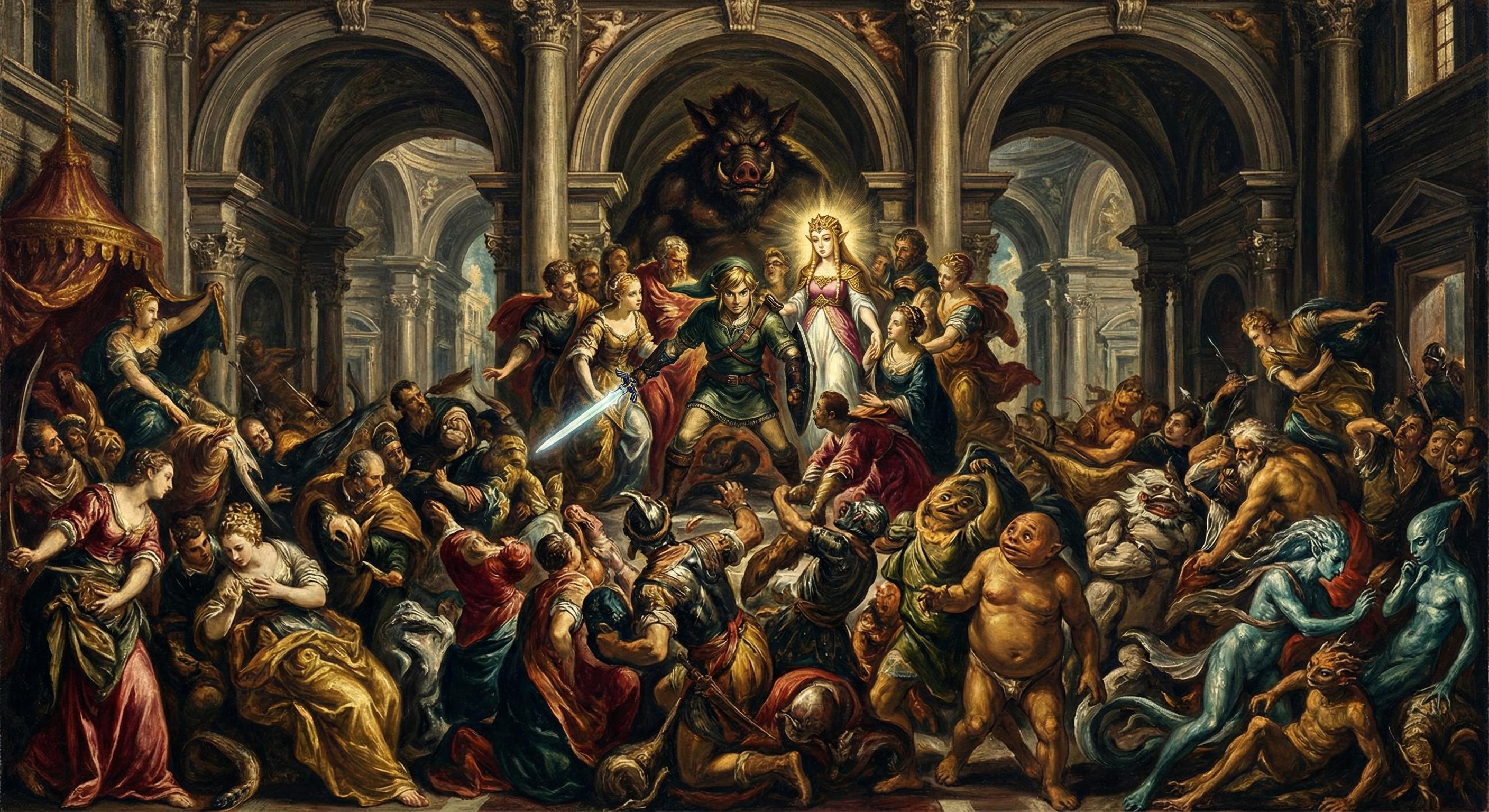
{The Legend of Zelda} illustrated in the Venetian Renaissance "Il Furioso" grand-vista style of Tintoretto (Jacopo Robusti; 1518/19–1594), specifically the monumental and complex series of fifty canvases painted between 1565 and 1587 for the meeting rooms of the Scuola Grande di San Rocco: {
More than humble craftsmanship, this work represents a deliberate artistic assertion against Tintoretto's chief rivals, Veronese (Paolo Caliari; 1528–1588) and Titian (c. 1488/1490–1576). To fully appreciate its significance, one must trace the conceptual foundations that inform its creation, examine the technical methods through which these ideas materialize, and finally observe how theory and technique converge in practical application.
Rooted in the rich tradition of Venetian colorism and oil painting, this work presents a monumental composite view infused with Mannerist dynamism and proto-Baroque theatricality—breaking away from the values of moderation and self-restraint prized by earlier generations of Venetians. At its philosophical core, the image embodies the essential "Feeling versus Reason" dialectic that defines the era's artistic discourse: a productive tension between Venetian colorito (emotional, painterly, gestural expression) and Florentine disegno (rational, planned, linear design). Where High Renaissance art emphasizes proportion, balance, and ideal beauty, Mannerism exaggerates these qualities to their extremes, resulting in compositions that are unnaturally elegant and charged with intellectual sophistication. This theoretical foundation, in turn, enables a synthesis of multiple artistic lineages: the dramatic, hyperbolic expressiveness (terribilità) and gestural intensity characteristic of Leonardo da Vinci (1452–1519); the anatomic rigor and bold, energetic design of Michelangelo's (1475–1564) Florentine disegno; and the painterly sensuality of Titian's Venetian colorito—where color and light serve as the primary vehicles of meaning. The synthesis further incorporates the atmospheric influence of Jacopo Bassano (Jacopo dal Ponte; c. 1510–1592) while anticipating the vivid tonal depth later realized by Caravaggio (1571–1610) and Dosso Dossi (c. 1486–1542). Such a fusion of distinct artistic schools establishes the conceptual scaffolding upon which specific technical methods and narrative strategies will be deployed.
Translating this conceptual foundation into material practice requires precise technical execution—from surface treatment and palette to figural articulation and compositional organization—achieved through meticulous planning via numerous preparatory drawings, bozzetti (oil sketches), and three-dimensional models. At the level of surface treatment, the work employs subtly impressionistic, rapid brushwork with visible brushstrokes and impasto patches that aspire toward Michelangelo's rational draughtsmanship while reveling in spontaneous gestural expression, complemented by luminous, sensual flesh tones and a crisp chiaroscuro depth reminiscent of Bassano. These structural forms are then bathed in a harmoniously vibrant, layered palette and a soft, atmospheric tonalità utilizing the purest pigments available to manifest the interlocking dynamics of a mythical pantheon. Moving to figural construction, the work deploys technically exacting, non-conventional momenti—thought-revealing mid-gesture poses engaged in diverse activities with almost insect-like urgency—and frequently employs acute, challenging instances of scorzo (foreshortening) within deliberately asymmetrical arrangements. Through such methods, the figures emerge as studies in contrast—ranging from muscular masculinity to voluptuous youth—monumental and charged with tension, rendered through twisting, foreshortened postures that demonstrate boldness in both conception and line. At the level of compositional structure, the work departs from the balanced, symmetrical hierarchies favored by earlier Renaissance masters to embrace a trademark dynamic complexity. Utilizing theatrical spatial arrangements defined by steep diagonal axes and swirling groupings, the scene generates a sense of movement that threatens to burst beyond the picture plane. These energetic clusters organize the vast tableau into cohesive yet self-contained narrative vignettes—each conveying a pivotal literary moment (the peripeteia or the kairos of the saga)—functioning as distinct dramatic episodes while contributing to a unified whole. This scenographic arrangement echoes the monumental grandeur of Veronese's architecturally staged canvases yet departs decisively from conventional Venetian theatrical stasis by privileging compositional tension and instability. Indeed, Tintoretto's painting practice—his rapid, layered brushwork, abrupt tonal shifts, and densely packed, contrapuntal figural groupings—maps directly onto sixteenth-century musical ideas of rhythmic drive, contrapuntal complexity, and chromatic experimentation; the canvas reads like a musical score where gesture supplies rhythm, color supplies timbre, and multiple narrative episodes function as interweaving melodic lines.
These technical strategies converge in their practical application to render the scene as an overwhelming, volatile moment reminiscent of a biblical drama's climax—emphasizing sudden, blinding divine revelation against human confusion. Beginning with spatial design, the composition employs an intensely dynamic and often compressed arrangement derived from Tintoretto's unique approach to perspective: influenced by theatrical stagecraft and his use of papier-mâché and wax models illuminated by candles to study light and shadow from various angles. Consequently, the work utilizes radical perspectives (di sotto in sù) and deeply saturated shadows akin to Caravaggio's tenebrism to center on a dramatic-but-elegant focal point, seamlessly reinforced through converging gazes, figural gestures, intense lighting, and spatial recession. Within this spatial logic, the figures are captured not in static, courtly decisiveness but in rapid, swirling motion—a "whirlwind of action"—their artificial, stylized poses privileging expressive intensity over naturalistic depiction. This dynamic formal language, enriched by Venetian colorito and propelled toward proto-Baroque theatrical spectacle, deliberately forsakes the static, linear sensibilities characteristic of the fifteenth-century Central Italian Quattrocento, instead maintaining a pristine command of chiaroscuro to propel the eye through a multi-fold narrative trajectory. The resulting visual dramaturgy, crafted with ingenious vision and expressed through decorative composition and captivating storytelling, creates a polyphonic composition with scenographic figural tableaux and continuous allegorical narrative—where spiritual turbulence manifests as emotionally intense, physically tumultuous activity, at times combining with literal depictions of figures from a spatially-distorting spiritual dimension. Executed in a highly florid manner befitting Mannerism's intellectual sophistication and intricately detailed in a manner reminiscent of Heinrich Aldegrever (1502–1555/1558), the scene transcends simple illustration. Through the integration of stylistic inheritance, formal innovation, and narrative intensity, the work achieves its primary objective: a cinematic, theatrical experience of visceral supernatural revelation designed to elicit profound awe, reverence, and hope. }