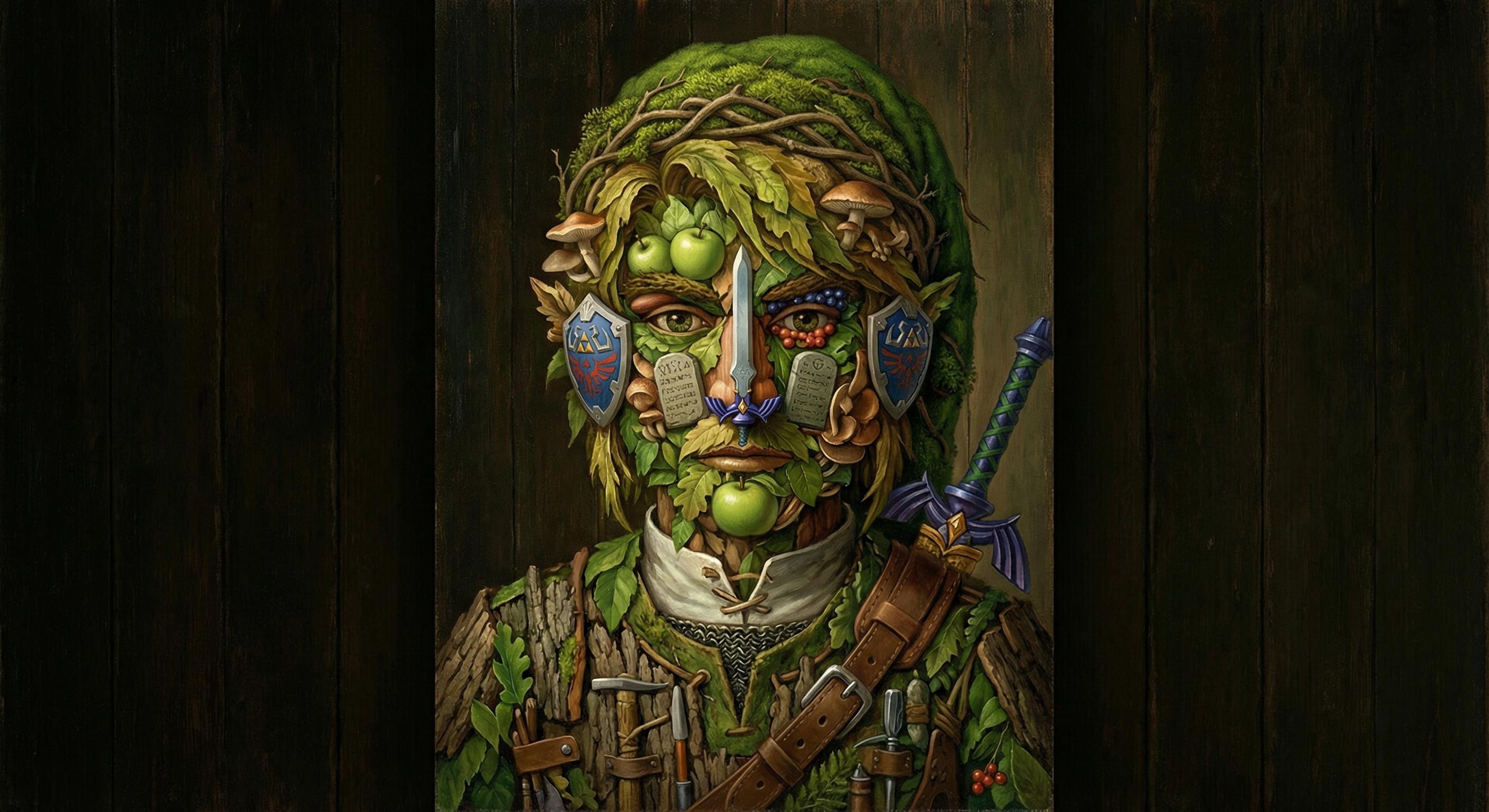
"Composite Heads" (teste composte) portrait style of Giuseppe Arcimboldo (1527–1593): Using complex double-image technique to create an allegorical editorial commentary. [Gemini Nano Banana Pro via LM Arena]
{Link (The Legend of Zelda)} illustrated in the “Composite Heads” (teste composte) portrait style of Giuseppe Arcimboldo (1527–1593): {
The "Composite Heads" (Teste Composte) of Giuseppe Arcimboldo represent a supreme intellectual feat of Mannerism, deliberately rejecting the rational harmony of the High Renaissance in favor of paradox and deep conceptual complexity signaling charming cleverness and wit. Rooted in the Aristotelian theory of the macrocosm and microcosm, these oil-painted, proto-Surrealist visual palindromes articulate a Renaissance Neo-Platonist view of unity between the natural world and humanity. The work channels the categorization obsession central to 16th-century alchemical research and occult studies—a visual encyclopedism aiming to uncover the secrets of nature and achieve universal harmony, exemplified by the Cabinet of Curiosities (Kunstkammer). Arcimboldo treats the human form not merely as a subject but as a whimsical, fantastical vessel for allegorizing nature, personalities, and abstract concepts through semantic arrangements of symbolic objects. By using double-image optical illusions that oscillate between portrait and still life, executed with miniaturist exactitude, he effectively editorializes the subject through a composite of visual allegories. This approach achieves large-scale compositional unity through segmented, modular assembly—akin to Byzantine mosaics—yet subverts expectation through the conceit of reversible imagery that can be read convincingly as both a unified face and a gathered set of objects. The resulting "gestalt" effect, where disparate elements resolve into a coherent whole, establishes a historical lineage bridging Leonardo da Vinci’s grotesque inventions with the anamorphic methods of Surrealists like István Orosz (b. 1951) and Octavio Ocampo (b. 1943), as well as the paranoid-critical methods of Salvador Dalí (1904–1989).
At the conceptual level, this technique fuses two distinct genres—still life and courtly portraiture—into a single composite form. It challenges the viewer’s perception, inviting playful engagement with the boundaries of facial recognition. The construction of these figures (whether in frontal, three-quarter, or profile pose) is driven by a rigorous semantic and semiotic selection process rather than mere anatomical convenience. Arcimboldo curates disparate, contextually resonant objects (fruits, animals, books, or symbolically charged emblems) whose collective associations metaphorically characterize the individual or anthropomorphize abstract concepts. The assemblage operates on multiple levels: as a literal depiction of natural specimens, as a metaphor for the unity of the cosmos, and as a vehicle for political or philosophical commentary. Beyond aggregate meaning, the specific anatomical placement of each object is directed to characterize the subject’s qualities analogously, drawing upon culturally resonant myths or lore to define a feature. These assemblages, often amplified through accentuated Mannerist distortions, transcend single-object symbolism to form compound allegories representing overarching themes such as the Seasons, the Elements, or the lifecycle. Importantly, meaning is carried by the objects' internal hierarchy and implied base context, producing a mnemonic density that rewards a sequential narrative reading. This masterful visual rhetoric equates compositional logic with the symbolic materialization of the subject's identity, yielding a meaning semantically richer than a traditional realist equivalent. The work’s built-in ambiguity actively invites irreconcilable responses—humor and discomfort, satire and homage—evolving from initial surprise toward a layered poetic decoding.
The successful execution of this illusion relies on technical mastery akin to the scientific precision and nuanced tonal distillation found in flora and fauna studies by contemporaries such as Jacopo Ligozzi (1547–1627), Jacques Le Moyne (c. 1533–1588), and Joris Hoefnagel (1542–1601). Arcimboldo exploits pareidolia—the human tendency to perceive faces in random patterns—by meticulously aligning objects to mimic facial morphology and physiognomic regions. He masters the suggestion of subcutaneous anatomy, producing a personality-bearing expression that remains legible despite the heterogeneity of the parts. This process involves a carefully orchestrated visual paradox: when viewed regionally at close range, each element retains trompe-l'œil hyper-realism and autonomy; when viewed holistically, the same objects are conformed through deliberate-but-subtle liquid perspectival warping, value calibration, and selective suppression of contrast to share a single facial lighting logic. Typically set against a dark, neutral background to enhance volumetric projection, the arrangement balances the legibility of discrete objects against the demands of anatomical cohesion. This structural rigor—attentive to visual weight and chiaroscuro modeling in a manner comparable to Francesco Melzi (1493–c. 1570) and Albrecht Dürer (1471–1528)—yields an emphatic facial conformation and a palpable physiognomy comparable to the psychological depth of masters like Johannes Vermeer (1632–1675), allowing the composite to function not merely as an optical trick but as a profound portrait built from meaning-bearing matter.
}


{Link (The Legend of Zelda)} illustrated in the “Composite Heads” (teste composte) portrait style of Giuseppe Arcimboldo (1527–1593): {
The "Composite Heads" (Teste Composte) of Giuseppe Arcimboldo represent a supreme intellectual feat of Mannerism, deliberately rejecting the rational harmony of the High Renaissance in favor of paradox and deep conceptual complexity signaling charming cleverness and wit. Rooted in the Aristotelian theory of the macrocosm and microcosm, these oil-painted, proto-Surrealist visual palindromes articulate a Renaissance Neo-Platonist view of unity between the natural world and humanity. The work channels the categorization obsession central to 16th-century alchemical research and occult studies—a visual encyclopedism aiming to uncover the secrets of nature and achieve universal harmony, exemplified by the Cabinet of Curiosities (Kunstkammer). Arcimboldo treats the human form not merely as a subject but as a whimsical, fantastical vessel for allegorizing nature, personalities, and abstract concepts through semantic arrangements of symbolic objects. By using double-image optical illusions that oscillate between portrait and still life, executed with miniaturist exactitude, he effectively editorializes the subject through a composite of visual allegories. This approach achieves large-scale compositional unity through segmented, modular assembly—akin to Byzantine mosaics—yet subverts expectation through the conceit of reversible imagery that can be read convincingly as both a unified face and a gathered set of objects. The resulting "gestalt" effect, where disparate elements resolve into a coherent whole, establishes a historical lineage bridging Leonardo da Vinci’s grotesque inventions with the anamorphic methods of Surrealists like István Orosz (b. 1951) and Octavio Ocampo (b. 1943), as well as the paranoid-critical methods of Salvador Dalí (1904–1989).
At the conceptual level, this technique fuses two distinct genres—still life and courtly portraiture—into a single composite form. It challenges the viewer’s perception, inviting playful engagement with the boundaries of facial recognition. The construction of these figures (whether in frontal, three-quarter, or profile pose) is driven by a rigorous semantic and semiotic selection process rather than mere anatomical convenience. Arcimboldo curates disparate, contextually resonant objects (fruits, animals, books, or symbolically charged emblems) whose collective associations metaphorically characterize the individual or anthropomorphize abstract concepts. The assemblage operates on multiple levels: as a literal depiction of natural specimens, as a metaphor for the unity of the cosmos, and as a vehicle for political or philosophical commentary. Beyond aggregate meaning, the specific anatomical placement of each object is directed to characterize the subject’s qualities analogously, drawing upon culturally resonant myths or lore to define a feature. These assemblages, often amplified through accentuated Mannerist distortions, transcend single-object symbolism to form compound allegories representing overarching themes such as the Seasons, the Elements, or the lifecycle. Importantly, meaning is carried by the objects' internal hierarchy and implied base context, producing a mnemonic density that rewards a sequential narrative reading. This masterful visual rhetoric equates compositional logic with the symbolic materialization of the subject's identity, yielding a meaning semantically richer than a traditional realist equivalent. The work’s built-in ambiguity actively invites irreconcilable responses—humor and discomfort, satire and homage—evolving from initial surprise toward a layered poetic decoding.
The successful execution of this illusion relies on technical mastery akin to the scientific precision and nuanced tonal distillation found in flora and fauna studies by contemporaries such as Jacopo Ligozzi (1547–1627), Jacques Le Moyne (c. 1533–1588), and Joris Hoefnagel (1542–1601). Arcimboldo exploits pareidolia—the human tendency to perceive faces in random patterns—by meticulously aligning objects to mimic facial morphology and physiognomic regions. He masters the suggestion of subcutaneous anatomy, producing a personality-bearing expression that remains legible despite the heterogeneity of the parts. This process involves a carefully orchestrated visual paradox: when viewed regionally at close range, each element retains trompe-l'œil hyper-realism and autonomy; when viewed holistically, the same objects are conformed through deliberate-but-subtle liquid perspectival warping, value calibration, and selective suppression of contrast to share a single facial lighting logic. Typically set against a dark, neutral background to enhance volumetric projection, the arrangement balances the legibility of discrete objects against the demands of anatomical cohesion. This structural rigor—attentive to visual weight and chiaroscuro modeling in a manner comparable to Francesco Melzi (1493–c. 1570) and Albrecht Dürer (1471–1528)—yields an emphatic facial conformation and a palpable physiognomy comparable to the psychological depth of masters like Johannes Vermeer (1632–1675), allowing the composite to function not merely as an optical trick but as a profound portrait built from meaning-bearing matter. }