"But I Did Eat Breakfast" is Actually a Smart Thing to Say
4Chan is stupid, and you're stupid for believing it

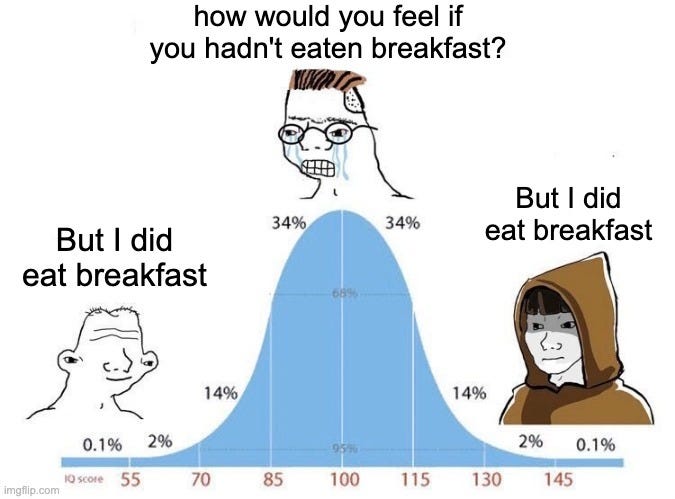
“But I did eat breakfast”.
If you’re the terminally online type, then you’re probably familiar with this phrase. This was once the flavor of the month Internet psyop (it came from 4Chan, so there’s a real chance some assholes in Langley or Tel Aviv seeded it, but I digress). To summarize, a bunch of corrections officers supposedly asked some prisoners the question: “how would you feel if you hadn’t eaten breakfast?” A lot of these prisoners would answer: “but I did eat breakfast”.
The point of the story is to show that these prisoners are so stupid (or “low IQ” in Internet-speak) that they can’t even conceive of counterfactuals.
If you want a quick primer on it, here’s a video courtesy of David V. Stewart:

I generally like Stewart, but I always felt he was naive in taking the story at face value, perhaps because it confirms his political biases. I said this not to cast aspersions on him, but because it’s basic human nature. Stewart was not the only one to have done this. Like I said, I personally doubt the veracity of the story. But that’s just me. Let us move on.
I’m sure there are people who are not smart enough to consider counterfactuals. However, I have come to the conclusion that “but I did eat breakfast” is a product of will, not capability. Let me explain:
Have you ever gotten yourself in an argument, and then your interlocutor made a good point. But instead of conceding that point, you dodged the implication of the argument by frustrating the other guy as much as you can; which of course, ends up making you sound ridiculous in retrospect?
I’m being abstract right now, so I’ll grab an example from the above video’s comments section, courtesy of lelseswhereleswhere94351:
A: “If you were this person (victim, perhaps a woman, etc), how would you have felt? If it was your sister or mother, how would you have felt?”
B: “But I’m not. And it’s not. Therefore, it can’t be wrong like that.”
The original commenter remarked that B can’t imagine the hypothetical that A put forward. I completely disagree.
It’s not that B couldn’t imagine the hypothetical, but that he refuses to.
So far, I made it seem like this is a bad thing. Indeed, some people are usually so stubborn that sometimes it’s best to just disengage. I’ve been in enough arguments, real life and online, to know when someone is just dodging the implication of my point.
However, this stubbornness can be a good thing. In the original 4Chan example, the question was asked to prisoners by corrections officers. This raises the question: why should a prisoner be expected to answer some random question posed by his jailers?
No, seriously. I’ve heard someone actually making the argument that it’s not that the prisoners are so stupid that they couldn’t conceive of hypotheticals, it’s that they’re wary of somebody asking such an out of the blue question and assumed that it’s some sort of a trap.
Perhaps it wasn’t a trap. Perhaps it was given whoever this asshole was, he decided to give away this information to the Internet. Either way, the point is that “they’re so stupid they can’t conceive of hypotheticals” is not the only explanation for this.
Now I understand hypotheticals well. And I get its use2. But you’d have to be as stupid as 4Chan thinks these prisoners are if you don’t think conditional hypotheticals can be weaponized.
I’ve seen this in basketball debates. You’ll see fans of LeBron James trying to argue that if he had been playing with the same teammates, coaches, conditions, etc. as Michael Jordan, then he would be the greatest basketball player of all time. Or they’ll argue that people would have respected the contrived “bubble championship” if anyone else other than Lebron and the Lakers had won it.
These arguments are tiresome and they relied on one magic word: if.
And it’s not just limited to sports. I’ve heard anti-colonialist arguments that goes along the lines of “if only [insert European country here] hadn’t colonized [insert third-world country here], then it would have been a first-world country”. Whether or not the argument is true is besides the point. The purpose is not discussion but rhetoric.
These lines of questioning can also get sinister. I’ve heard atheists asking Christians a question that goes along the lines of “what would you do if they found the deceased body of Jesus Christ?”
My answer to this question is simple: they didn’t and they won’t.
I guarantee that answer will shut them up good because the purpose of that line of questioning isn’t discussion but rhetoric.
Notice that you don’t hear such questions being asked about the invalidation of the claims of Judaism, Islam, Hinduism, and so on. For that matter, you don’t see this question being turned on the atheists: “what would you do if God appeared to you and affirmed Jesus Christ as His only begotten son?”
So sorry 4Chan, but I did eat breakfast3. Because in the immortal words of the great Rafael Nadal, if… if… if… doesn’t exist.

-Michael P. Marpaung
For the sake of the article, I assigned the quotes to hypothetical people I made up. But here’s the original comment:

In fact, I love hypotheticals so much that I used to be really into alternate history until I decided that alternate history is stupid because if the point-of-divergence is far away enough (I’d say a little over a generation), then history would have been so radically different that the human mind wouldn’t be able to conceive of it.
I actually did lol. Also, enjoy this meme because I don’t know where else to put it: