


No AI will ever compose Good Vibrations
On The Nature of Reality in the Information Age

Perfecting Equilibrium Volume Four, Issue 20
If I could see the sky above
And my mind could be set free
As wild white horses reach the shore
I’d stand alone and oversee
And if the bush before me burned
Should I turn my eyes away
And still the voices I can hear
As clear to me as light of day
I believed in my dreams
Nothing could change my mind
(Nothing could change my mind)
Now I know what they mean
How could I be so blind
The Sunday Reader, Oct 26, 2025
The tightrope walk between genius and madness was etched on tape and film as Brian Wilson created the song Good Vibrations.
Wilson didn’t have access to modern AIs like Suno to create his music. No worries; he had something much, much better.
He had the Wrecking Crew, the legendary troupe of session musicians who played on hundreds of Top 40 hits. The Good Vibrations crew included Glen Campbell on guitar, Carol Kaye on bass, and Hal Blaine on drums. They were musical chameleons who could play any song in any style; they were the band for the Righteous Brothers You’ve Lost That Lovin’ Feelin’, Richard Harris’ MacArthur Park, the Mamas & the Papas California Dreamin’, Frank Sinatra’s Strangers in the Night, Sonny and Cher’s The Beat Goes On, and the Beach Boys Help Me, Rhonda and California Girls.
The Wrecking Crew recorded MacArthur Park in two takes. So why did it take seven months to record Good Vibrations?
Because that’s how long it took to recreate the song that was already in Brian Wilson’s head.
There’s a great scene illustrating this in the movie Love and Mercy. Wilson describes the low thrumming he hears in his head to a pair of cellists, who try to recreate it.
All day. For dozens and dozens and dozens of takes. Until other Beach Boys melt down and storm out of the studio. Until finally the sound on the recording tape matches the sound in Brian Wilson’s head.
Now write a prompt for that.
We’ve discussed the fatal flaws in the design of Large Language Models – so called AIs – at length. Indeed, air has started leaking out of the bubble: Meta just laid off 600 employees from its “bloated” AI unit just months after engaging in wild bidding wars for AI talent.
AIs are doomed dinosaurs as we enter the Information Age

Perfecting Equilibrium Volume Four, Issue 12
But just like the Dot Com boom led to the Dot Bomb crash, which then led to the Internet boom of the past decade, there will be new Language Models and new AIs. (Hopefully, Data Object Language Models will be in the mix.)
And those new models will be tools, nothing more. They will be no more capable of composing Good Vibrations than those cellos, or the Electro-Theremin Wilson dragged into the studio.
That’s not how creativity works.
Every account of the creation of Good Vibrations is a recounting of a painful exorcism. Wilson heard the song in his head; the challenge was extracting what was going on inside his head and getting musicians to match the pure song he heard inside.
This story is the story of many of our greatest songwriters. Paul McCartney can be seen in all those Beatles videos trying to get his bandmates to play the songs he’d already heard in his head. One of his greatest songs, Let It Be, came to him in a dream.
But perhaps the best story goes unsurprisingly to Keith Richards, who kept a little cassette recorder by his bed. He got up one morning started noodling on his guitar, went to record what he was working on…and accidently hit PLAY.
And heard Satisfaction, which he has no memory of recording; he’d apparently written one of the most famous guitar riffs at some point during the night without knowing it.
Photography also works deep inside the brain. Photography is the art of envisioning, and then translating that vision into a physical image. It’s a process, a process that starts with noticing those details in the first place.
My photography education came from Ansel Adams. He created the Zone System for translating your vision into a finished image, and laid his system out in three books: The Camera; The Negative; and The Print. One of his key teachings is previsualization: the ability to see like a camera. Adams preached the need to practice with your equipment until your eyes see exactly the way the camera photographs.
My main camera is the Pentax K-3 Mark III Monochrome, which only shoots black & white images. It has an optical viewfinder, so I see the world through the camera as it is. And folks occasionally ask me if I wouldn’t prefer a mirrorless camera with an electronic viewfinder, so that when I look through that EVF I would see a monochrome world.
It’s the wrong question.
These days I’m always in that state of previsualization. My mind’s eye composes and exposes: black & white, high key, low key, high contrast…
So, yes, I carry a camera everywhere. But I do it to capture the previsualized photos that are my eyes have already snapped by the time I lift a camera to shoot.
I never met Diane Arbus; I was still in grade school when she died. And yet when I look at Child with a toy hand grenade in Central Park, N.Y.C. I know exactly what she was thinking and how it happened. She saw that boy, and that toy, and immediately saw this image in her mind. By all reports he was a sweet and agreeable child. Arbus’ contact sheet shows him smiling and goofing off for the camera.
It also shows her following him and fussing at him until he turned on her in exasperation.
That moment of exasperation at her is the famous photo that now hangs in Metropolitan Museum of Art in New York.
Is this image a slice of reality? Arbus created it; does that make it any less real?
What of this image of birds silhouetted by a setting sun that I chased across decades and a dozen states?

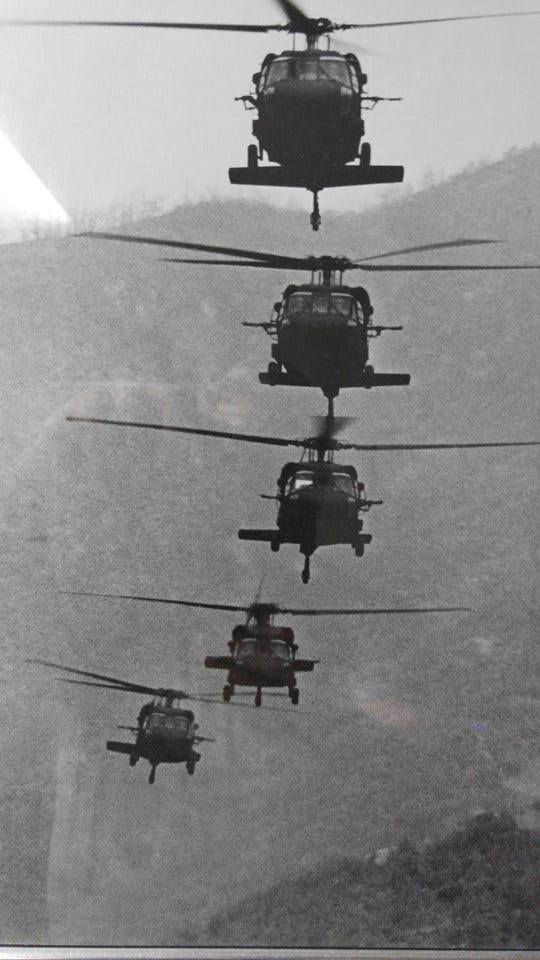
Or these helicoptors that I spent a morning waiting for in the Korean mud?

The great John Cole was taken aback by this video claiming that Google’s Nano Banana has replaced photography: Chris, plz tell me that he’s wrong!
He’s wrong, John. Indeed, this video is mislabeled clickbait.
Indeed, he makes my point. Look at the images he’s discussing. The point is not photography. The point is marketing. Product photography has been a tool for marketers for decades; now there’s a new tool available. Sure, it sucks if you’ve built a business as a product photographer. But it doesn’t mean you’re done. You are one tool on the marketer’s workbench; now there is another.
There have been drum machines for decades. Yet all over the world drummers will pull their stools up to their kits tonight and set the rhythm for their bands.
There have been synthesizers and vocorders and auto tuners for years and years and years. Yet all over the world today musicians will play and singers will sing. Some will program synthesizers and the latest AIs. Some will pound drums, an instrument older than recorded human history.
A tool is a tool is a tool. Use the one that’s best for the job.
So be at ease, John. AI is just one more tool for marketers; it doesn’t replace photography. And marketing is not photography; do you think Ansel Adams or Diane Arbus or Christopher J Feola ever previsualized an image of a bottle of hot sauce wreathed in flames?
(OK, there was that one time, but in my defense I’d been up all night drinking whisky and eating ghost pepper chili…)
Writers are even less likely candidates for replacement. While many songwriters hear new songs fully formed in their minds, most writers will tell you that writing is a process they use to work out what they think.
The truest thing that was ever said about writing was Scotty Reston’s lament during the Great Newspaper Strike of 1962, which killed four of New York’s seven newspapers: How do I know what I think if I can’t read what I write? The New York Times columnist was so depressed by the strike that he continued writing his Sunday column even though there was no place to publish it, and went on TV to read it aloud.
Scotty Reston could not have created a prompt for an AI to write his column, because he had no idea what the column would say until he’d written it.
So will AIs be just another tool for writers? Yes, just like research and notes and notebooks.
Tools are useful. There’s no need for fear.
And there is no need to fear we will program a creative AI because we have no idea how creativity works. Heck, we still have no idea how consciousness works, never mind advanced functions like creativity.

Creativity is how we shape reality. Good Vibratrions and Let It Be and Satisfaction and Child with a toy hand grenade in Central Park, N.Y.C. exist in the real world now because people envisioned them and brought them into being.
And we have no idea how that works.
The only thing we do know is that creativity is as wild and varied as the creators themselves.
Just ask Adrian Belew.
Belew’s big break came when Frank Zappa asked the guitarist to join his band. Zappa was an exacting composer and band master; every song had to be played note-for-note the way Zappa had written it. And Zappa wrote everything; when he wasn’t writing for the band he wrote symphonies. Belew later said it was like going to musicians’ school.
And then Belew joined David Bowie’s band.
Belew went from being expected to play the exact notes of the song as written to being locked in a sound booth and told to just go wild and play. Bowie refused to even let Belew hear the rest of the song, the lyrics, or any of the other instruments, or even tell him what key the song was written in. So Belew just played, and Bowie and producer Brian Eno took those recordings, cut them up, and wove them into the rest of the music into Lodger.
Zappa’s regimented work with Belew produced the double album Sheik Yerbouti; with over 2 million sold it’s Zappa’s biggest selling album.
Bowie’s boundaryless work with Belew produced the album Lodger, widely regarded as one of the most influential works of the 1970s.
We don’t know how creativity works. But we can see how it changes reality when it does work.
Here’s another image of birds silhouetted by a setting sun. It’s still not exactly the image that I see in my mind’s eye…so I guess I need to grab my camera and head out again.


>And there is no need to fear we will program a creative AI because we have no idea how creativity works. Heck, we still have no idea how consciousness works, never mind advanced functions like creativity.
I agree very much with the overall thesis of this piece, but I'm not sure this is a very strong argument, considering that LLMs are not so much the result of deliberate programming as a surprising accident of scale. The transformer architecture, which modern LLMs are based on, was originally developed for machine translation. LLMs arose from feeding way more data than ever before into this transformer architecture, and the results surprised everyone. We don't really understand how or why these things work as well as they do. So understanding how something works does not seem to be an essential prerequisite for creating it, in this realm at least.