
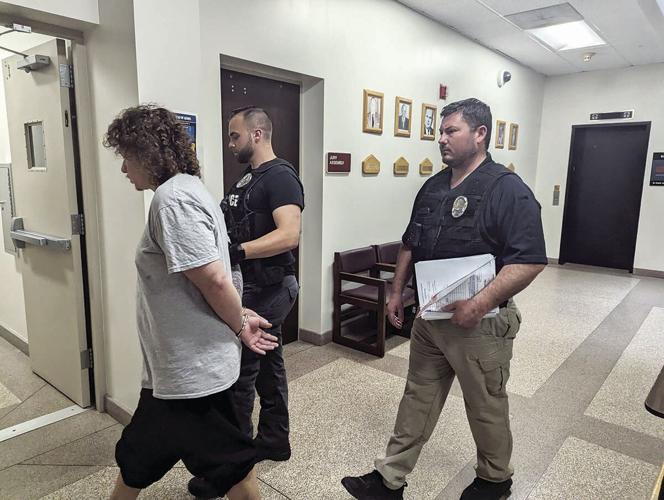


OSWEGO — Due for trial for murder in just two months, Ricky Colon sat in Oswego County Court on Dec. 2 listening to attorneys’ motions in his case.
The lawyers argued over whether the search warrant obtained by police on the night of the investigation was too broad in its scope and whether the motions should be heard at all.
Colon’s trial, for allegedly murdering Rachael M. Allen, 38, of Baldwinsville in July of 2024, was originally scheduled for April before it was pushed back to October, then February.
Michael Spano, Colon’s attorney, faced off against part-time Assistant District Attorney James McCarthy on the issues at hand on Dec. 2. First Assistant District Attorney Louis Mannara will be handling the trial. McCarthy, as he told Judge Armen Nazarian, is more of a researcher.
On the night Colon allegedly murdered Allen, police said he used his cellphone to access the Kayak app to search for cheap flights from New York to Florida.
Spano argued that the warrant was too broad, asking to search for information about the alleged murder that might be in Colon’s phone, without any temporal restrictions as to when it got there.
Webster’s Dictionary defines temporal as “of or relating to time.”
Nazarian asked McCarthy if he was missing something.
McCarthy cited several cases stating that when information got into a phone matters less when weighed against the severity of the crime.
“This is a murder, judge — well, an alleged murder,” McCarthy said, correcting himself.
After plenty of back and forth among Nazarian, Spano and McCarthy about where certain information is stored on a phone, IP addresses and website information and whether the warrant allowed them to search for it, Nazarian asked McCarthy if he knew how the police came by the information about the Kayak search.
Nazarian said it looked like the Kayak app was open on Colon’s phone, according to information from the scene of the crime.
Spano compared the police discovery of the Kayak search and other information gleaned from Colon’s phone to “looking for a flat-screen TV in a medicine cabinet.”
McCarthy said Spano’s analogy would be like saying police need a search warrant for every room in a house to search the house.
McCarthy deferred to Mannara and Senior Assistant Matt Bell, both in the courtroom, as to how that information was gathered.
Nazarian asked prosecutors if they knew what led officers to the Kayak app on Colon’s phone.
The officer who obtained the flight information should provide the court how he came by the information, Nazarian said. The judge asked Mannara if he knew which individual supplied the information and would he sign an affidavit as to how he came by it.
“Judge, we will in fact seek and acquire that information and supply it to the court,” Mannara said.
Nazarian said he was going to reserve his decision on the motions until that evidence is presented to him. The following issues that came up Tuesday will be in consideration when the case continues: The lack of temporal restrictions on the search warrant, whether a Mapp hearing is necessary for the results of the affidavit and whether the information would’ve been inevitably discovered.
A Mapp hearing is a pre-trial hearing in which a judge decides whether to let in or exclude physical evidence.
Nazarian ordered Mannara and Spano to have their findings on the issues by Jan. 9. The group will reconvene Jan. 16 at 9 a.m. to argue their cases.
The hearing opened with prosecutors stating that Spano’s motions should be waived as they should’ve already been argued.
Colon is facing charges of second-degree murder, first-degree assault, third-degree criminal possession of a weapon and tampering with physical evidence.
Colon is accused of hitting Allen with a stove top grate, moving her body and burning her clothes before calling 911 to report an overdose on July 13. One of the issues that came up on Dec. 2 concerning Colon’s phone was how long he took to call 911.
Police and firefighters responded to Colon’s West Schuyler Street house and found Allen dead in a bathtub.
According to court documents, Colon told first responders that he came downstairs, found Allen on the kitchen floor and dragged her into the tub to try to revive her.
But authorities said in documents that Colon had moved Allen’s body, washed away the blood and disposed of Allen’s clothing and other items related to the crime by setting them on fire and then throwing the charred remains of evidence over a fence and onto a neighboring property.





Commented
Sorry, there are no recent results for popular commented articles.