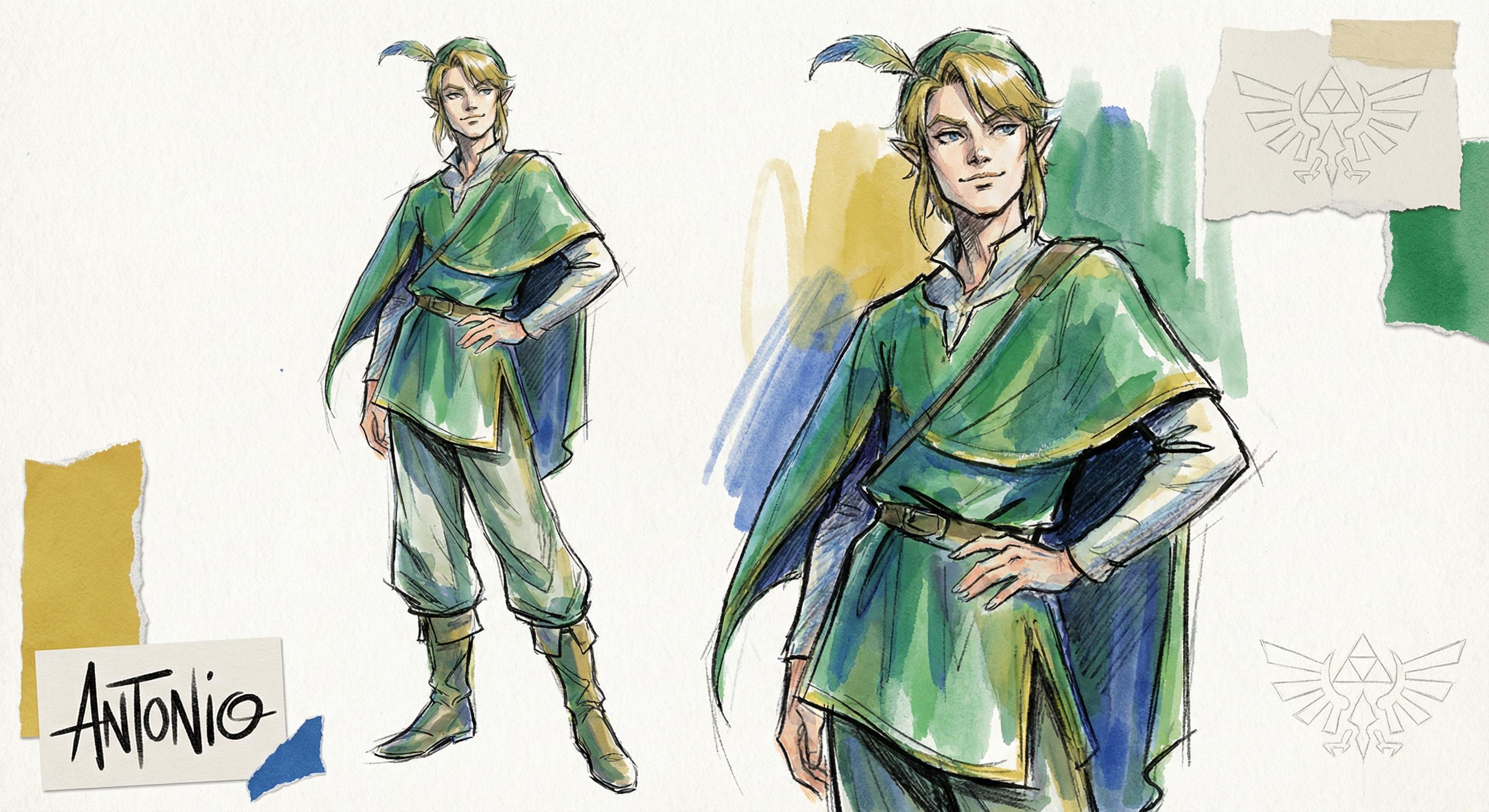
Fashion sketch style of Antonio Lopez (1943–1987): A Pop Expressionist marker illustration showcasing effortless glamour with unapologetic inclusivity. [Gemini Nano Banana Pro via LM Arena]
{Link (The Legend of Zelda)} illustrated in the fashion sketch style of Antonio Lopez (1943–1987): {
This Pop Expressionism style is defined by an aesthetic of gestural contour drawing with key-chroma selective chromatic wash, achieving a subtle expressionist, gestural dynamism—the looseness of contouring linework and deliberate partial, loose color shading animates the figure, conveying movement and defining form while paralleling the effortless cool of its subjects. This aesthetic was the product of the collaborative 'ANTONIO' signature (Antonio Lopez as illustrator/virtuoso and Juan Ramos as art director/theorist), ensuring the drawings possessed the necessary intellectual rigor—rooted in Ramos's knowledge of art history and color theory—to transcend mere commercial sketching. This visual strategy distills fashion into an essential, streamlined language, treating fashion personas as narrative canvases that capture the interconnected, deep extensions of lifestyle, personality, and culture. Rather than merely documenting or repurposing existing visual semantics, the approach grasps alluring qualities from the entire spectrum of visual culture—traditional, modern, and underground—translating their core desires and appeals into universal, dynamic concepts that break the myopic ethnic stereotyping rooted in mainstream commercial imagery. By empathizing with avant-garde design trends, this approach functions as prophetic cultural commentary, illuminating resonant aspirations rooted in universal values of unfettered self‑expression and unapologetic identity—a vision that actively influenced major design houses through its profound, authentic connection to multicultural underground scenes. Channeling the infectious, crowd-inviting energy of 1970s psychedelic art, fashion magazine covers, hip-hop dance culture, and the soul and rock music of the era, the work synthesizes these influences into a singular artistic vocabulary of aspirational visual storytelling, inflected with surrealism-inspired decorative artistic freedom.
The fashion figure echoes the idealized sensual silhouettes of Tom of Finland (1920–1991) while assuming gender-expressive body language with stylish yet believable gestures reminiscent of candid fashion photography by Bill Cunningham (1929–2016)—poses that serve as markers for aspirational, glamorous chic social circles full of offbeat, fun personalities, showcasing unpretentious, sleek personal styles reflecting a vibrant lifestyle akin to the designs of Geoffrey Beene (1924–2004) and Anne Klein (1923–1974). This overall aesthetic is reinforced by a hybrid, mixed-media methodology, integrating meticulous traditional drawing (using pencil, ink, charcoal, and watercolor, including a 'composite pencil' for intense chiaroscuro) with the raw immediacy of fashion moodboard collage, which bridges illustration and photography by offering a sense of documentation and real-time captures. The composition originates from a spatial grid underdrawing, subsequently rendered with Cubist-infused streamlined linework that distills multi-perspectival complexity into an easily readable yet non-reductive aesthetic; guided by Gesamtkunstwerk sensibilities, the composition achieves a semantically dense yet lightweight reading through essentialized, sparse arrangement. Mastery of fashion silhouette translates into airy gestural calligraphy—possessing the semiotic precision of modernist typography—conveying rich, fantastical fashion narratives with aspirational appeal through efficient, sparse semiotics that mirror the chill atmosphere and genuine effortlessness of the subjects. Confident, clean strokes of modulated intensity and romanticized looseness create gesturally expressive contours and patterns with defined focal points and visual flow. These are complemented by highly selective, painterly shading in an evocative, sensory limited color palette—rendered as partial, loosely applied solid color planes or directional hatching with broad marker strokes and tonal-depth gradations—realizing the subtly expressionist ephemerality and gestural dynamism that animate form and embody the subjects’ self-absorbed naturalism.
}
Sources
Meet the queer Latino illustrator who brought breakdancing to the Fashion World — VICE, July 23, 2016


{Link (The Legend of Zelda)} illustrated in the fashion sketch style of Antonio Lopez (1943–1987): {
This Pop Expressionism style is defined by an aesthetic of gestural contour drawing with key-chroma selective chromatic wash, achieving a subtle expressionist, gestural dynamism—the looseness of contouring linework and deliberate partial, loose color shading animates the figure, conveying movement and defining form while paralleling the effortless cool of its subjects. This aesthetic was the product of the collaborative 'ANTONIO' signature (Antonio Lopez as illustrator/virtuoso and Juan Ramos as art director/theorist), ensuring the drawings possessed the necessary intellectual rigor—rooted in Ramos's knowledge of art history and color theory—to transcend mere commercial sketching. This visual strategy distills fashion into an essential, streamlined language, treating fashion personas as narrative canvases that capture the interconnected, deep extensions of lifestyle, personality, and culture. Rather than merely documenting or repurposing existing visual semantics, the approach grasps alluring qualities from the entire spectrum of visual culture—traditional, modern, and underground—translating their core desires and appeals into universal, dynamic concepts that break the myopic ethnic stereotyping rooted in mainstream commercial imagery. By empathizing with avant-garde design trends, this approach functions as prophetic cultural commentary, illuminating resonant aspirations rooted in universal values of unfettered self‑expression and unapologetic identity—a vision that actively influenced major design houses through its profound, authentic connection to multicultural underground scenes. Channeling the infectious, crowd-inviting energy of 1970s psychedelic art, fashion magazine covers, hip-hop dance culture, and the soul and rock music of the era, the work synthesizes these influences into a singular artistic vocabulary of aspirational visual storytelling, inflected with surrealism-inspired decorative artistic freedom.
The fashion figure echoes the idealized sensual silhouettes of Tom of Finland (1920–1991) while assuming gender-expressive body language with stylish yet believable gestures reminiscent of candid fashion photography by Bill Cunningham (1929–2016)—poses that serve as markers for aspirational, glamorous chic social circles full of offbeat, fun personalities, showcasing unpretentious, sleek personal styles reflecting a vibrant lifestyle akin to the designs of Geoffrey Beene (1924–2004) and Anne Klein (1923–1974). This overall aesthetic is reinforced by a hybrid, mixed-media methodology, integrating meticulous traditional drawing (using pencil, ink, charcoal, and watercolor, including a 'composite pencil' for intense chiaroscuro) with the raw immediacy of fashion moodboard collage, which bridges illustration and photography by offering a sense of documentation and real-time captures. The composition originates from a spatial grid underdrawing, subsequently rendered with Cubist-infused streamlined linework that distills multi-perspectival complexity into an easily readable yet non-reductive aesthetic; guided by Gesamtkunstwerk sensibilities, the composition achieves a semantically dense yet lightweight reading through essentialized, sparse arrangement. Mastery of fashion silhouette translates into airy gestural calligraphy—possessing the semiotic precision of modernist typography—conveying rich, fantastical fashion narratives with aspirational appeal through efficient, sparse semiotics that mirror the chill atmosphere and genuine effortlessness of the subjects. Confident, clean strokes of modulated intensity and romanticized looseness create gesturally expressive contours and patterns with defined focal points and visual flow. These are complemented by highly selective, painterly shading in an evocative, sensory limited color palette—rendered as partial, loosely applied solid color planes or directional hatching with broad marker strokes and tonal-depth gradations—realizing the subtly expressionist ephemerality and gestural dynamism that animate form and embody the subjects’ self-absorbed naturalism.
}