2


Photo-screenprinting Pop-Art style of Andy Warhol (1928–1987): Uses screenprinting's serial degradation for abstract expressionism paradoxically critiquing mass media consumerism while engaging with its shallow glamour appeal. [Gemini Nano Banana Pro]


2
100% Upvoted
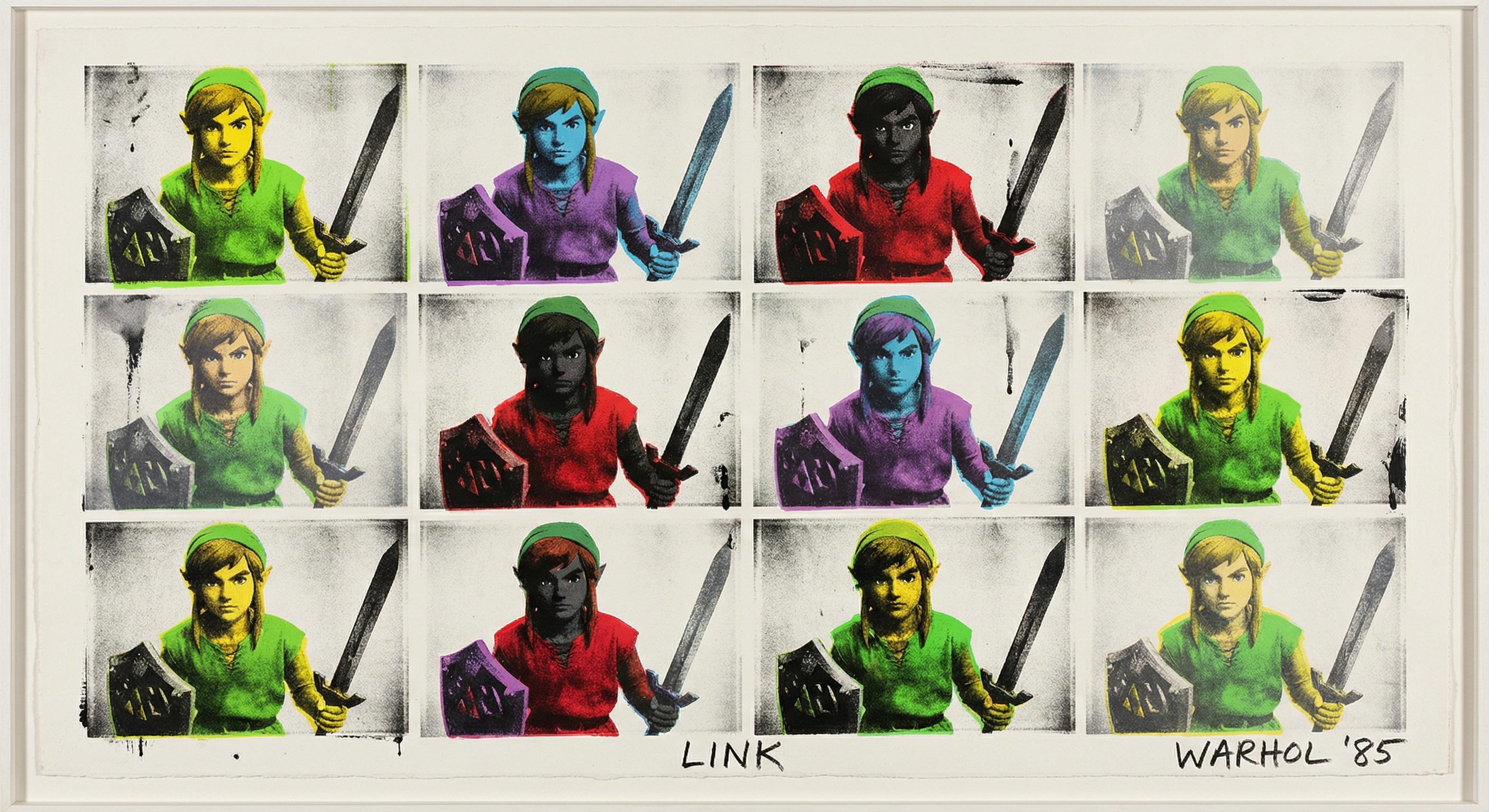
{Link (The Legend of Zelda)} illustrated in the photo-screenprinting Pop-Art style of Andy Warhol (1928–1987): {
The artwork mimics mass media's indifference toward cultural icons reduced to commodities, juxtaposing the paradoxical allure of consumerism with spiritual emptiness and emotional desensitization. Through the mechanized language of serial repetition, the work employs banality as a deliberate strategy—exposing the commodification of art that objectifies and trivializes human connections, while forcing viewers to confront their complicity in an apathetic consumer culture fueled by mass media.
This critique targets a culture implicated in celebrity tragedies such as those of Marilyn Monroe and Jackie Kennedy. The work subconsciously mirrors the dehumanizing commercialization it indicts through its own exploitation of iconic imagery, including Catholic images appropriated for personal and commercial gain. In doing so, it expresses a weary disillusionment with worldly aspirations that have repeatedly failed society, while paradoxically affirming prophetic warnings embedded in religious tradition regarding materialism and idol worship. Influenced by Neo-Dada's embrace of chance and British Pop Art's mass-media appropriation, the approach functions simultaneously as a parody of the American Dream and a direct critique of the desensitization and moral decay pervading increasingly commercialized postwar America.
By accumulating repetitive images into a single field—analogous to Marie Kondo's method of grouping belongings to reveal their abundance—the piece viscerally exposes the sheer volume of excess and the cheapening effect of dilution, while simultaneously celebrating the beauty of graphic precision and messaging immediacy akin to Edward Ruscha (1937–). Yet this same seriality generates surreal horror through its inhumane monotony: emotional disconnect emerges from lost context, uncanny one-dimensionality, manufactured expressions, and automation's indifference. Progressive image degradation—toward defective prints commonly rejected in industrial Quality Control—mirrors the military-like ruthless disposability of celebrity as stardom's vitality fades. This iterative decay parallels decaying corpses or diminishing ghosts: presence progressively voided of substance.
The artwork's commercial success—achieved with populist self-awareness—ironically validates its own critique, completing a conceptual loop wherein the work simultaneously participates in and indicts the very systems it interrogates. This auto-cannibalistic dynamic renders the piece both artifact and analysis: a commodity that theorizes its own commodification.
Inspired by Ray Johnson (1927–1995), identical photographic compositions repeat in a condensed, grid-like arrangement, producing an all-over field resembling a photographer's contact sheet or film strips placed side by side. This rhythmic seriality—marked by hasty misalignment and imperfection—evokes both the relentless, grinder-like pace of urban consumer existence and the inexorable progression of biographical aging. Each pictorial unit functions as a time capsule, editorially framed through its color-blocked background. Controlled variations across the series convey sequential storytelling and dramatic juxtaposition through symmetrical relationships, implied modulations, and subtle transformations.
The process generates a complex visual vocabulary fusing pop-urban-decay stylization with a hybrid of handmade and mass-produced aesthetics. This synthesis draws upon the encaustic materiality of Jasper Johns (1930–), the raw expressionistic urgency of Jean-Michel Basquiat (1960–1988), and the combinatory image-layering of Robert Rauschenberg (1925–2008). Influenced by the dramatic energy of punk-rock culture, this symbolic approach employs sequential, filmstrip-like repetition featuring garish, iridescent color fields punctuated by droll markings within transparent, color-blocked backgrounds rendered in a high-contrast noir-grit palette. Screenprinting variations—ranging from colorless monochrome to vivid saturated hues with psychedelic visual weight, sequentially modulated through rhythmic saturation shifts—employ either anatomically contoured blocking or flat application. This chromatic intensity—inspired by the psychedelic pop kineticism of Frank Stella (1936–2024)—undercuts political propaganda's formality with a flamboyance befitting celebrity culture.
The work employs screenprinting as both technique and conceptual vehicle, deliberately preserving the process's imperfect registration marks, ink variations, and mechanical artifacts as expressions of abstract expressionism. These controlled accidents—achieved through inconsistent manual squeegee pressure, screen clogging, variable ink viscosity, and misalignment during both photo-emulsion exposure and print registration—produce progressive loss of fidelity, depth, and shadow detail across successive image transfers. This Xerox photocopy-like degradation draws parallels to the high-contrast fashion photography of Eugene Korman (1897–1978), effecting a gradual streamlining of persona devoid of human depth and frailty: a mythic brand detached from its original personality. The variation and degradation of screenprinted inks further evoke Arthur C. Danto's concept of ink-blot naturalism and the gestural immediacy of Jackson Pollock, wherein accident becomes authorship. }