

Why I Write About the Jews
Or how hollow rage is incinerating everything we cherish

I know this place has been very Jew-heavy lately. I owe you an explanation for that, and a reassurance: I have no desire to make this my permanent beat. My ideal outcome is that this topic stops being relevant enough to write about.
This essay is about what happens when a political movement becomes immune to accountability. When the guy next to you at a rally is screaming genocidal slogans, and you convince yourself there must be some charitable explanation. When intelligent people build elaborate scaffolding to rationalize the unjustifiable. When people convinced they’re fighting for justice become incapable of recognizing the carnage they’re causing.
It’s not about Israel/Palestine itself. Rather, it’s about how reactions to the issue are corroding institutions and revealing dangerous pathologies. What happens in Gaza is beyond almost anyone’s control; what happens to kosher delis, universities, and civic discourse around us is not.
1. The Con
The first thing to re-establish is the motte-and-bailey duality within the contemporary “pro-Palestinian” movement, which I’ve extensively written about. It’s an incoherent buddy comedy where someone chanting for “peace and human rights” can stand shoulder to shoulder with someone else calling for “mass violence and extermination” and both insist they are part of the same cause:
The unabashed loons braying for the complete destruction of Israel could take cover behind the normies who showed up to protests simply because they hated seeing pictures of dead kids on their Instagram feed. Kind of like human shields.
I’m not going to argue about proportions, partly because the methodology is unclear, thorny, and dull, but also because it doesn’t matter. The problem isn’t the specific fraction of lunatics, but rather whose behavior defines the boundaries of what’s acceptable.
Moreover, this problem isn’t confined to an inconsequential fringe. One of the movement’s cause célèbre, Mahmoud Khalil,1 openly justified October 7th as a “desperate” attempt to avert Saudi normalization, handed out flyers from the “Hamas Media Office”, and served as spokesman and negotiator for CUAD — a coalition of over a hundred student groups that publishes glowing hagiographies of Yahya Sinwar.
Now imagine a world where the public face of this movement looked different. Imagine if Rashida Tlaib, literally the highest‑ranking Palestinian legislator in the United States, chose to align herself with anyone other than Hasan Piker, the largest political streamer on Twitch and an unapologetic endorser for terrorism. Imagine if, instead of reflexively blaming Israel for every atrocity committed by Palestinian terrorists, she took one minute to say: “Those who celebrate, condone, or excuse terrorism have no place in our movement. We are a humanitarian movement that disavows violence.”
Imagine if no one chanted about Khaybar, because what does the massacre of a Jewish city by Muslim forces in the year 628 CE have to do with Palestinian liberation today? Imagine if no one romanticized Intifada, because why would any human rights activist conjure up the period of time where children’s television shows were extolling the virtues of suicide bombings?
Imagine if Jewish Voice for Peace didn’t celebrate violence against Jews!
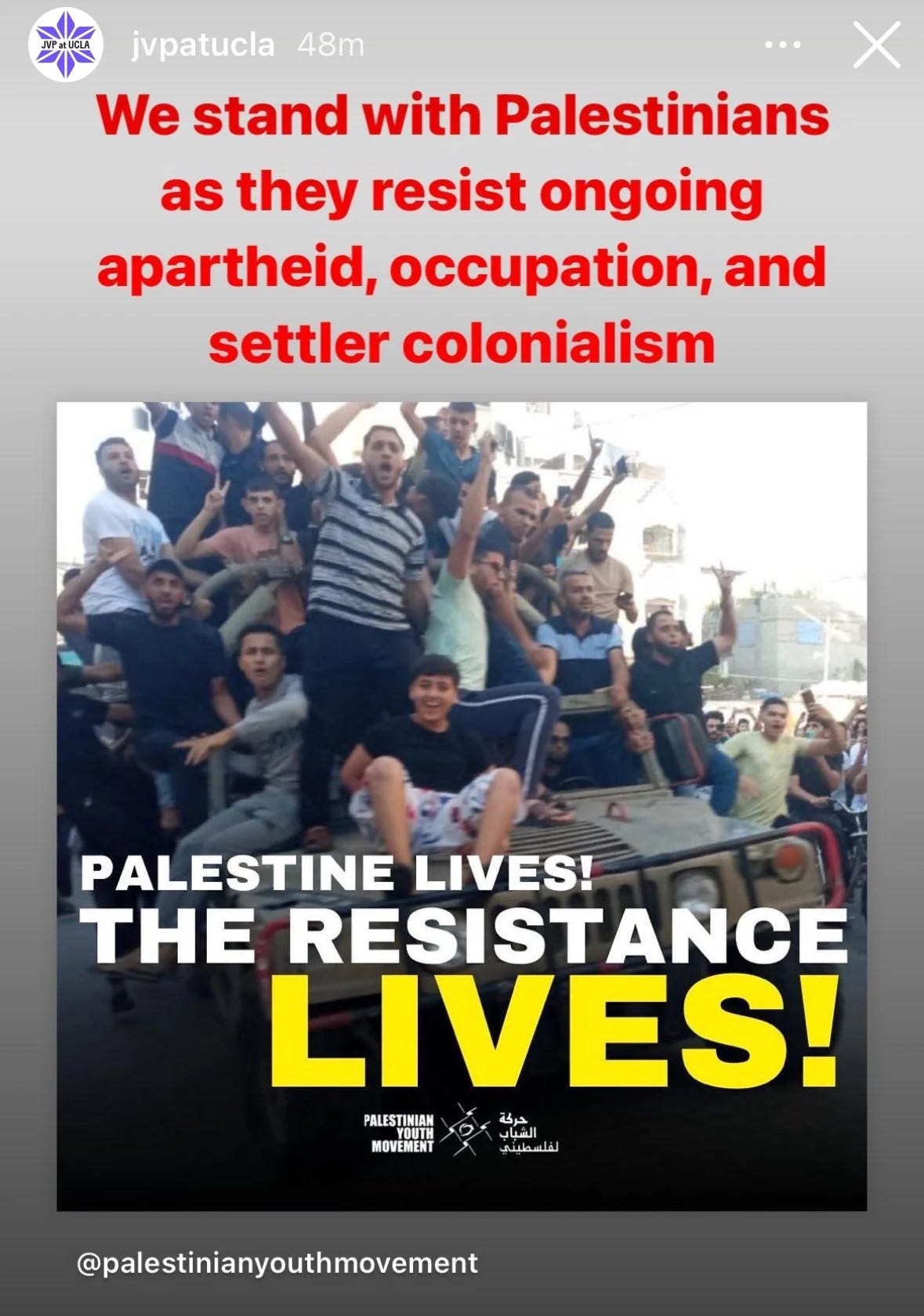
If any of that were true, it would be strong evidence that, yes, while there are plenty of crazies, at least the leadership is trying to steer things toward sanity. It would show a visible effort to push the movement’s center of gravity away from bloodlust and toward genuine concern for Palestinian lives.
We do not live in that reality.
Pause and consider how insane this is. Imagine if Greenpeace was infiltrated by human-extinction advocates holding “KILL ALL HUMANS” signs at rallies. Imagine if the NAACP had a vocal contingent calling for race war, and the organization’s response was to shrug and say “big tent, you know?”
If you suspect this is just a cranky hit piece from someone who hates protest on principle, I’ve already written the opposite essay: a blueprint for what a sane, genuinely pro-Palestinian movement would look like.
At this point, decent people face a choice. If you’re earnestly interested in advancing Palestinian wellbeing, you have an obligation to distance yourself from those who are not. Obvious, no? That doesn’t just mean condemning Hamas, it means disavowing their cosplaying cheerleaders. You either draw a bright line against agitating for violence or…you play along and pretend there’s nothing to see.
The con works because it’s so audacious. It serves the same filtering function as the spelling errors in Nigerian email scams: screening for marks primed to suppress their own cognitive dissonance. When you show up to a protest and the guy next to you is chanting genocidal slogans, it’s uncomfortable. A decent person doesn’t want to believe they’re complicit. So they deny. They sanewash. They invent alternative interpretations that let them stay in the group without confronting what others actually want.
After all, who would lie that openly? Who chants Falasteen Arabiya (“Palestine will be Arab”) then sanitizes it in translation as “Palestine will be free”? Who frames calling for an Intifada — a campaign of suicide bombings that sent mentally disabled teenagers onto Jerusalem school buses with explosives strapped to their chests — as a “a desperate desire for equality and equal rights”?
Who could possibly be that dishonest? Surely there must be some charitable explanation.
2. The Enablers
The dumb are gullible for obvious reasons, but paradoxically, intelligent people fall prey to more sophisticated cons. These aren’t the useful idiots who fall for the con, they’re the smart ones who know better but construct elaborate justifications anyway.
According to
, the best guard against this pitfall is the symbiotic remedy of both curiosity and humility. Absent that combination, brilliance becomes a liability — smart people simply build more elaborate scaffolding to support their delusions or dishonesty. One conspicuous tell is how terrified they are to have any of it examined in real time.My essays on Israel have generated torrents of written outrage. Concordant with sound epistemic hygiene, I’ve offered dozens of critics an unvarnished opportunity to herald my errors for the world to see. The response rate has been close to zero. They’ll hoot and holler behind the safety of a keyboard, but the moment you ask them to defend those ideas in a format where they can’t edit, revise, and retreat into rhetorical obfuscation, they vanish.
The aversion to real-time scrutiny reveals two distinct pathologies among intelligent enablers: sophisticated obfuscation and sophisticated rationalization. I’ll use two people as case studies here just because I had a front-row seat to how this works in practice.
Sam Kriss is a paradigmatic case: a genuinely gifted prose stylist whose flourish functions as camouflage for intellectual emptiness. Others have noticed how he’s perfected the trick of saying nothing, beautifully, and relying on readers to mistake opacity for depth. He’s fully aware that his prose can’t save him in real-time, investing far more energy in avoiding a conversation than having one.2 It’s a cowardly phobia he desperately masquerades as sophistication.
Sophisticated obfuscation is one way to cope with cognitive dissonance; another is to rationalize ever more baroque horrors. The only person who ever agreed to discuss this topic with me, Robert Farrell, is a picture of the latter. By his own account he’s spent over twenty-five years obsessed with Palestine and sent me a fifty-six-page bibliography of his own making before we spoke. There is no doubt he “knows” far more than I ever will.
Robert is also a verifiable lunatic, opening with an astounding deny-and-defend performance. He simultaneously denied that children were ever used as suicide bombers while also explaining that all the teenagers caught with explosive vests at Israeli security checkpoints were merely couriers — simply one link in the greater logistical chain of ferrying explosives to blow up discotheques.
You see, I’m the one who is deluded for assuming children were used in chain link A rather than simply chain link B. I urge you to listen to the full exchange in context if you doubt any of my retelling.
But to his credit, at least he showed up. He was willing to have his ideas tested without a delete button, and in the process transparently exposed the derangement of his own worldview.3
What unites both types is their sophistication. Kriss wields obfuscation; the madman wields rationalization. Both are intelligent enough to construct elaborate justifications for the unjustifiable. Both understand, at some level, that their positions cannot survive unmediated examination.
3. All Raged Up & Nowhere To Go
This is the ecosystem: advocates openly calling for violence, useful idiots who’ve been screened to deny what’s happening right in front of them, and intelligent enablers providing sophisticated cover for both. Each component reinforces the others.
You’ve mixed up a vial of nitroglycerin. You’ve whipped up an angry mob. You’ve packed a blunderbuss with shrapnel and sulfur. Now where do you point it?
Activism of any kind relies on imploring others to pursue concrete calls to action — call your representative, donate, vote, protest, volunteer. When someone gets agitated about police violence in America, that energy can fuel either serious legislative reform or burning down a Target in the name of racial justice. That’s why guardrails are important.
This problem becomes exponentially worse when the cause is as remote and intractable as Israel/Palestine. If you whip people into a frenzy without giving them a coherent outlet, they’ll find their own. And they do.
The fuel driving this movement’s most dangerous elements is ignorance married to absolute moral certainty. An unapologetic marriage between jihadi absolutism and simpleton oppressor/oppressed sanctimonious binary-thinking. You literally have activists spray-painting “FREE PALESTINE” on a brick before hurling it through the window of a kosher deli. Rothstein’s Deli, the IDF, what’s the difference really?
You get twisted moral calculus that would be laughable if it weren’t so dangerous. When three Jews are stabbed to death in front of a Manchester synagogue, explainers rush in to clarify: it wasn’t just any synagogue. You see, the rabbi said provocative things, such as calling Gaza a “war” instead of a genocide, so really, what did they expect? That’s the line being drawn: if your rabbi uses the wrong vocabulary, homicide against anyone in your congregation becomes explicable, perhaps even deserved.
I know this dynamic intimately. My origin story was the vitriol I received from close friends — people I’d known for decades — simply for pointing out the problem of tolerating violent agitation. I’ve pointed out how insightful writers like
can somehow demand materialistic rigor from every activist, and yet carve out an exemption allowing Palestinian activists to evade accountability:He knows the Palestinian movement is failing to achieve material gains. He knows that attempts to justify sister city revisions or municipal investigations of weapons manufacturing would be horrendously humiliating displays. He knows he cannot possibly justify boycotting a falafel shop because the owner was born in the wrong country.
It should go without saying that a movement huffing eliminationist fumes shouldn’t get enraged when you suggest it calm down, and yet…
4. Not Just Cosplay
The causal chain is crystal clear, and the consequences are playing out exactly as you’d expect. How does misdirected rage become normalized? Start with indelible guilt…
Many progressive activists are essentially good people who genuinely want to do good — but years of being told they’re complicit in systemic oppression have left them desperate to demonstrate their virtue rather than achieve material outcomes. Folks who couldn’t point to the region on a map on October 6th, 2023 suddenly woke up as if by a sleeper cell activation switch.
Guilt makes you credulous: when atonement is the goal, you’re less likely to interrogate whether the cause actually helps anyone. Ignorance gets shored up by rolodex talking points, and resolute moral certainty is immediately downloaded and ready to go. This zombie movement continues lurching forward even after they finally got the ceasefire they’ve been supposedly pining over for two years.
MAGA’s sky-high gullibility and authoritarian cuckoldry remains deeply alarming, but at least there’s comfort in knowing it’s an incompetent low-IQ movement. The Palestine cult has fewer such assurances. Right now it’s mostly harmless twinks, privileged activists faintly cosplaying as bona fide guerilla terrorists — but its next iteration might not be as performative. Even if the automatons grow bored and move on, the damage has already been done. We have millions fully steeped in indoctrination, and therefore prone to fall sway to whatever next ideology hijacks the same cultural pathways now firmly established. That destination isn’t optimistic.
I have no connection or special affinity with Israel. I appreciate it the same way I would any other country, only to the extent it reflects the values I care about.
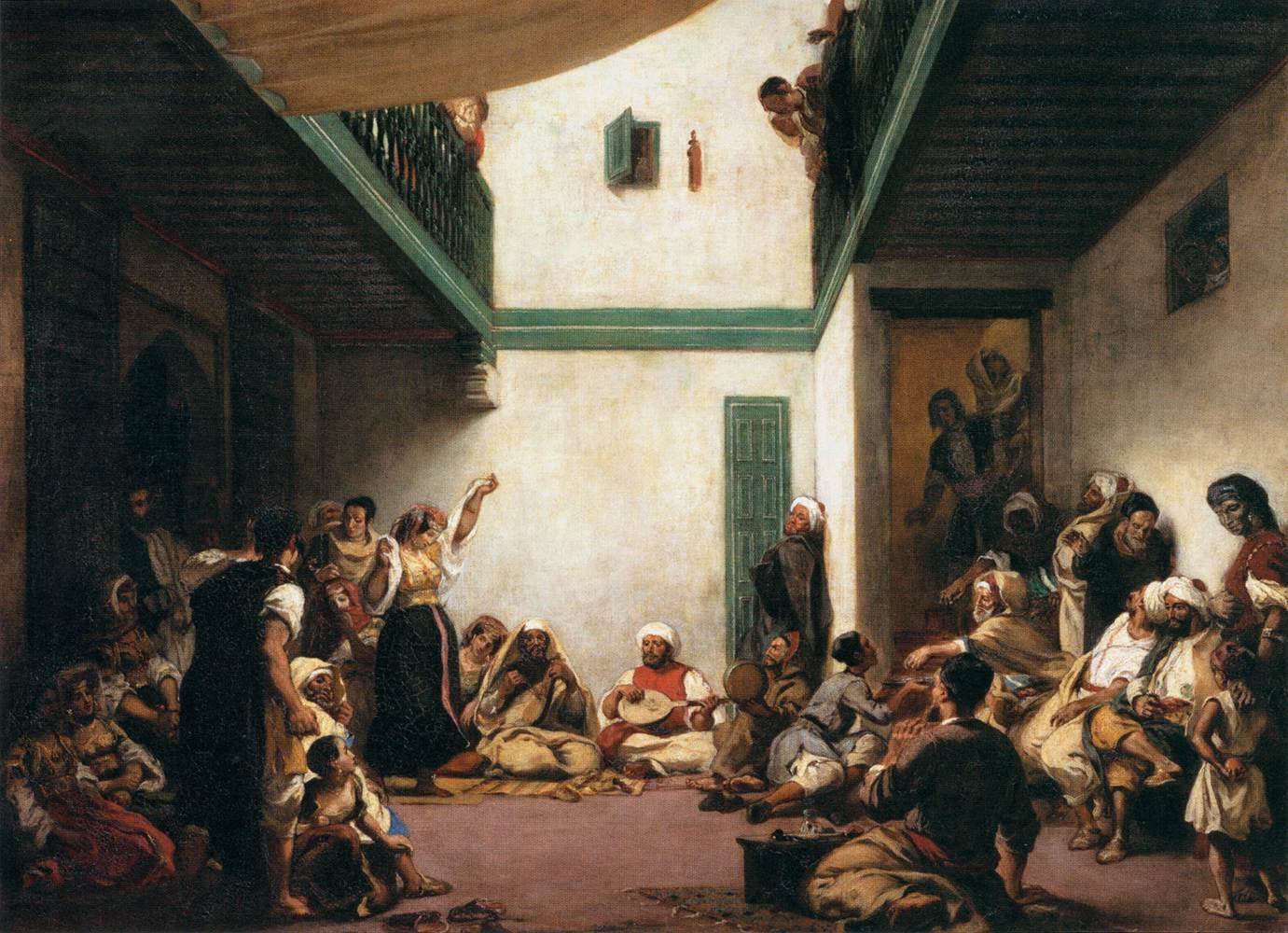
There’s nothing Jewish about me personally. I’m a Moroccan who grew up in a Muslim society where my uncles would pull me aside to caution me about Yahudi treachery. The painting above — a Jewish wedding in Morocco — is a reminder that diasporic Jewish life has always existed at the mercy of its neighbors’ moods. I’ve sat and drank tea in homes that looked exactly like the one depicted, and if it wasn’t for the title, I’d have no idea this wasn’t a Muslim wedding.
There’s a non-zero chance one of those homes I walked through used to belong to a Jewish family for generations, before hundreds of thousands of them eventually fled the country.
I care about the safety of my Jewish neighbors here and now, and the resilience of the institutions that have built our unprecedented liberal culture. Universities that advance human knowledge, organizations that foster civic engagement, and spaces where epistemic humility lets us act like adults instead of gullible tribal chimpanzees.
There is a way out if you earnestly care about Palestinian lives. Step one is refusing to let the eliminationists speak in your name. If you got swept up in the worst of this and now feel sick about it, you can stop anytime. Draw bright red lines around anyone who treats Jewish massacres as a feature, not a bug. Refusal is a declaration of where your priorities lie.
I wish I didn’t need to write about the Yahud, but right now it’s the issue with the most direct consequences for me and my community.
I welcome the day that stops.
I’ve said it before: because I’m a free speech maximalist and in favor of actual open borders immigration, I absolutely do not support Mahmoud Khalil’s deportation — no matter how odious his views are.
Extremely short version: after months of back-and-forth, Sam Kriss agreed to a conversation only if I completed a homework assignment he set. I did exactly that, and he reneged anyways. I saw no point in further engagement with such transparent cowardice, so I blocked him. Now he spends a non-zero slice of his day creating sock puppet accounts to check if I’m still talking about him (I am!) and he knows how to get unblocked if it’s so important to him).
Robert presents an absolutely fascinating psychological profile and he still emails me out of the blue. Oscillating seamlessly between token condemnations of Hamas and glowing revolutionary poems paired with a picture of Yahya Sinwar “defiantly” holding a stick with one arm. He also sent me multiple pictures of Gaza children suffering from cerebral palsy and then directly accused me of being complicit in their famine.


I oscillate between two explanations, which are both drawn from my inconsequential life experience of course, so, grain of salt bla bla:
1. Fandom. Israelis aren't real people, Palestinians certainly aren't. Fandom culture has taken on an increasingly morally charged tone over time, as far as I can tell, as people can be called Nazis for liking Harry Potter given the author's politics, but also as people can be called Nazis for being fans of the wrong character. This mostly takes place online, thank god, but all the same - real people get harassed over their fictional tastes. And so, Israel/Palestine is just another fandom. I think this could account for the Free-Palestines' palpable disappointment when it turns out that fewer Palestinians have died than previously believed. Likewise, their displeasure with the ceasefire deal - it's not very pleasing, you know, narratively. So even though they got what they wanted, it feels shoe-horned and poorly written and imposed from above, which, you know, it was. Not a very satisfying character arc or resolution or anything.
2. They're terrified. Not of Israel and not of Jews. They're terrified of Jihadi terrorists, and they're deep in doublethink. They are helpless to actually fight it, so out of wishful thinking, they cast Israel as the villain, hoping that they wouldn't have to fight anything because they cast themselves as the saviors and not as potential victims. They also know, but can't afford to know, that at the bottom of it all lies Jihadi ideology that will come for them just as fast. If they pointed it out, it would only draw the Jihadis' ire. So they do everything within their power to not know anything.
Excellent essay Yassine. It is the best explanation I have seen recently on how so many people can be so confused for so long. I hope some day soon you can start writing about other topics.