Art style of Beryl Cook (1926-2008): A satirical naive folk-baroque art style of modern Britain expressing introvert's extroverted fantasy with subtle dark humor. [Gemini Nano Banana Pro]
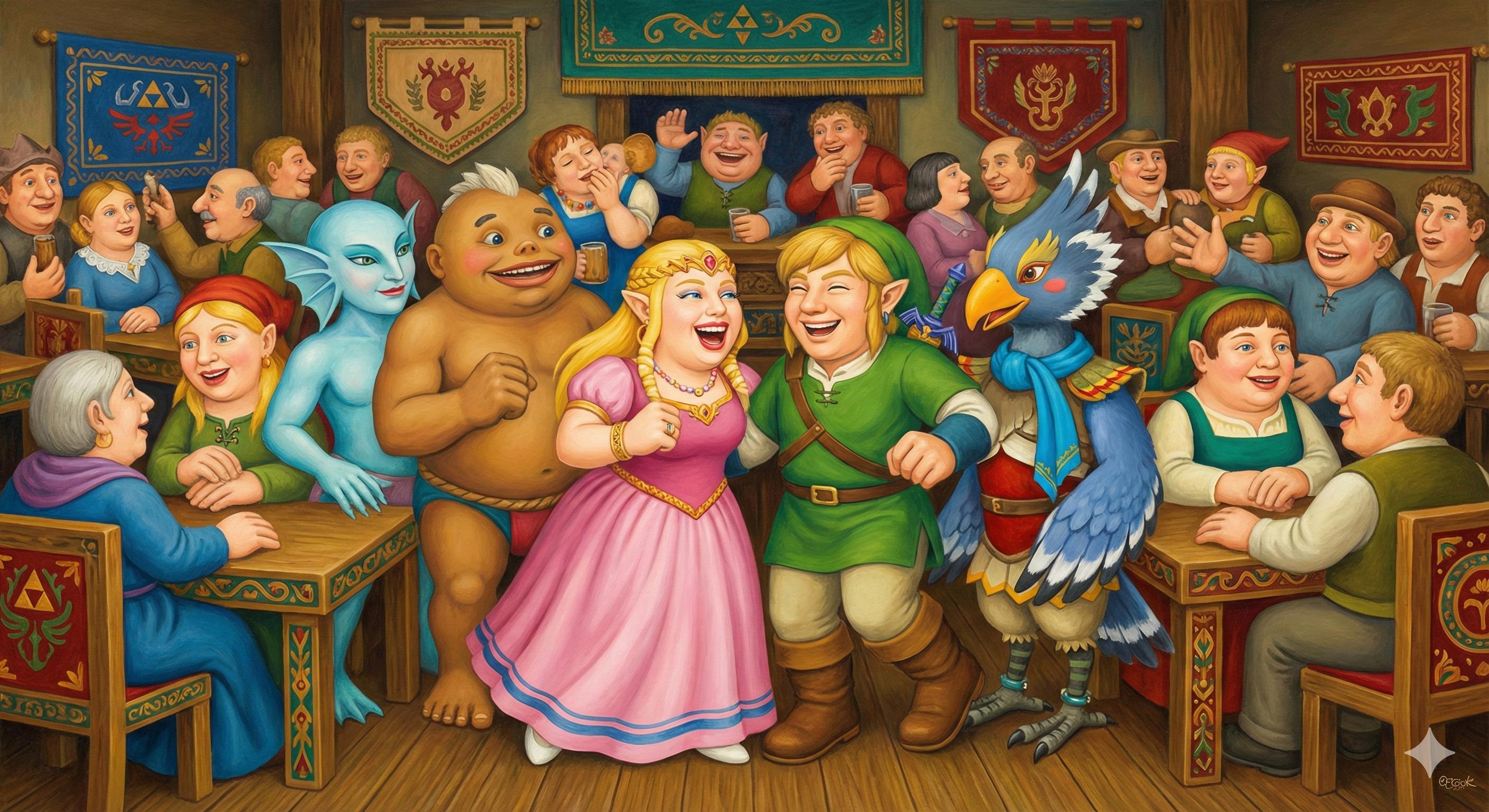
{The Legend of Zelda: Link and his companions across Hyrule} illustrated in the style of Beryl Cook (1926-2008), a satirical naive folk-baroque art style of modern Britain: {
The style frames the unsentimental reality of adulthood through a nostalgic, nursery-like lens, treating a full spectrum of social archetypes—from flamboyant extroverts to aspiring introverts—as joyful nursery children engaged in spontaneous role-play. This worldview celebrates diversity in social roles, capturing relational warmth and social harmony through lively social engagements. It seizes impromptu, memorable crowd moments imbued with saucy humor, framing adult activities as spontaneous, playful acts encompassing both an introvert's aspiration for civic belonging and an extrovert's fantasy in the spirit of Tom of Finland (1920–1991).
This intentionally ironic, nostalgic escapism—naïvely shallow and reminiscent of a child's unfiltered, tone-deaf retelling—fuses the saucy "seaside postcard" humor of Donald McGill (1875–1962) with the sharp social observation of William Hogarth (1697–1764) and Otto Dix (1891–1969), yet completely strips away their malice. Instead of aloofness or judgment, the narrative offers a convivial, nonjudgmental humanism capturing the authentic banter of Western culture and the "comedy of manners" inherent in crowded leisure scenes. This comedic sensibility echoes George Grosz (1893–1959) and James Gillray (1756–1815) but rendered in lighthearted frankness—celebrating communal vivacity while deliberately eliding complex social and psychological realism.
Content is staged using cinematic, musical-feature-film framing with choreographed poses and rhythmic variations, presenting a dialogue-less, comic-strip-like format where the entire story is implied through the image itself—much like a children's storybook. This approach impressionistically captures ordinary, authentic mannerisms, favoring everyday intimacy and grounded reality over theatrical or aspirational idealism.
The visual structure fuses the mural-like modernism of Stanley Spencer (1891–1959) with horror vacui sensibilities reminiscent of Fernando Botero (1932–2023). The composition relies on densely packed, stage-like interiors to reinforce communal abundance by avoiding large empty spaces. Figures are arranged within a compressed, subtly multi-perspectival framework that transforms chaotic crowds into organized, rhythmic tableaux achieving monumental graphic stability.
Figures are stylized into familiar and relatable, voluminous, curvaceous archetypes with evocative facial expressions and distinct personalities reminiscent of The Simpsons and James Thurber (1894–1961). Figural forms are streamlined in geometric shapes that avoid extreme caricature in favor of sympathetic roundness, coupled with a vivid, naive color palette reminiscent of The Muppets. The storytelling technique draws from Edward Burra (1905–1976) but exchanges his sinister melancholy for immediate comic clarity, and from Stanley Spencer's poetic density for cartoonish gestural directness. These subtly salacious, archetypal urban characters favor friendlier, rounded contours over sharp edges, prioritizing tactile safety and belonging while conveying a nonjudgmental humanist perspective—capturing whimsy in everyday people with realistic warmth, frailties, and absurdities.
The surface aesthetic bridges oil painting and graphic illustration, achieving a decorative balance akin to Eleanor Fortescue-Brickdale (1872–1945). The rendering style mimics the tactile quality of layered, hand-cut wool felt: figures are defined by opaque color blocking overlaid with subtle monotonal gradients and micro-patterned textures rather than complex realistic shading.
The palette is vivid and limited, inspired by period-specific fashion. It utilizes unblended colors with monotonal shifts to achieve comic-strip clarity and a naive simplification, resulting in a deliberately shallow visual vocabulary. This technique establishes rhythmic, Art Nouveau-infused ornamental harmony where repeated motifs and flattened backgrounds act as stage-like set pieces, allowing deviations to highlight individual personality traits rather than encode complex allegory.
}
Sources
Beryl Cook: The Beloved British Artist Who Captured Life’s Joyful Moments — Sothebys Institute of Art, March 28, 2025
Beryl Cook: A Private View by Kara Wilson at The Finborough — The London Pub Theatres, Oct 6, 2024
Beryl Cook's grotesque art sparks a discussion — Collater.al, Dec 2022
A Snapshot of Artists with a Plymouth Connection — Old Plymouth Society, July 2018


{The Legend of Zelda: Link and his companions across Hyrule} illustrated in the style of Beryl Cook (1926-2008), a satirical naive folk-baroque art style of modern Britain: {
The style frames the unsentimental reality of adulthood through a nostalgic, nursery-like lens, treating a full spectrum of social archetypes—from flamboyant extroverts to aspiring introverts—as joyful nursery children engaged in spontaneous role-play. This worldview celebrates diversity in social roles, capturing relational warmth and social harmony through lively social engagements. It seizes impromptu, memorable crowd moments imbued with saucy humor, framing adult activities as spontaneous, playful acts encompassing both an introvert's aspiration for civic belonging and an extrovert's fantasy in the spirit of Tom of Finland (1920–1991).
This intentionally ironic, nostalgic escapism—naïvely shallow and reminiscent of a child's unfiltered, tone-deaf retelling—fuses the saucy "seaside postcard" humor of Donald McGill (1875–1962) with the sharp social observation of William Hogarth (1697–1764) and Otto Dix (1891–1969), yet completely strips away their malice. Instead of aloofness or judgment, the narrative offers a convivial, nonjudgmental humanism capturing the authentic banter of Western culture and the "comedy of manners" inherent in crowded leisure scenes. This comedic sensibility echoes George Grosz (1893–1959) and James Gillray (1756–1815) but rendered in lighthearted frankness—celebrating communal vivacity while deliberately eliding complex social and psychological realism.
Content is staged using cinematic, musical-feature-film framing with choreographed poses and rhythmic variations, presenting a dialogue-less, comic-strip-like format where the entire story is implied through the image itself—much like a children's storybook. This approach impressionistically captures ordinary, authentic mannerisms, favoring everyday intimacy and grounded reality over theatrical or aspirational idealism.
The visual structure fuses the mural-like modernism of Stanley Spencer (1891–1959) with horror vacui sensibilities reminiscent of Fernando Botero (1932–2023). The composition relies on densely packed, stage-like interiors to reinforce communal abundance by avoiding large empty spaces. Figures are arranged within a compressed, subtly multi-perspectival framework that transforms chaotic crowds into organized, rhythmic tableaux achieving monumental graphic stability.
Figures are stylized into familiar and relatable, voluminous, curvaceous archetypes with evocative facial expressions and distinct personalities reminiscent of The Simpsons and James Thurber (1894–1961). Figural forms are streamlined in geometric shapes that avoid extreme caricature in favor of sympathetic roundness, coupled with a vivid, naive color palette reminiscent of The Muppets. The storytelling technique draws from Edward Burra (1905–1976) but exchanges his sinister melancholy for immediate comic clarity, and from Stanley Spencer's poetic density for cartoonish gestural directness. These subtly salacious, archetypal urban characters favor friendlier, rounded contours over sharp edges, prioritizing tactile safety and belonging while conveying a nonjudgmental humanist perspective—capturing whimsy in everyday people with realistic warmth, frailties, and absurdities.
The surface aesthetic bridges oil painting and graphic illustration, achieving a decorative balance akin to Eleanor Fortescue-Brickdale (1872–1945). The rendering style mimics the tactile quality of layered, hand-cut wool felt: figures are defined by opaque color blocking overlaid with subtle monotonal gradients and micro-patterned textures rather than complex realistic shading.
The palette is vivid and limited, inspired by period-specific fashion. It utilizes unblended colors with monotonal shifts to achieve comic-strip clarity and a naive simplification, resulting in a deliberately shallow visual vocabulary. This technique establishes rhythmic, Art Nouveau-infused ornamental harmony where repeated motifs and flattened backgrounds act as stage-like set pieces, allowing deviations to highlight individual personality traits rather than encode complex allegory. }