1


Color-washed, black-heavy pen-and-ink style of Victor Ambrus (1935–2021): An observational drawing with impressionistic artistic freedoms using confident strokes and line-weight control of lithography. [Gemini Nano Banana Pro via LM Arena]


1
100% Upvoted
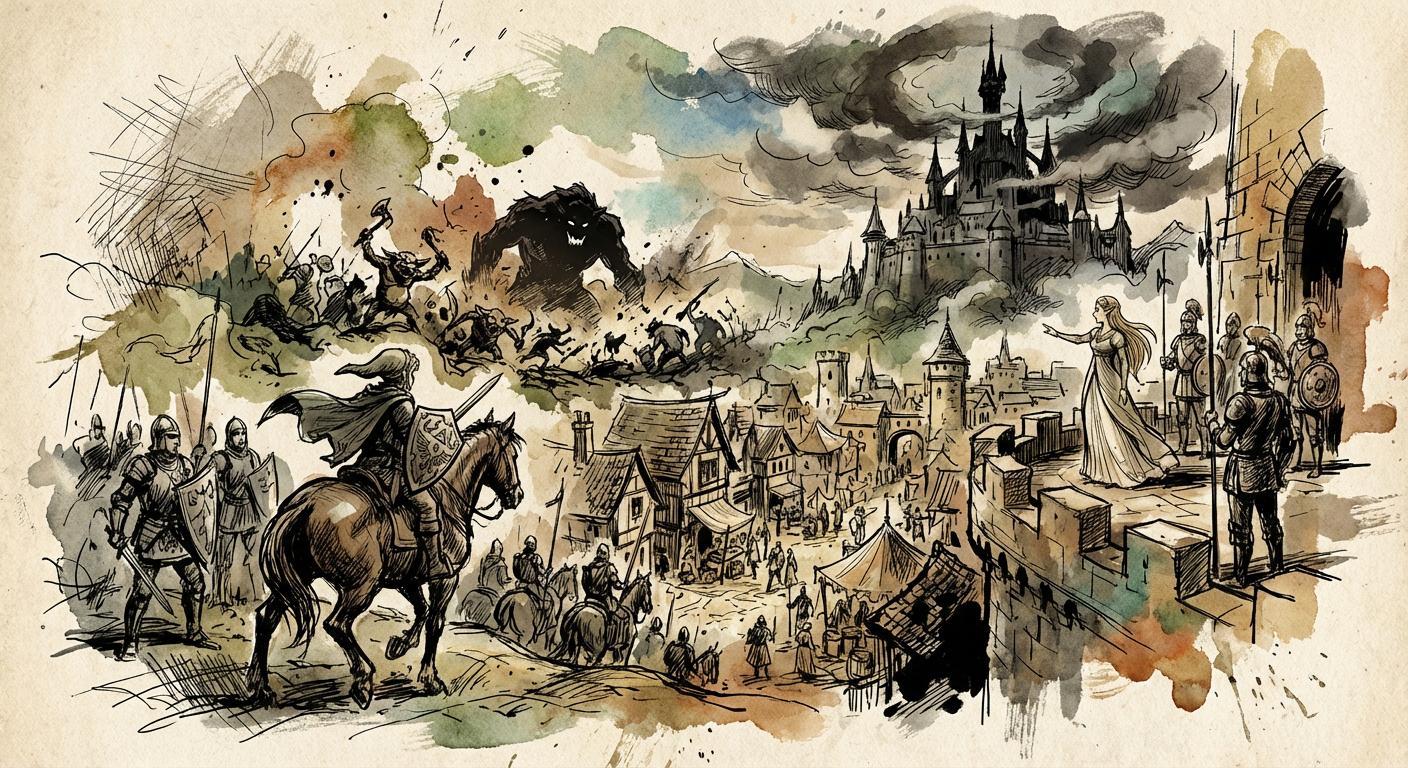
{The Legend of Zelda} illustrated in the color-washed, black-heavy pen-and-ink style of Victor Ambrus (1935–2021): {
An observational drawing with impressionistic artistic freedoms rooted in acute visual memory, fusing gestural figure-drawing mastery and economy of line with the confident strokes and line-weight control of engraving and lithography. Imaginative on‑site sketching and perceptually aware mark‑making produce the selective, impressionistic immediacy of direct observation—a kinetic realism shaped by Mihály Zichy's dramatic narratives, large‑scale compositional ambition, and unsentimental depictions of conflict. This adaptable pictorial approach communicates across subjective registers—from the gravitas of historically grounded reconstructions to the comic exaggeration of hyper-expressive cartoons—through gesturally rich, haptic linework that seamlessly condenses into black washes, overlaid with bleeding watercolor washes and textured with visceral mark-making. The narrative sensibility favors accessibility over ambiguity, empathy over eroticism, and clarity over brooding melancholy, maintaining storybook warmth even when rendering the brutality of historic conflict with unsentimental visual authenticity, prioritizing gestural theatricality and impressionistic characterization over romanticism. Within a selective rendering reminiscent of W.T. Benda, the spatial framework adopts a sweeping, elevated panorama whose dynamic angle shifts between intimate focus and expansive tableau, compressing time so multiple subnarratives unfold across the pictorial plane.
Filament-fine linework defines contour and models volume with broad tonal density, creating a precise yet fluid structural framework reminiscent of John Tenniel, layered with the freeform ephemerality and folkloric narrative bravura of Arthur Rackham and E. H. Shepard. Compositional focus operates through a calibrated dual-peripheral dissolution system: outward edges fade toward luminous white reserve, while inward recesses seamlessly condense into a mass of pooled black lines, directing the eye through enveloping contrast rather than uniform detail.
Within this framework, focal areas receive intensified treatment through reiterative, Renaissance fold-like linework that accumulates in dense, animated passages. Each stroke in these zones exhibits tissue paper-like fluctuation and rhythmic tremor, building both volumetric form and haptic urgency. This animation diminishes seamlessly toward the periphery, where linework stabilizes into calmer, less fluctuating strokes before dissolving entirely into either white void or saturated black. Shadows are thus defined impressionistically as broad black shapes that simultaneously anchor composition and simplify complex forms into essential silhouettes. Gradient black washes bleed into and reinforce the linework, each stroke transitioning fluidly between delicate contour and saturated ink mass, simultaneously defining edges and modeling broad tonal planes. This rhythmic fold-like contouring, blended with condensed black wash, underpins the sketch-like rendering while ensuring dynamic compositional focus with clearly defined focal areas.
Over this tonal foundation, layered washes in a storybook pastel palette introduce a naturalistic atmosphere: muted sepias temper the stark blacks, while saturated pigments, diluted to pale, atmospheric washes, and bleeding out to evoke streamlined, visceral impressions and ephemeral perceptual distortions reflecting transient mental states. The washes—particularly lighter ones—are deliberately unbounded by outlines, bleeding beyond drawn edges to soften transitions and create a hazy, nostalgic vignette evoking humanistic fleeting memory grounded in acute attentiveness.
Expressive, powdery textures animate surfaces through dry-brushing and gentle lifting, while scratched marks provide linear counterpoint and tactile abrasion. Uneven, dissipating watercolor spots punctuate planes with incidental luminosities and tonal fades, producing a lived, weathered patina. Tonal instability guides focal flow through selective emphasis and gestural intensity, heightening absorptive focus via transient dynamism, focal intensity, and reductive spatial depth.
Together, these techniques convey storybook lyricism grounded in rigorous observational study. Although linework and washes read as swift, impressionistic gestures, each mark is executed with clear perceptual vision, reinforcing the evocative power of its semantic layers: historical accuracy, eloquent storytelling, and emotional nuance. }