Advertisement
Advertisement

East Asia

Hong Kong fire rescue efforts cease, death toll rises to 128

Around 200 people are still unaccounted for. 

Hong Kong fire rescue efforts cease, death toll rises to 128

Police cordons are placed at the scene of the Wang Fuk Court housing estate fire in Tai Po, Hong Kong on Nov 28, 2025. (Photo: Reuters/Tyrone Siu)

Read a summary of this article on FAST.
FAST

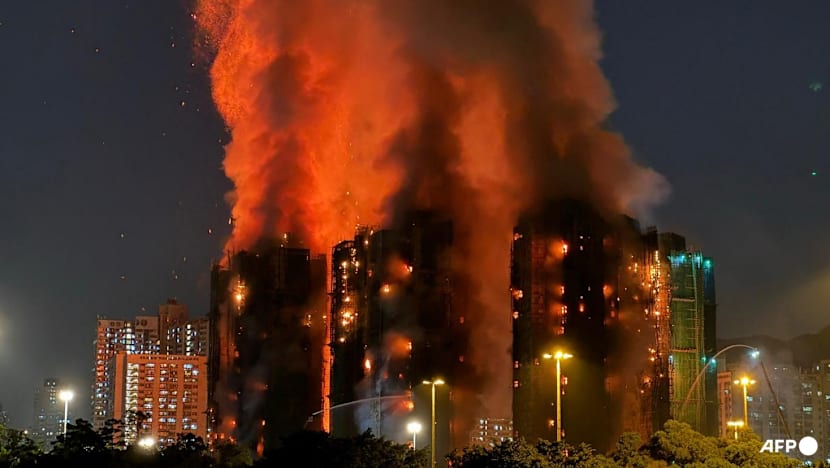
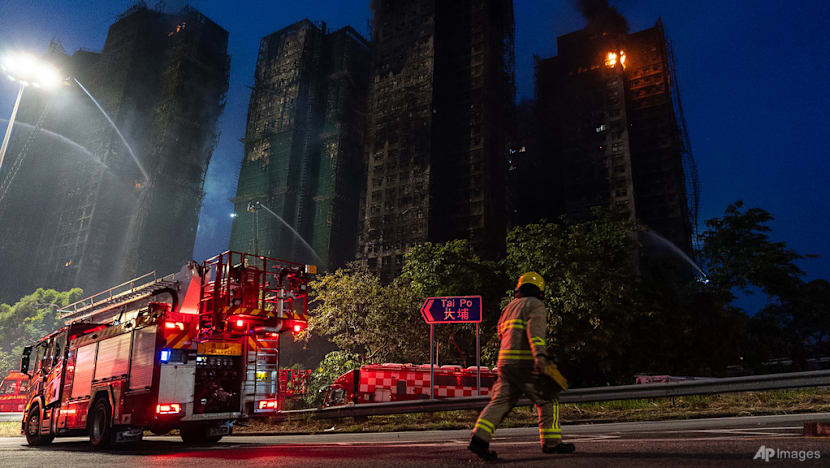
HONG KONG: Hong Kong authorities on Friday (Nov 28) raised the death toll from the city's worst fire in nearly 80 years to 128, with around 200 people still unaccounted for.

Rescue efforts for the blaze, which broke out at Wang Fuk Court housing complex in the northern district of Tai Po, ended on Friday, said the authorities at a press briefing.

At least 79 people were injured, including 12 firemen, with one in serious condition, they added. 

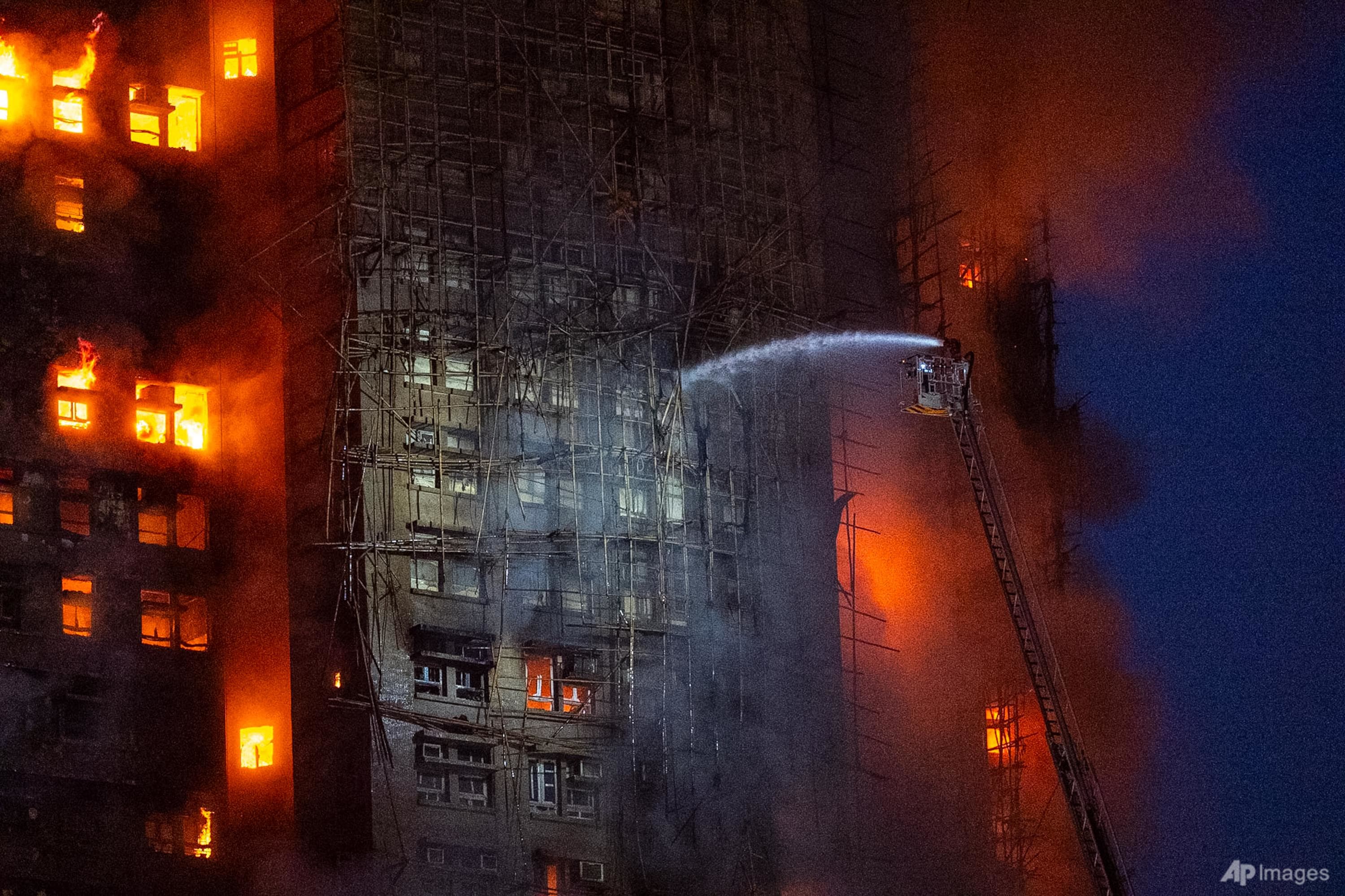
The eight-tower estate housing more than 4,600 people had been undergoing renovations and was wrapped in bamboo scaffolding and green mesh when the fire started and quickly spread on Wednesday afternoon.

Police said they had arrested three construction company officials on suspicion of manslaughter for using unsafe materials, including flammable foam boards blocking windows.

Authorities said on Friday that fire alarms in the affected buildings were not operating properly. 

Rescuers had battled intense heat, thick smoke and collapsing scaffolding and debris as they fought to reach residents feared trapped on the upper floors of the complex.

On Thursday, a distraught woman carrying her daughter's graduation photograph searched for her child outside a shelter, one of eight that authorities said are housing 900 residents.

"She and her father are still not out yet," said the 52-year-old, who gave only her surname, Ng, as she sobbed. "They didn’t have water to save our building."

Most of the victims were found in two towers in the complex, while firefighters found survivors in several buildings, Deputy Fire Services Director Derek Chan told reporters early on Friday.

Two of the dead were Indonesian nationals working as domestic helpers, the Indonesian consulate said. Hong Kong has around 368,000 domestic workers, mostly women from low-income Asian countries who live with their employers.

Firefighters work at the scene in the aftermath of a major fire that swept through several apartment blocks at the Wang Fuk Court residential estate in Hong Kong's Tai Po district on Nov 28, 2025. (Photo: AFP/Philip Fong)

WORST FIRE SINCE 1948

The fire is now Hong Kong's deadliest since 1948, when 176 people died in a warehouse blaze, and has prompted comparisons to London's Grenfell Tower inferno, which killed 72 people in 2017. That fire was blamed on firms fitting the exterior with flammable cladding, as well as failings by the government and the construction industry.

Police arrested two directors and an engineering consultant of Prestige Construction, a firm that had been doing maintenance on the buildings for more than a year.

"We have reason to believe that the company’s responsible parties were grossly negligent, which led to this accident and caused the fire to spread uncontrollably, resulting in major casualties," Police Superintendent Eileen Chung said on Thursday. Prestige did not answer repeated calls for comment.

Police seized bidding documents, a list of employees, 14 computers and three mobile phones in a raid of the company's office, the government added.

The city's development bureau has discussed gradually replacing bamboo scaffolding with metal scaffolding as a safety measure. Hong Kong's leader, John Lee, said the government would set up a HK$300 million (US$39 million) fund to help residents while some of China's biggest listed companies announced donations.

On the second night after the blaze, dozens of evacuees set up mattresses in a nearby mall, many saying official evacuation centres should be saved for those in greater need.

People - from elderly residents to schoolchildren - wrapped themselves in duvets and huddled in tents outside a McDonald's restaurant and convenience shops as volunteers handed out snacks and toiletries.

Hong Kong, one of the world's most densely populated cities, is scattered with high-rise housing complexes. Its sky-high property prices have long been a trigger for discontent and the tragedy could stoke resentment towards authorities despite efforts to tighten political and national security control. 

The leadership of both the Hong Kong government and China's Communist Party moved quickly to show they attached utmost importance to a tragedy seen as a potential test of Beijing's grip on the semi-autonomous region. 

Source: Agencies//CNA/co

Sign up for our newsletters

Get our pick of top stories and thought-provoking articles in your inbox

Subscribe here
Inbox
FAST
Advertisement

Sport

10 SEA Games events moved to Bangkok after Songkhla flooding

Songkhla province has been hard hit by days of flooding, with the death toll now at 55.

10 SEA Games events moved to Bangkok after Songkhla flooding

This aerial photo taken on Nov 26, 2025 shows flood waters submerging vehicles in Hat Yai in Thailand's southern Songkhla province. (Photo: AFP/Arnun Chonmahatrakool/THAI NEWS PIX)

New: You can now listen to articles.

This audio is generated by an AI tool.

Read a summary of this article on FAST.
FAST

SINGAPORE: Some events at the upcoming 33rd SEA Games will be shifted to Bangkok after days of severe flooding in the southern Thai province of Songkhla.

The Games organising committee on Thursday (Nov 27) approved the venue changes due to the floods, which caused "damage and impacted readiness". Songkhla had been set to host the Dec 9 to Dec 20 biennial multi-sport event, along with Bangkok and Chonburi.

The competition venues for 10 sports that were originally scheduled to take place in Hat Yai and Mueang Songkhla districts, will now be held in Bangkok.

They are: Muay (boxing), the men's football qualification rounds, chess, kabaddi, wushu, pencak silat, judo, petanque, karate, billiards and snooker. Wrestling will also be moved to Chonburi.

"The committee emphasised that these adjustments were made to ensure safety for athletes, officials, and spectators, and to safeguard the international standards of the Games," a statement read on Facebook.

"The organising committee reaffirmed that despite the venue changes, Thailand remains fully committed to delivering an efficient, well-managed, and world-class 33rd SEA Games, reinforcing the confidence of all participating nations."

A government spokesperson said that flood-related deaths in Songkhla surged from six to 55 on Thursday, bringing the overall death toll across seven provinces to at least 82 people.

Devastating flooding has overwhelmed southern Thailand this week, particularly in Hat Yai, near the border with Malaysia, where large areas were submerged, pushing residents to seek shelter on rooftops.

Events with venue changes

  • Muay (boxing). New venue: Lumpinee Boxing Stadium, Bangkok
  • Men’s Football – Qualification Round. New venue: Rajamangala National Stadium, Bangkok
  • Chess. New venue: The Bazaar Hotel Bangkok
  • Kabaddi. New venue: Chalermphrakiat Sports Center, Rajamangala University of Technology Rattanakosin (Bangkok)
  • Wushu. New venue: Government Complex, Chaeng Watthana (Multi-purpose Hall, 2nd Floor, Ratthaprasasabhakit Building)
  • Pencak Silat. New venue: IMPACT Arena Muang Thong Thani, Hall 4 (Bangkok)
  • Judo. New venue: Rajamangala Auditorium, Rajamangala University of Technology Thanyaburi (Bangkok)
  • Petanque. New venue: Valaya Alongkorn Rajabhat University under the Royal Patronage (Bangkok)
  • Karate. New venue: Government Complex, Chaeng Watthana (Multi-purpose Hall, 2nd Floor, Ratthaprasasabhakit Building)
  • Wrestling. New venue: Pacific Park Sriracha, Chonburi Province
  • Billiards and Snooker. New venue: Thunder Dome, Muang Thong Thani (Bangkok)
Expand

Singapore National Olympic Council (SNOC) president Grace Fu said that the country's Olympic Council backed Thailand's decision to relocate the Songkhla events.

In a Facebook post on Friday, Ms Fu, who is also Singapore's Minister for Sustainability and the Environment, said the council recognises the challenges facing the Games organisers, and commended the “organisers and authorities for their efforts to find alternative solutions for our athletes and officials”.

"Our thoughts are with the residents of Hat Yai and the Songkhla province who have been affected by the floods.

"We are confident that, together, the SEA Games family will overcome this difficult period with resilience and unity."

She added that Team Singapore will continue to prepare and adapt as needed, and that SNOC will fully support the athletes and officials from the affected sports as they "adjust to the changes".

"We remain grateful to Thailand for their continued commitment to hosting the SEA Games under challenging circumstances."

Singapore is sending its largest contingent to the Games, with 930 athletes set to compete in 48 sports.

Source: CNA/fh(sn)

Sign up for our newsletters

Get our pick of top stories and thought-provoking articles in your inbox

Subscribe here
Inbox
FAST
Advertisement

Asia

Cyclone Ditwah kills 46 in Sri Lanka, leaves 23 missing as rescue efforts continue 

Cyclone Ditwah kills 46 in Sri Lanka, leaves 23 missing as rescue efforts continue 

A house stands partially submerged following heavy rainfall in Kelaniya, Sri Lanka, on Nov 28, 2025. (Photo: Reuters/Thilina Kaluthotage)

COLOMBO: A cyclone swept across Sri Lanka on Friday (Nov 28), leaving 46 people dead and 23 more missing, officials said, with the weather department warning the storm could intensify as it moves across the island over the next 12 hours. 

Most fatalities were attributed to landslides triggered by torrential rainfall exceeding 300mm over the past 24 hours as Cyclone Ditwah lashed the island nation, with the eastern and central regions most severely affected.

Nationwide, 43,991 people were evacuated to schools and other public shelters, the Disaster Management Centre (DMC) said in a statement, including families stranded on rooftops.

Schools remained closed, train services were suspended, and the Colombo Stock Exchange announced an early trading halt as heavy rains persisted. 

"We are continuing rescue operations in the worst-hit areas, but some villages are difficult to reach because roads are blocked by landslides ... we are doing our best to get everyone to safety," Brigadier S Dharmawickrema, Emergency Operations Director at the DMC, told Reuters. 

Sri Lanka may divert flights from its main airport to Trivandrum or Cochin airports in south India if conditions worsen, Ports and Civil Aviation Minister Anura Karunathilake told reporters. 

Local media reported that six flights, including those from Muscat, Dubai, New Delhi and Bangkok, had already been redirected from Colombo's Bandaranaike International Airport.

Source: Reuters/rl

Sign up for our newsletters

Get our pick of top stories and thought-provoking articles in your inbox

Subscribe here
Inbox
FAST
Advertisement

Asia

Thai city morgue exceeds capacity after flooding: Medic

Thai city morgue exceeds capacity after flooding: Medic

A man stands on a roof next to high flood waters in Hat Yai in Thailand's southern Songkhla province on Nov 26, 2025, as severe flooding affected thousands of people in the country's south following days of heavy rain. (File photo: AFP/Arnun Chonmahatrakool)

BANGKOK: The main facility receiving bodies of flood victims in southern Thailand has filled up, prompting authorities to bring in three refrigerated trucks, a hospital staffer said on Friday (Nov 28).

"The morgue has exceeded its capacity, so we need more," Charn, a morgue official at Songkhla Hospital who only gave his first name, told AFP after the death toll rose to 55.

Footage filmed by an AFP journalist showed white refrigerated lorries parked outside the hospital's main building.

This aerial photo taken on Nov 26, 2025 shows people surrounded by floating products from a supermarket as they wade through flood waters in Hat Yai in Thailand's southern Songkhla province. (File photo: AFP)

Devastating flooding has overwhelmed southern Thailand this week, particularly in Hat Yai, near the border with Malaysia, where large areas were submerged, pushing residents to seek shelter on rooftops.

The Thai government said in a statement late on Thursday that the death toll from several days of flooding in Songkhla province had jumped to 55, up from six the previous day.

The government said on Friday it had suspended the Hat Yai district chief over an alleged failure to respond to the flooding.

Source: AFP/dc

Sign up for our newsletters

Get our pick of top stories and thought-provoking articles in your inbox

Subscribe here
Inbox
Advertisement

Entertainment

2025 MAMA Awards in Hong Kong still proceeding despite fire tragedy, will have 'restrained production'

This year's edition of the MAMA Awards, which honours the K-pop and Asian music industry, is slated to take place at Hong Kong's Kai Tak Stadium. 

2025 MAMA Awards in Hong Kong still proceeding despite fire tragedy, will have 'restrained production'

This year's MAMA Awards in Hong Kong will proceed despite the recent tragedy involving a fire at a high-rise building. (Photo: MAMA Awards)

New: You can now listen to articles.

This audio is generated by an AI tool.

Read a summary of this article on FAST.
FAST

This year's edition of the MAMA Awards will proceed in Hong Kong, despite the recent apartment fire that has claimed more than 90 lives and left dozens missing. Since its inception in 1999, the show has become a hallmark of the Asian music scene, honouring the best in the K-pop industry.

In a statement to media outlets on Thursday (Nov 27), organisers confirmed that this year's MAMA Awards will continue with a "restrained production" and will also include a moment of silence for victims of the tragedy.

"We extend our deepest condolences to all those affected by the tragic fire in Hong Kong. Our hearts go out to all those affected by this devastating event. We offer our heartfelt condolences to the families who have lost loved ones and our thoughts are with those injured," wrote organisers.

"2025 MAMA Awards is a stage built upon the passion and dedication of many artistes, staff and fans over a long period of time. We believe in the healing and unifying power of music and hope to provide comfort and support during this difficult time. Our stage and performances are being carefully and thoughtfully prepared with restrained production, so that even amid grief, they may offer small moments of courage and comfort. As a mark of respect, we will observe a moment of silence to honour the victims and are committed to providing donations in support of the victims."

In a separate post on its social media pages, organisers of the MAMA Awards said that the event's red carpet will be cancelled, but the ceremony will continue to be broadcast live.

The 2025 MAMA Awards is set to take place on Nov 28 and 29 at Hong Kong's Kai Tak Stadium, with viewers in Singapore being able to watch it via streaming platform HBO Max and tvN Asia.


This year's MAMA Awards is set to feature numerous performances from popular K-pop acts such as Ive, Aespa, G-Dragon and Enhypen, as well as a cover of the megahit song Golden by Babymonster members Pharita, Ahyeon and Rora. 

However, the recent tragedy has led to several artistes withdrawing from the ceremony, including Hong Kong band Mirror, Hong Kong actor Chow Yun-fat and Malaysian actress Michelle Yeoh.


Source: CNA/hq

Sign up for our newsletters

Get our pick of top stories and thought-provoking articles in your inbox

Subscribe here
Inbox
Advertisement

Asia

Most Asian markets build on week's rally

Most Asian markets build on week's rally

A man walks past a stock quotation board showing the Topix average, the Nikkei share average, the exchange rate between Japanese yen and US dollar and the Nikkei share average outside a brokerage in Tokyo, Japan on Nov 21, 2025. (File photo: Reuters/Kim Kyung-Hoon)

Read a summary of this article on FAST.
FAST

HONG KONG: Most markets squeezed out gains on Friday (Nov 28) at the end of a strong week for equities fuelled by growing expectations that the Federal Reserve will cut interest rates again next month. 

Traders took silence from New York's Thanksgiving break as a reason to have a breather and take stock of a healthy rebound from November's swoon that was sparked by AI bubble threats.

But while there is much debate on whether valuations in the tech sector are overstretched, focus this week has been firmly on the prospect of more rate cuts.

A string of top Fed officials have lined up to back a third straight reduction, mostly saying that worries over a weakening labour market trumped still elevated inflation.

Attention now turns to a range of data releases over the next week or so that could play a role in the bank's final decision, with private hiring, services activity and personal consumption expenditure - the Fed's preferred gauge of inflation.

With the government shutdown postponing or cancelling the release of some key data, closely watched non-farm payrolls figures are now due in mid-December, after the Fed's policy decision.

"This delay places much greater scrutiny on the latest November ADP (private) payrolls report," wrote Market Insights' Michael Hewson. He said there would likely be a Thanksgiving-linked spike in hiring "that is not entirely representative of recent slower trends in the US labour market".

"While a big jump in payrolls in November could be construed as a positive signal for the US labour market, it might not be enough to stop the Fed from cutting rates again with another close decision expected on Dec 10," he added.

Markets see around an 85 per cent chance of a cut next month and three more in 2026.

With no catalyst from New York, Asian investor excitement was limited but most markets managed to rise.

Tokyo, Shanghai, Singapore, Wellington, Taipei, Manila, Mumbai and Bangkok all advanced, though Hong Kong, Sydney, Seoul and Jakarta reversed.

The yen swung against the dollar after data showed inflation in Tokyo, seen as a bellwether for Japan, came in a little higher than expected, reigniting talk on whether the central bank will hike interest rates in the coming months.

The yen remains under pressure against the greenback amid concerns about Japan's fiscal outlook and pledges for more borrowing, but it has pulled back from the levels near 158 per dollar seen earlier this week.

Source: AFP/dc

Sign up for our newsletters

Get our pick of top stories and thought-provoking articles in your inbox

Subscribe here
Inbox
Advertisement

Asia

Death toll from floods and landslides in Indonesia rises to 84

Death toll from floods and landslides in Indonesia rises to 84

Partially submerged cars stuck in a residential area affected by flood, following heavy rains in Padang, West Sumatra province, Indonesia, Nov 27, 2025. (Photo: REUTERS)

Read a summary of this article on FAST.
FAST

MEDAN: Flooding and landslides across Indonesia's Sumatra island have killed at least 84 people this week, and dozens more are missing, rescue officials said on Friday (Nov 28).

Indonesia, along with neighbouring Malaysia and Thailand, have been hit by severe rains that have caused dozens of deaths across the region in recent days.

In North Sumatra, "as of this morning, the number of fatalities is 62, with 95 people injured, both serious and minor injuries", said local police spokesman Ferry Walintukan.

"At least 65 people are still being searched for," he told AFP.

In neighbouring West Sumatra, at least 22 people have died, with 12 others missing, according to the local disaster agency.

Walintukan said authorities in North Sumatra were focused on "evacuation and providing assistance".

In North Sumatra, access to some areas and communication was still cut off, he added.

"Hopefully, the weather will clear up so we can move the helicopter to the (worst-hit) locations."

In Sibolga, the hardest-hit town, more than 30 people were killed, he said.

In West Sumatra, local disaster agency head Abdul Malik told AFP that "22 people have died and 12 people are still being searched for."

Local residents carry their belongings in an area affected by flash floods, following heavy rains in Agam, West Sumatra province, Indonesia, Nov 27, 2025. (Photo: REUTERS)
Fallen tree branches and debris lie on the ground near a damaged house hit by flash floods, following heavy rains in Agam, West Sumatra province, Indonesia, Nov 27, 2025. (Photo: REUTERS)

Heavy rain has also caused flooding in Aceh, Indonesia's westernmost province, triggering landslides and prompting the evacuation of nearly 1,500 people, according to the local disaster agency.

Electricity services in parts of the province have also been knocked out, according to an AFP journalist.

State-owned electricity company Perusahaan Listrik Negara said earlier this week that it had deployed personnel to gradually restore power supplies after a flash flood brought down a transmission tower.

The annual monsoon season, typically between June and September, often brings heavy rains, triggering landslides, flash floods and waterborne diseases.

It has been exacerbated by a tropical storm in the region in recent days.

The weather system has inundated parts of southern Thailand, killing dozens and trapping many in their homes. In Malaysia, it also brought heavy flooding and killed at least two people.

Climate change has impacted storm patterns, including the duration and intensity of the season, leading to heavier rainfall, flash flooding and stronger wind gusts.

At least 38 people died this month in landslides triggered by heavy rainfall in Central Java, and around 13 are still missing.

Source: Agencies/fh

Sign up for our newsletters

Get our pick of top stories and thought-provoking articles in your inbox

Subscribe here
Inbox
Advertisement

Asia

Thailand's ancient cat breeds get official national status, but will it improve animal welfare?

Five native Thai cat breeds have been crowned national pet symbols, a move celebrated by breeders but met with both optimism and caution by rescuers confronting a growing stray-cat problem.


Thailand's ancient cat breeds get official national status, but will it improve animal welfare?

Preecha Vadhana, a cat breeder, inspects a Siamese feline at his facility in Bangkok. The breed is one of five recognised by the government as a national symbol. (Photo: CNA/Jack Board)

New: You can now listen to articles.

This audio is generated by an AI tool.

Read a summary of this article on FAST.
FAST

BANGKOK: In centuries-old Thai manuscripts, the cat appears as a revered species, a bearer of prosperity, protection and royal favour.

In books made from samut khoi - traditional Thai paper folding books made from the bark of a mulberry tree - scribes depicted silver-coated and white, jewel-eyed felines as guardians of temples and described their unique traits in verse.

These animals have deep roots and national heritage, dating back beyond these 14th-century scripts called the Tamra Maew.

From ancient symbols to modern-day icons, the kingdom’s iconic species are being elevated once again: Officially recognised alongside some other historic heavyweights.

Five cat breeds native to Thailand were approved as national pet symbols by the government on Nov 18, joining the Thai elephant, fighting fish and Naga among other nationally recognised emblems.

The pure Thai breeds - Suphalak, Korat, Siamese, Konja and Khao Manee - possess distinctive physical and behavioral traits that clearly differentiate them from other breeds, according to Thailand’s National Identity Committee, which had proposed their designations as national pets.

“Their uniqueness has gained international recognition, with some foreign breeders attempting to register purebred Thai cat lines and establish global breed standards,” the Thai government’s public relations department said in a report on Nov 20.

Preecha Vadhana, a cat breeder who operates Bangrak Cat Farm in Bangkok, said that each of the five breeds has very distinct features, making them easily distinguishable from one another.

“But they also share similarities, particularly their structure and short coat.”

The Suphalak has a distinct copper coat and is considered a symbol of prestige and fortune. The Korat is a bluish-grey cat with large, vivid green eyes, while the Khao Manee - a rare, white species - often has eyes with two strikingly different colours such as gold and blue.

The Konja is known as a lucky black cat, unlike its foreign counterparts which are often infamous for the opposite.

Finally, the “king of cats”, the Siamese or Wichienmas, is marked by its distinct dark spots and treasured for its intelligence. It is typically the most expensive of the breeds and can cost 15,000-20,000 baht (US$465-US$620) from a local breeder, while others cost 7,000-15,000 baht.

“I think it’s a great step, and it will encourage more interest in Thai breeds,” said Titipat Laohaprasertsiri, the president of the International Maew Boran Association (TIMBA), an organisation that seeks to promote Thai iconic species. Maew Boran means ancient cats in Thai.

“Thai cats are energetic, fun, curious and incredibly affectionate. Thai cats seem to love humans more than they love other cats. They’re very people-oriented. They really add warmth and joy to your daily life,” he said.

There are no publicly available figures on how many such cats there are in Thailand.

The decision to elevate these species is not just symbolic: It is meant to help conserve rare native breeds, standardise them and protect Thailand’s ownership of them. The species will also be used more in creative-economy and tourism branding, according to the government.

A Thai Suphalak cat seen at Bangrak Cat Farm in Bangkok. (Photo: CNA/Jack Board)

“I see it as a huge potential positive. Unfortunately, ‘breeds’ tend to hold more value and receive better welfare than animals without that status,” said Henna Pekko, the managing director of Rescue P.A.W.S. Thailand, a not-for-profit animal welfare organisation in Thailand.

“If cats are considered national treasures, it’s a good day for cat lovers,” added Karan Bhatia, the owner of Catsanova Cat Shelter & Playroom in Bangkok, a business that focuses on ethical cat adoption.

But like many involved in the wider cat industry, both have some caveats, noting that the longtime prestige of certain species contrasts with the reality faced by many cats in Thailand today.
 

Thai Korat cats are known for their grey fur and bright emerald eyes. (Photo: CNA/Jack Board)

LIFE ON THE STREET

Stray cats and dogs number in the hundreds of thousands nationwide, possibly more. There were an estimated 820,00 animals on the street, based on past estimates by the Department of Livestock Development in 2018.

Big cities like Bangkok carry a heavy burden but it is a major, country-wide problem.

State-supported sterilisation, rehoming or vaccination programmes are rare. But from Jan 10 next year, cat owners in the Bangkok metropolitan area will be required to register and microchip their animal.

There will also be limits imposed on the number of cats one can own based on the size of their home.

Pet abandonment remains a major issue, a situation exacerbated by the COVID-19 pandemic.

“COVID was an extreme situation, but nonetheless, it contributed to a huge influx of new animals out on the street,” said Sam McElroy, the operations director at Soi Dog Foundation, a non-profit dedicated to improving the welfare of stray dogs and cats across Asia.

“A lot of those lived in someone's house for however-many years, and then they found themselves out on the street. And they kind of melt into the background in a country like Thailand, because there are so many strays,” he added.

A rescued cat rests in an enclosure at Catsanova in Bangkok. (Photo: CNA/Jack Board)

There is a huge number of stray and free-roaming cats, many with no access to veterinary care, Pekko said. As a result, these cats often have multiple litters and suffer from parasites, injuries and illness.

“Access to affordable or subsidised sterilisation is limited, which makes the problem worse over time,” she said.

The new government recognition of Thai heritage cats does not indicate any measures to address the stray cat problem in the country, beyond “public awareness” of the five pure breeds and their importance. But animal advocates hope there will be flow-on effects.

“I think it will help if the government or the people behind it can use this as a platform to start educating people on how to treat community cats and stray cats,” Bhatia said.

Others are more direct in saying the government needs to take more concrete actions, instead of symbolic gestures directed at uncommon species of Thai cats.

The Siamese or Wichienmas cat is highly revered in Thailand. (Photo: CNA/Jack Board)

Mavin Russameethongthakul is a Bangkok resident who shelters 25 rescued cats in his home.

He said that instead of campaigning specifically for pure Thai breeds, it would be better to encourage people to help stray cats instead.

“These specific Thai breeds are actually quite rare, and I don’t really see the benefit,” he said.

Pekko said the government’s move could help raise awareness and encourage more compassion for cats among the general public.

“Hopefully this recognition will have a positive effect for Thai cats in general - not just the specific breeds,” she said.

But she expressed fears that increased attention on these breeds may ignite more targeted breeding, that if not regulated properly, could lead to further welfare issues. Thailand has minimal regulation of commercial cat breeding.

“So while the decision is promising, the real impact remains to be seen,” Pekko added.

There are estimated to be hundreds of thousands of street animals in Thailand. (Photo: CNA/Jack Board)

INSIDE THE WORLD OF BREEDING

In a small alleyway in the Bangk Rak district of Bangkok - wedged between the city’s riverside and the hustle of Silom - behind a set of metal gates, dozens of cages rise in narrow rows.

Close to a hundred cats fill the space with constant meowing.

Bangrak Cat Farm is a breeding ground for all of Thailand’s five sought-after native species, a rare type of operation in the country.

Preecha, the 76-year-old breeder, walks and inspects the cats with a sharp eye, stopping occasionally to brush some of his favourites or check the conditions of others.

Breeder Preecha Vadhana at his Bangrak Cat Farm in Bangkok, Thailand. (Photo: CNA/Jack Board)

He has pride in his cats and about the new government recognition, something he said he has pushed for many years, through many different governments.

“Thai cats have always been part of our national identity; the government just hadn't paid attention. But now, they’ve embraced Thai cats as part of the country’s soft power and that’s something to be proud of,” he said.

The recognition will help build trust within the industry, ensure quality, species longevity and extend a sense of pride to cat owners, he said.

It may also encourage others to join the Thai cat breeding industry, if business is healthy and the breeds become more popular, he added.

Most cats here are bound for Thai homes rather than being exported overseas, although there is demand from the United States and Europe. Overall, there is a growing interest domestically in owning one of the ancient Thai breeds, said Titipat of TIMBA.

Thai Korat cats are considered a symbol of good luck and prosperity. (Photo: CNA/Jack Board)

More cat owners are starting to recognise that domestic breeds are more suitable for Thai conditions, compared to foreign breeds, Preecha said.

“What’s noticeably increasing is the number of former foreign-breed owners coming to Thai cats. One major reason is health,” he said, noting that cats from overseas often suffer fungal skin infections in Thailand’s climate.

“These are some of the reasons more people are turning to Thai cats - and I think the trend will continue.” 

With the elevated status, these cats are finally being recognised as the “truly precious” animals they are, he added.

That could have unintended benefits for street cats too, he said; many strays that naturally resemble Thai breeds are now being adopted more often.

“I believe Thai cats will continue just like they have for hundreds of years,” he added.

“And we, the people who love them, will continue alongside them, hopefully for hundreds more.” 

Source: CNA/jb(js)

Sign up for our newsletters

Get our pick of top stories and thought-provoking articles in your inbox

Subscribe here
Inbox
Advertisement

Commentary

Commentary: Southeast Asia can’t afford to sit out the ‘killer robots’ debate

How lethal autonomous weapon systems are defined could determine whether existing weapons will be regulated or prohibited, says Liu Mei Ching from the S Rajaratnam School of International Studies.

Commentary: Southeast Asia can’t afford to sit out the ‘killer robots’ debate

A mock "killer robot" is pictured as part of the Campaign to Stop "Killer Robots," which calls for the ban of lethal robot weapons that would be able to select and attack targets without any human intervention. (Photo: AFP Photo/Carl Court)

New: You can now listen to articles.

This audio is generated by an AI tool.

Read a summary of this article on FAST.
FAST

SINGAPORE: Think super-intelligent killer robots and our minds flash to popular films and television series like The Terminator and Black Mirror.

While the idea of these sci-fi versions running rampant remains far-fetched, lethal autonomous weapon systems (LAWS) have nonetheless raised concerns – from the risk of losing human control during conflict to the challenges in ensuring accountability and compliance with international law.

Due to myriad humanitarian, security and legal concerns, the United Nations Secretary-General Antonio Guterres has urged the international community to adopt a legally binding instrument for these weapon systems by 2026. This discussion started in 2013 and is currently led by a UN Group of Governmental Experts (GGE) that recently convened in September. 

Existing weapon systems may already fit the working definition of LAWS. As of May, the GGE defines them as “an integrated combination of one or more weapons and technological components, that can select and engage a target, without intervention by a human user in the execution of these tasks”.

Air defence systems at military bases that are designed to autonomously strike incoming missiles, rockets or mortars could qualify. The most prominent example is the Iron Dome in Israel. Other planned systems that might mirror its technology include the United States’ Golden Dome, or Taiwan’s T-Dome which was announced in October.

The Israeli Iron Dome air defense system fires to intercept missiles during an Iranian attack over Tel Aviv, Israel, early Wednesday, June 18, 2025. (AP Photo/Leo Correa)

While there are no such air defence systems in Southeast Asia, how LAWS are defined could determine whether weapons already in Southeast Asian states’ arsenals will be included.

SOUTHEAST ASIA’S VOICE IN WEAPONS DISCUSSION

The potential regulation or prohibition of existing weapon systems underscores the importance of Southeast Asian states joining and shaping the LAWS debate.

Close-in weapon systems (CIWS) used on ships, such as the Palma CIWS on Vietnamese frigates, could also qualify. LAWS’ definition could also include active protection systems designed to protect military tanks against incoming missiles.

Loitering munitions (also commonly called kamikaze drones), which Indonesia and Malaysia have taken an interest in, could also be included.

Sitting out of the conversation means letting others define the rules, including countries that are major weapons manufacturers.

UNCLEAR POSITIONS AND CONCERNS

But the positions and specific concerns across Southeast Asian countries are still unclear. 

Four – Cambodia, Laos, the Philippines and Singapore – have ratified or acceded to the Convention on Certain Conventional Weapons (CCW), making them a High Contracting Party. This grants them the full right to participation, including the right to vote in the GGE’s decision-making, as compared to observers who do not have. Vietnam is a signatory but has not yet ratified the convention.

Among them, the Philippines and Singapore are the most active participants.

The Philippines has been engaged in the LAWS debate since the GGE’s inception. Its commitment is highlighted by its nomination as a Friend of the Chair, a role that involves facilitating consultations and helping the GGE chairperson build consensus. 

The Philippines supports a legally binding instrument on LAWS. However, it did not support a joint statement delivered by Brazil in September which called for the negotiation of such an instrument. This could be due to a number of reasons, such as the language of the statement or process constraints, as representatives might have insufficient time to consult their capitals.

Singapore acceded to the CCW in 2023, and its interventions during the GGE meetings have received praise from other states, such as Austria, for being pragmatic, bringing real-life examples, and setting an example for others to follow. 

Singapore supported, not the joint statement delivered by Brazil, but another statement with Australia, the United Kingdom, Canada and others, on considering the next steps but which stopped short of calling for negotiations.

Without delving into the technical details, if states ultimately decide to pursue a legally binding instrument, it could be established as a new protocol under the CCW. If states decide against a legally binding instrument, non-legally binding measures, such as a political declaration, may help to shape norms of behaviour and lay the foundation for a future legally binding instrument.

HOW TO ENGAGE IN THE LAWS DEBATE

It is essential that more Southeast Asian states engage in the LAWS debate. 

Southeast Asian states could ratify or accede to the CCW to become a High Contracting Party, though the process is lengthy and typically requires a state to enact legislation. Alternatively, they could consider joining as observer states.

Observer Thailand did not actively intervene during the September meeting, but it joined other states in calling for the negotiation of an instrument for LAWS. This support came amid its recent border conflict with Cambodia – a conflict in which armed drones were used to inflict damage.

Drone technology is generally regarded as the precursor of LAWS because the foundational technologies, such as sensors, navigation and robotics, that support drones are essential for developing LAWS. For a Southeast Asian nation recently involved in a conflict featuring drones, Thailand’s action underscores the concerns raised by increasingly autonomous weapons.

The issues of LAWS that are currently being discussed at the GGE are closely linked to the interests of Southeast Asian states. More should make their voices heard.

Mei Ching Liu is an Associate Research Fellow with the Military Transformations Programme at the S. Rajaratnam School of International Studies (RSIS), Singapore.

Source: CNA/ch

Sign up for our newsletters

Get our pick of top stories and thought-provoking articles in your inbox

Subscribe here
Inbox
Advertisement

Commentary

Commentary: China's UK mega-embassy plan was bulletproof after all

The London super embassy has become the biggest obstacle to the UK's hopes of a reset in relations with China, says Matthew Brooker for Bloomberg Opinion.

Commentary: China's UK mega-embassy plan was bulletproof after all

Demonstrators hold placards and banners as they gather outside the Royal Mint, to protest against the plans of building a new Chinese Embassy on site, in London, March 15, 2025.(AP Photo/Alberto Pezzali)

Read a summary of this article on FAST.
FAST

LONDON: The end is in sight for the saga of China’s London “super embassy”. Keir Starmer’s Labour government has let it be known that it will approve Europe’s largest diplomatic compound on the site of the former Royal Mint, jumping the gun ahead of a twice-delayed formal decision due next month.

The sensitivity of handing a complex of such size, strategic location and symbolic value to a Communist superpower spurred a yearslong campaign of opposition and has become the biggest obstacle to Starmer’s hopes of a reset in relations with China. He can thank the security services for lighting a path through. 

Government approval is a formality after MI5 and MI6, the domestic and foreign intelligence agencies, gave the green light, according to the Times. The leak surfaced shortly after MI5 issued an alert over Chinese espionage efforts targeted at parliamentarians and their staff, prompting Security Minister Dan Jarvis to say that the government wouldn’t tolerate such “covert and calculated” interference.

In response, a spokesperson for the Chinese embassy called the accusations a “self-staged charade” and said Britain should “stop going further down the wrong path of undermining China-UK relations”.

A CHOREOGRAPHED DANCE

This has the feel of a choreographed dance, giving both sides the chance to display some performative outrage before getting down to business. The need for the MI5 alert was questionable: Few can be unaware by now that China is targeting the UK parliament, after the blizzard of publicity that surrounded the September collapse of a China spying case involving a former House of Commons researcher (both defendants denied the charges).

It did, though, provide some opportune cover for the embassy decision. The Royal Mint controversy has opened Starmer’s government to charges of placing economic advantage ahead of national security. But who can object when the security service itself is relaxed about the project – while warning loudly of the risks of Chinese espionage elsewhere?

The mega-embassy has drawn many objections, chief among them being that the site – close to 10 times the gross floor area of China’s existing London mission – will provide an enhanced base for the Communist Party’s expanding espionage and transnational repression operations.

Like all good spy dramas, there are probably a few red herrings in here. Some China analysts with no illusions about the party nevertheless regard the embassy issue as overblown. Almost all diplomatic missions host spies, but they are also visible places and unlikely to be the venue for the most sensitive activities.

Likewise, suspicions raised by redactions in the plans may be overstated. Such blanked-out areas aren’t unusual in embassy applications. Once approval is granted and the premises become inviolable, Britain will have little control over what China does with the space in any case – whatever the plans say.

The one concern that has resonated widely is the reported presence of fibre-optic cables running underneath (or close by) the site, opposite the Tower of London in the borough of Tower Hamlets. These carry sensitive data linking financial services firms in the nearby City of London with Canary Wharf to the east.

The risk that China could access these cables has elicited expressions of unease from governments and lawmakers in the US, Netherlands and New Zealand. Again, MI5 and MI6 appear to believe that these risks can be managed. If Britain can’t trust its own security services on such an issue, then it has a much bigger problem than just where to site a foreign embassy.

MEGA-EMBASSY PLANS HAVE PROVED IMPERVIOUS

There’s no debate that China needs a bigger diplomatic base. In addition to its main premises in Portland Place in the West End, the embassy has sections spread across half a dozen other locations in London. Consolidating these (which should be a condition of any approval) would make China’s activities easier to monitor.

Meanwhile, Britain’s own embassy in Beijing is in sore need of renovation, a project that Chinese authorities have held up pending signoff on their London plans. 

I sympathise with nearby residents who view the site as unsuitable and blanch at the thought of living in the shadow of a one-party surveillance state. It’s unfortunate that Royal Mint Court, centred on a 19th-century Georgian mansion and including the ruins of a 14th-century Cistercian abbey, was sold to China.

The sale took place in 2018, under the Conservative government of Boris Johnson, at the tail end of the “golden era” of UK-China relations. It was a different world, when Beijing had yet to crush Hong Kong’s freedoms or extend support to Russia’s invasion of Ukraine.

Opponents made a compelling case that the plan would lead to traffic paralysis and the site lacked the space to accommodate protests (Hong Kong exiles turned out in force to drive home the point). In the end, these local concerns didn’t count for much. The mega-embassy has proved impervious to everything thrown at it. The force majeure of national priorities meant this was always the likely destination.

The saga isn’t quite over. The Royal Mint Court Residents Association has sought two opinions from planning lawyer Charles Banner and is preparing to lodge a judicial review. Members, whose homes now stand on land owned by China, are now raising money to fund the action.

At a minimum, that’s likely to prolong the process by a few months – further irritating China, which has already railed at the UK government’s delay in delivering. Few who remember the Chinese embassy’s initial, unanimously rejected attempt to win local approval will lose sleep over that.

Whether the prospect of a legal challenge reflects the beauty of a democratic system with checks and balances or the decadence and sclerosis of a faded former imperial power is likely to depend on whether you sit in Beijing or Westminster. Or Tower Hamlets.

Source: Bloomberg/el

Sign up for our newsletters

Get our pick of top stories and thought-provoking articles in your inbox

Subscribe here
Inbox
Advertisement

East Asia

Grieving Hong Kong families search stark photos for fire victims

The small hall was set up so people could look through dozens of pictures of the dead. 

Grieving Hong Kong families search stark photos for fire victims

Relatives react after identifying family members from photos at Kwong Fuk Community Hall following the Wang Fuk Court housing estate fire, in Tai Po, Hong Kong, on Nov 27, 2025. (Photo: Reuters/Tyrone Siu)

Read a summary of this article on FAST.
FAST

HONG KONG: A middle-aged woman emerged, weeping and clinging to her companion, from a community hall now used as a victim identification station in the shadow of smouldering apartment towers that mark Hong Kong's worst fire in decades.

Dozens passed through the station on Thursday (Nov 27) desperately seeking news of loved ones after the blaze tore through a residential estate in the northeastern district of Tai Po, killing at least 94 people and displacing hundreds more.

The small hall was set up so people could look through dozens of pictures of the dead. A makeshift sign on a nearby wall read simply: "Photo-viewing".

Paramedics and social workers stood ready inside.

"I cannot find my family members in the photos ... If they have more photos, I may come again to take a look," said a woman surnamed Cheung, whose sister and brother-in-law are missing.

"I cannot describe my feelings. There were children ... " an emotional Cheung said after leafing through the pages of photos.

Karen Lam, a social worker running a support centre next door, told AFP that her team had seen "a few cases" of distraught residents who required help.

The mood was sombre as people waited in groups to be led in, with onlookers being kept away by police and media access limited.

A 77-year-old man surnamed Lai said he wanted to help his sister identify a missing friend.

"(The friend) didn't reply to messages. We can't say for sure the worst has happened, maybe fortune smiles on them," Lai said.

People stand next to aid supplies for those who were evacuated after a deadly fire broke out at Wang Fuk Court housing complex, outside an evacuation centre, in Hong Kong on Nov 27, 2025. (Photo: Reuters/Maxim Shemetov)

"MY SUPERHERO"

Hong Kong leader John Lee said in the early hours of Thursday that 297 people were unaccounted for, although firefighters said later they had made contact with some of them.

Yayuk, a 40-year-old Indonesian woman, told AFP she could not find her elder sister Sri-Wahyuni, who worked and lived in a household in the estate.

"I couldn't sleep the whole night. This morning I went to the consulate to ask if she was checked into the hospital," she said.

The Indonesian consulate in Hong Kong said on Thursday two Indonesian nationals had been killed in the fire and two others injured.

A general view shows the aftermath of a major fire that swept through several apartment blocks at the Wang Fuk Court residential estate in Hong Kong's Tai Po district, on Nov 27, 2025. (Photo: AFP/Philip Fong)

Some family members of the deceased travelled to a mortuary in the city's Shatin district to identify bodies, Hong Kong media reported.

Among the dead was a 37-year-old firefighter, who was found with burns to his face half an hour after losing contact with colleagues.

A woman reported to be his girlfriend wrote on social media that she had lost her "superhero", posting a black-and-white picture.

"My superhero has completed his mission and returned to Krypton. I'm proud of you," she wrote.

"I really can't accept this. I really, really want to hold your hand again."

Source: AFP/fs

Sign up for our newsletters

Get our pick of top stories and thought-provoking articles in your inbox

Subscribe here
Inbox
Advertisement

East Asia

Hong Kong fire: Death toll rises to 94, with scores missing

At least 76 people were injured in the blaze, including 11 firefighters.

Hong Kong fire: Death toll rises to 94, with scores missing

Bystanders look on after a major fire swept through several apartment blocks at the Wang Fuk Court residential estate in Hong Kong's Tai Po district, on Nov 27, 2025. (Photo: AFP/Philip Fong)

Read a summary of this article on FAST.
FAST

HONG KONG: Hong Kong authorities said on Friday (Nov 28) the death toll from the city's worst fire in decades has risen to at least 94, with the blaze almost entirely extinguished and rescuers scouring torched high-rise buildings for scores of people still listed as missing.

Early Friday, authorities said the fire had been contained to four of the sprawling apartment complex's almost 2,000 units, well over 24 hours after the blaze broke out in the eight-building complex.

At least 76 people were injured in the blaze, including 11 firefighters, a government spokesperson said. Scores remain missing, although the exact number has not been updated since early Thursday.

Authorities have begun investigating what sparked the blaze - the financial hub's worst in almost 80 years - including the presence of bamboo scaffolding and plastic mesh wrapped around the structures as part of an estate-wide renovation.

Hong Kong's anti-corruption body said it has launched a probe into renovation work at the housing complex, hours after police said they had arrested three men on suspicion of negligently leaving foam packaging at the fire site.

A general view shows the aftermath of a major fire that swept through several apartment blocks at the Wang Fuk Court residential estate in Hong Kong's Tai Po district, on Nov 27, 2025. (Photo: AFP/Philip Fong)

Residents of Wang Fuk Court, located in Hong Kong's northern district of Tai Po, told AFP that they did not hear any fire alarms and had to go door-to-door to alert neighbours to the danger.

"The fire spread so quickly. I saw one hose trying to save several buildings, and I felt it was far too slow," said a man surnamed Suen.

"Ringing doorbells, knocking on doors, alerting the neighbours, telling them to leave - that's what the situation was like," he said.

"CANNOT DESCRIBE IT"

Of the 94 people confirmed dead by Friday morning, one was a 37-year-old firefighter and two were Indonesians working as migrant domestic workers.

It is Hong Kong's deadliest fire since 1948, when an explosion followed by a fire killed 135 people.

But the toll could yet rise, with city leader John Lee saying in the early hours of Thursday that 279 people were unaccounted for. However, firefighters said later that they had established contact with some of those people.

Firefighters said later that they had made contact with some of those people and authorities have not updated the figure since.

Police at a nearby community centre, hoping to identify victims, showed photos of bodies pulled from the fire to people seeking missing loved ones.

"If the faces are unrecognisable, there are personal items for people to identify," said a woman surnamed Cheung who was looking for her relatives.

"I cannot describe my feelings. There were children," she said.

Relatives react after identifying family members from photos at Kwong Fuk Community Hall following the Wang Fuk Court housing estate fire, in Tai Po, Hong Kong, on Nov 27, 2025. (Photo: Reuters/Tyrone Siu)

Deadly fires were once a regular scourge in densely populated Hong Kong, especially in poorer neighbourhoods, but improved safety measures have made them far less common.

Hong Kong authorities will immediately inspect all housing estates undergoing major works following the disaster, city leader Lee said.

The city's number two official, Eric Chan, told a news conference it was "imperative to expedite the full transition to metal scaffolding".

The government of Hong Kong, a semi-autonomous territory of China, said Beijing would provide assistance such as drones and medicine. 

City authorities said they had opened nine shelters and were organising temporary accommodation and emergency funds for those who had lost their homes.

Activities around Hong Kong's legislative elections, set to take place on Dec 7, have been suspended.

HELLISH SCENES

Sections of charred scaffolding fell from the burning apartment blocks in hellish scenes late on Wednesday, as flames inside apartments sometimes belched out through windows into a night sky that glowed orange.

Fire services said the wind and drifting debris likely spread the fire from one building to another.

Some of the residents in adjacent blocks who had been evacuated as a precaution were allowed back into their homes on Thursday afternoon.

People shelter at an evacuation centre, after a deadly fire broke out yesterday at Wang Fuk Court housing complex, in Hong Kong, China on Nov 27, 2025. (Photo: Reuters/Maxim Shemetov)

Crowds moved by the tragedy gathered near the complex to organise aid for displaced residents and firefighters, part of a spontaneous effort in a city that has some of the world's most densely packed and tallest residential blocks.

Volunteers distributed clothes and lunch boxes at the open-air podium of a nearby mall, while a few people gave out flyers with information about missing people.

"It's truly touching," said Stone Ngai, 38, one of the organisers of an impromptu aid station.

"The spirit of Hong Kong people is that when one is in trouble, everyone lends support... It shows that Hong Kong people are full of love."

Source: AFP/dy/fs

Sign up for our newsletters

Get our pick of top stories and thought-provoking articles in your inbox

Subscribe here
Inbox
Advertisement

East Asia

'My superhero': Girlfriend mourns loss of firefighter killed in Hong Kong blaze

Ho Wai-ho, 37, was found with burns to his face on the ground floor of a residential complex that was consumed by fire.

'My superhero': Girlfriend mourns loss of firefighter killed in Hong Kong blaze

Firefighter Ho Wai-ho died while battling the fire at Wang Fuk Court on Nov 26, 2025. (Photos: Threads/@cacmama, AFP)

New: You can now listen to articles.

This audio is generated by an AI tool.

Read a summary of this article on FAST.
FAST

Pride mingled with grief as the family and loved ones of the Hong Kong firefighter who died while battling Wednesday (Nov 26)’s disastrous high-rise inferno shared their feelings of tragic loss.

The girlfriend of the deceased firefighter Ho Wai-ho posted a heartfelt message on social media on Thursday, revealing her grief and longing for her boyfriend.

"I really, really want to be able to hold your hand again," she wrote, adding that she "could not accept" what had happened and wished to "take a break" from the internet.

Ho was pronounced dead at Prince of Wales Hospital at 4.45pm on Wednesday - nearly 45 minutes after the 37-year-old was found with burns to his face on the ground floor of Wang Cheong House.

The No 5 alarm inferno in Tai Po had claimed at least 94 lives, including Ho, and left dozens hospitalised as of Thursday evening, while full-scale rescue operations were still underway.

Ho had served in the Fire Services Department for nine years and was stationed at Sha Tin Fire Station when he was dispatched to the blaze.

He arrived at the scene at 3.01pm to combat the fire on the ground floor but lost contact with his colleagues at 3.30pm.

His girlfriend expressed pride in Ho’s dedication to duty, calling him a "superhero".

"My superhero has finished his mission and returned to Krypton. You’re my pride!" she wrote.

Social media users flooded her post with messages of sympathy, calling Ho a hero and expressing solidarity with her grief.

"He isn’t just your superhero, he’s also our superhero. [It’s] OK to not be OK, take care," one user wrote.

Another user, who referred to Ho as "brother", also made a post remembering the firefighter before deleting it after it went viral.

"[Your] shift’s over, please rest well bro," the post read.

The post also included a photo of Ho in uniform and began, "please remember well what a hero looks like", thanking the firefighter for his sacrifice.

"Brothers from Yan Oi Tong are all proud of you. See you in our next lives, gorilla," the post concluded.

Another person, who identified herself as Ho’s younger cousin, also shared her sorrow on social media, expressing disbelief and longing for her relative.

"When I was young, I found you annoying and pretentious, but now I think you’re incredibly cool. You’re the coolest..." she wrote.

"But I don’t want to feel you’re cool because of this…"

She said news of her cousin’s death had shocked her and that she wished he could have returned safely from duty.

Her post was similarly inundated with kind messages from online users, some revealing their own connections to Ho.

Others who said they were Ho’s classmates or former colleagues expressed their shock at his passing and urged her to take care.

This article was first published on SCMP.

Source: South China Morning Post/dy

Sign up for our newsletters

Get our pick of top stories and thought-provoking articles in your inbox

Subscribe here
Inbox
Advertisement

Commentary

Commentary: Hong Kong high-rise fire shows how difficult it is to evacuate in an emergency

Once a fire takes hold, getting thousands of people safely down dozens of storeys becomes a race against time, say academics.

Commentary: Hong Kong high-rise fire shows how difficult it is to evacuate in an emergency

Firefighters try to extinguish a fire which broke out at Wang Fuk Court, a residential estate in the Tai Po district of Hong Kong's New Territories, Nov 26 2025. (Photo: AP/Chan Long Hei)

Read a summary of this article on FAST.
FAST

MELBOURNE: The Hong Kong high-rise fire, which spread across multiple buildings in a large residential complex, has killed dozens, with hundreds reported missing.

The confirmed death toll is now 75, with close to 280 people still unaccounted for and dozens in hospital with serious injuries. This makes it one of Hong Kong’s deadliest building fires in living memory, and already the worst since the Garley Building fire in 1996.

Although more than 900 people have been reportedly evacuated from the Wang Fuk Court, it’s not clear how many residents remain trapped.

This catastrophic fire – which is thought to have spread from building to building via materials used in renovation works and fanned by strong winds – highlights how difficult it is to evacuate high-rise buildings in an emergency.

WHEN THE STAKES ARE HIGHEST

Evacuations of high-rises don’t happen every day, but occur often enough. And when they do, the consequences are almost always severe. The stakes are highest in the buildings that are full at predictable times: residential towers at night, office towers in the day.

We’ve seen this in the biggest modern examples, from the World Trade Center in the United States to Grenfell Tower in the United Kingdom.

The patterns repeat: Once a fire takes hold, getting thousands of people safely down dozens of storeys becomes a race against time.

But what actually makes evacuating a high-rise building so challenging?

It isn’t just a matter of “getting people out”. It’s a collision between the physical limits of the building and the realities of human behaviour under stress.

IT’S A LONG WAY DOWN TO SAFETY

The biggest barrier is simply vertical distance. Stairwells are the only reliable escape route in most buildings.

Stair descent in real evacuations is far slower than most people expect. Under controlled or drill conditions people move down at around 0.4 to 0.7m per second. But in an actual emergency, especially in high-rise fires, this can drop sharply.

During 9/11, documented speeds at which survivors went down stairs were often slower than 0.3m/s. These slowdowns accumulate dramatically over long vertical distances.

Fatigue is a major factor. Prolonged walking significantly reduces the speed of descent. Surveys conducted after incidents confirm that a large majority of high-rise evacuees stop at least once. During the 2010 fire of a high-rise in Shanghai, nearly half of older survivors reported slowing down significantly.

Long stairwells, landings, and the geometry of high-rise stairs all contribute to congestion, especially when flows from multiple floors merge into a single shaft.

Slower movers include older adults, people with physical or mobility issues and groups evacuating together. These reduce the overall pace of descent compared with the speeds typically assumed for able-bodied individuals. This can create bottlenecks. Slow movers are especially relevant in residential buildings, where diverse occupants mean movement speeds vary widely.

Visibility matters too. Experimental studies show that reduced lighting significantly slows down people going down stairs. This suggests that when smoke reduces visibility in real events, movement can slow even further as people hesitate, misjudge steps, or adjust their speed.

HUMAN BEHAVIOUR CAN LEAD TO DELAYS

Human behaviour is one of the biggest sources of delay in high-rise evacuations. People rarely act immediately when an alarm sounds. They pause, look for confirmation, check conditions, gather belongings, or coordinate with family members.

These early minutes are consistently some of the costliest when evacuating from tall buildings.

Studies of the World Trade Center evacuations show the more cues people saw – smoke, shaking, noise – the more they sought extra information before moving. That search for meaning adds delay. People talk to colleagues, look outside windows, phone family, or wait for an announcement. Ambiguous cues slow them even further.

In residential towers, families, neighbours and friend-groups naturally try to evacuate together. Groups tend to form wider steps, or group together in shapes that reduce overall flow. But our research shows when a group moves in a “snake” formation – one behind the other – they travel faster, occupy less space, and allow others to pass more easily.

These patterns matter in high-rise housing, where varied household types and mixed abilities make moving in groups the norm.

WHY STAIRS AREN’T ENOUGH

As high-rises grow taller and populations age, the old assumption that “everyone can take the stairs” simply no longer holds. A full building evacuation can take too long, and for many residents (older adults, people with mobility limitations, families evacuating together) long stair descents are sometimes impossible.

This is why many countries have turned to refuge floors: Fire- and smoke-protected levels built into towers as safe staging points. These can reduce bottlenecks and prevent long queues. They give people somewhere safe to rest, transfer across to a clearer stair, or wait for firefighters. Essentially, they make vertical movement more manageable in buildings where continuous descent isn’t realistic.

Alongside them are evacuation elevators. These are lifts engineered to operate during a fire with pressurised shafts, protected lobbies and backup power. The most efficient evacuations use a mix of stairs and elevators, with ratios adjusted to the building height, density and demographics.

The lesson is clear: High-rise evacuation cannot rely on one tool. Stairs, refuge floors and protected elevators should all be made part of ensuring vertical living is safer.

Milad Haghani is Associate Professor and Principal Fellow in Urban Risk and Resilience at the University of Melbourne. Erica Kuligowski is Principal Research Fellow at the School of Engineering, RMIT University. Ruggiero Lovreglio is Professor in Digital Construction and Fire Engineering at Massey University. This commentary first appeared on The Conversation.

Source: Others/el

Sign up for our newsletters

Get our pick of top stories and thought-provoking articles in your inbox

Subscribe here
Inbox