Color‑washed pen‑and‑ink narrative illustration style of Henry Justice Ford (1860–1941): A monochrome pictorial that supplements what is lost from colored painting with gestural linework and textures. [Gemini Nano Banana Pro]
{Link (The Legend of Zelda)} illustrated in the color-washed pen-and-ink narrative illustration style of Henry Justice Ford (1860–1941): {
Rooted in the Pre-Raphaelite Brotherhood and infused with the decorative graphic sensibilities of the Arts and Crafts Movement as taught by Hubert von Herkomer and Alphonse Legros, this archetypal Victorian illustration is anchored in historical storytelling, meticulous draughtsmanship, and aestheticized theatrical gesture. Functioning as novelistic narrative framing, its entertaining showmanship translates painterly richness into spatially condensed line art adapted to reproducible print technologies.
Constrained by late-Victorian monochrome relief processes, Ford employed a Walter Crane-like decorative compositional strategy designed for pen-and-ink translation—structuring scenes with compressed spatial depth and romanticized escapist perspectival framing reminiscent of Edward Burne-Jones. This approach optimizes angled display of gestural texture, density, and rhythmic line flow to simulate the jewel-like luminosity and gold-toned depth of painted surfaces.
Chromatic substitution and tactile illusion: In place of literal color, densely layered directional cross-hatching, stippling, and varied line weights evoke the tactile shimmer of enamel, metal, and jewel tones. Linework becomes a surrogate for color pigment, encoding tonal gradations and surface qualities into black-and-white textures that convey light, shadow, and the materiality of surfaces, so viewers "feel" the scene despite the monochrome palette.
Linework characterization: Contrasting qualities of line communicate character and affect through the illustrator's implied drawing attitude: soft, thin strokes for delicate, angelic figures; confident, bold contours for heroic or authoritative presences; nervous, sketchy hatching for agitated or uncanny creatures. These deliberate variations in touch model form while assigning temperament, social status, and moral weight, making characterization legible at the level of mark-making as well as pose.
Psychological scaling and lighting: Form, scale, and lighting are subtly exoticized and blended with ambiguous perspective angles—similar to Herkomer—for psychological effect rather than literal accuracy. Important figures are slightly enlarged or foregrounded, foreshortening compresses or expands perceived space, and selective lighting isolates emotional beats. These non-literal, mildly uncanny choices prioritize emotional emphasis and narrative perspective, guiding interpretation as much as they describe physical space.
Visual orchestration: Compositions guide the eye through hierarchies of texture and density, creating subtle emphasis where color would normally dominate. Line orchestration substitutes chromatic contrast with structural clarity and dynamic flow, while gestural cues and compositional density preserve drama and atmosphere—ensuring detail enriches rather than distracts and the plot reads instantly.
Color evolution: When chromolithography and watercolor reproduction became viable, Ford layered subdued sepia or jewel-like washes over his ink scaffolding; even then, line remained primary, with color functioning as enhancer rather than replacement.
Key story moments are staged as theatrical narrative spreads functioning like classic fable or biblical plates, adapting narrative dramaturgy to mid-19th-century British visual culture. Figures and crucial narrative elements are ethereally idealized and arranged in tableau-like groupings with deliberately literal, rhetorically charged poses and gazes—operating as pictorial synopses with didactic clarity that compress pages of action into single readable scenes where every pose, gaze, and prop carries narrative weight. Simultaneously, these spreads imply a broader narrative arc, suggesting antecedent events and likely consequences so that a single image evokes an adventurous odyssey, moral journey, or cyclical fate beyond the frozen instant. Framing devices, patterned surfaces, and hierarchical focal points create textile-like visual balance with mild flow, while symbolic props and staged sightlines provide causal cues linking the depicted moment to past and future. The result is an ephemeral experiential window into a living narrative: immediate and didactic enough to orient the reader and create memorable impressions, yet generative enough to suggest what comes before and after.
}
Sources
HJ Ford - Once Upon a Canvas: Exploring Fairy Tale Illustrations from 1870-1941 — Tulane Exhibits
H. J. Ford - Illustrator Biography and Works — Pook Press


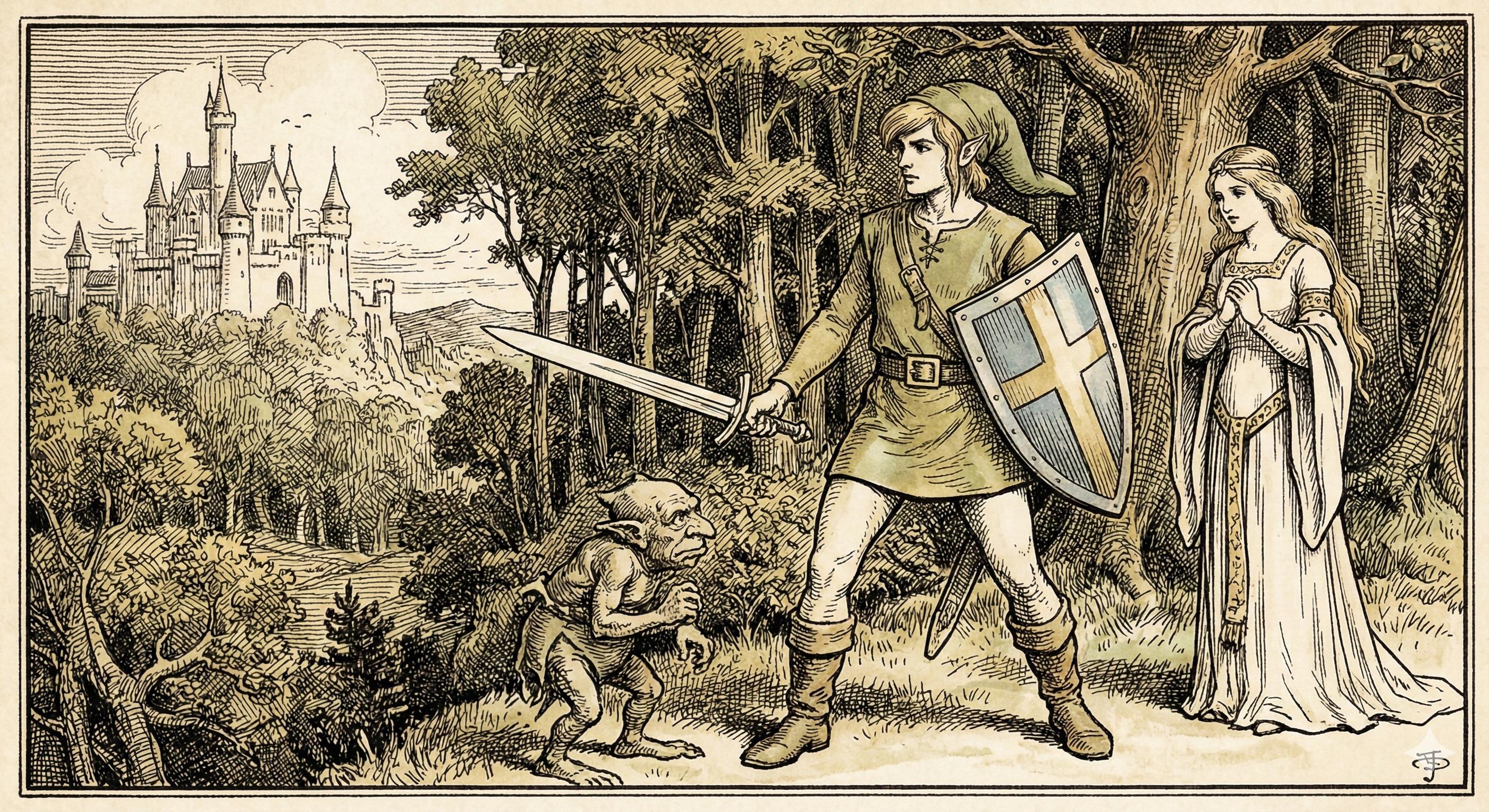
{Link (The Legend of Zelda)} illustrated in the color-washed pen-and-ink narrative illustration style of Henry Justice Ford (1860–1941): {
Rooted in the Pre-Raphaelite Brotherhood and infused with the decorative graphic sensibilities of the Arts and Crafts Movement as taught by Hubert von Herkomer and Alphonse Legros, this archetypal Victorian illustration is anchored in historical storytelling, meticulous draughtsmanship, and aestheticized theatrical gesture. Functioning as novelistic narrative framing, its entertaining showmanship translates painterly richness into spatially condensed line art adapted to reproducible print technologies.
Constrained by late-Victorian monochrome relief processes, Ford employed a Walter Crane-like decorative compositional strategy designed for pen-and-ink translation—structuring scenes with compressed spatial depth and romanticized escapist perspectival framing reminiscent of Edward Burne-Jones. This approach optimizes angled display of gestural texture, density, and rhythmic line flow to simulate the jewel-like luminosity and gold-toned depth of painted surfaces.
Chromatic substitution and tactile illusion: In place of literal color, densely layered directional cross-hatching, stippling, and varied line weights evoke the tactile shimmer of enamel, metal, and jewel tones. Linework becomes a surrogate for color pigment, encoding tonal gradations and surface qualities into black-and-white textures that convey light, shadow, and the materiality of surfaces, so viewers "feel" the scene despite the monochrome palette.
Linework characterization: Contrasting qualities of line communicate character and affect through the illustrator's implied drawing attitude: soft, thin strokes for delicate, angelic figures; confident, bold contours for heroic or authoritative presences; nervous, sketchy hatching for agitated or uncanny creatures. These deliberate variations in touch model form while assigning temperament, social status, and moral weight, making characterization legible at the level of mark-making as well as pose.
Psychological scaling and lighting: Form, scale, and lighting are subtly exoticized and blended with ambiguous perspective angles—similar to Herkomer—for psychological effect rather than literal accuracy. Important figures are slightly enlarged or foregrounded, foreshortening compresses or expands perceived space, and selective lighting isolates emotional beats. These non-literal, mildly uncanny choices prioritize emotional emphasis and narrative perspective, guiding interpretation as much as they describe physical space.
Visual orchestration: Compositions guide the eye through hierarchies of texture and density, creating subtle emphasis where color would normally dominate. Line orchestration substitutes chromatic contrast with structural clarity and dynamic flow, while gestural cues and compositional density preserve drama and atmosphere—ensuring detail enriches rather than distracts and the plot reads instantly.
Color evolution: When chromolithography and watercolor reproduction became viable, Ford layered subdued sepia or jewel-like washes over his ink scaffolding; even then, line remained primary, with color functioning as enhancer rather than replacement.
Key story moments are staged as theatrical narrative spreads functioning like classic fable or biblical plates, adapting narrative dramaturgy to mid-19th-century British visual culture. Figures and crucial narrative elements are ethereally idealized and arranged in tableau-like groupings with deliberately literal, rhetorically charged poses and gazes—operating as pictorial synopses with didactic clarity that compress pages of action into single readable scenes where every pose, gaze, and prop carries narrative weight. Simultaneously, these spreads imply a broader narrative arc, suggesting antecedent events and likely consequences so that a single image evokes an adventurous odyssey, moral journey, or cyclical fate beyond the frozen instant. Framing devices, patterned surfaces, and hierarchical focal points create textile-like visual balance with mild flow, while symbolic props and staged sightlines provide causal cues linking the depicted moment to past and future. The result is an ephemeral experiential window into a living narrative: immediate and didactic enough to orient the reader and create memorable impressions, yet generative enough to suggest what comes before and after. }