{Link (The Legend of Zelda)} illustrated as a Neo-Symbolist painting in the style of Alex V. Dolgikh—a mythological dreamscape staged with theatrical precision, theatrical academic realism symbolically and optically composed akin to geometric abstraction to parallel visceral insect dramaturgy ad visualize the extreme depths of the human psyche: {
A fantastical, figurative composition that transforms traditional subject categories (Nude, Portrait, Landscape, Flower) through compositional mastery derived from theatrical staging into archetypal mythological entities, thereby elevating them beyond mere representation to embody universal psychological states. The work channels Tim Burton-esque strange-whimsy drama with operatic grandeur, featuring delicate, Pre-Raphaelite figures staged and propped in hybridized, theatrical poses inside a Jacek Yerka-like spatial liminality that invokes pan-mysticism rooted in Northern and Slavic folklore, ancient mythology, legends, and fairy tales, with a hint of ephemeral, romantic perspective akin to Mikhail Vrubel.
The composition achieves Gustav Klimt-like awe-evoking, delicate, monumental balance through symmetrically weighted elements while maintaining high-tension theatrical dynamism—figures and iconography arranged in subtly optical-illusionistic spatial relationships within earthy, warm tones. This duality isolates mythic archetypes as allegorical figures reminiscent of the supreme gods of the pagan Slavic pantheon, locked in dramatically charged stasis. These characters engage in culturally-escapist, ritualized fable scenes that, at first glance, subliminally mimic insect kingdom-like instinctual dramaturgy in their uncanny, cultist arrangements and paganistic, gothic processions. Upon closer examination, the decorative, composition-aware design reveals Ernst Fuchs-like geometric abstraction with theatrically-tensioned visual vectors, where fairy tale iconography is staged in symbolically charged, dynamically poised poses, akin to Gustave Moreau, that convey light-dark transitional narratives from Slavic mytho-lore—an existentialist journey toward the darkest depths of the soul.
Executed with academic hyperrealist rigor as the structural anchor, the work layers gesturally emotive, atmospheric, pastiche-like textural motifs rooted in Abstract Expressionism. The archival-durable technique employs seamless blending: acrylic underpainting superimposed and refined with oil paint (inspired by Franz Hals' mixed-media practice), creating a wide variety of textures and precise tonal range. Crispy focal points define visual flow against flat, matte-finished surroundings, achieving a dream-like, ethereally hazy chiaroscuro, akin to Zdzisław Beksiński and Odd Nerdrum, that holds a fluid tension between physical reality and the subconscious mythological realm.
}


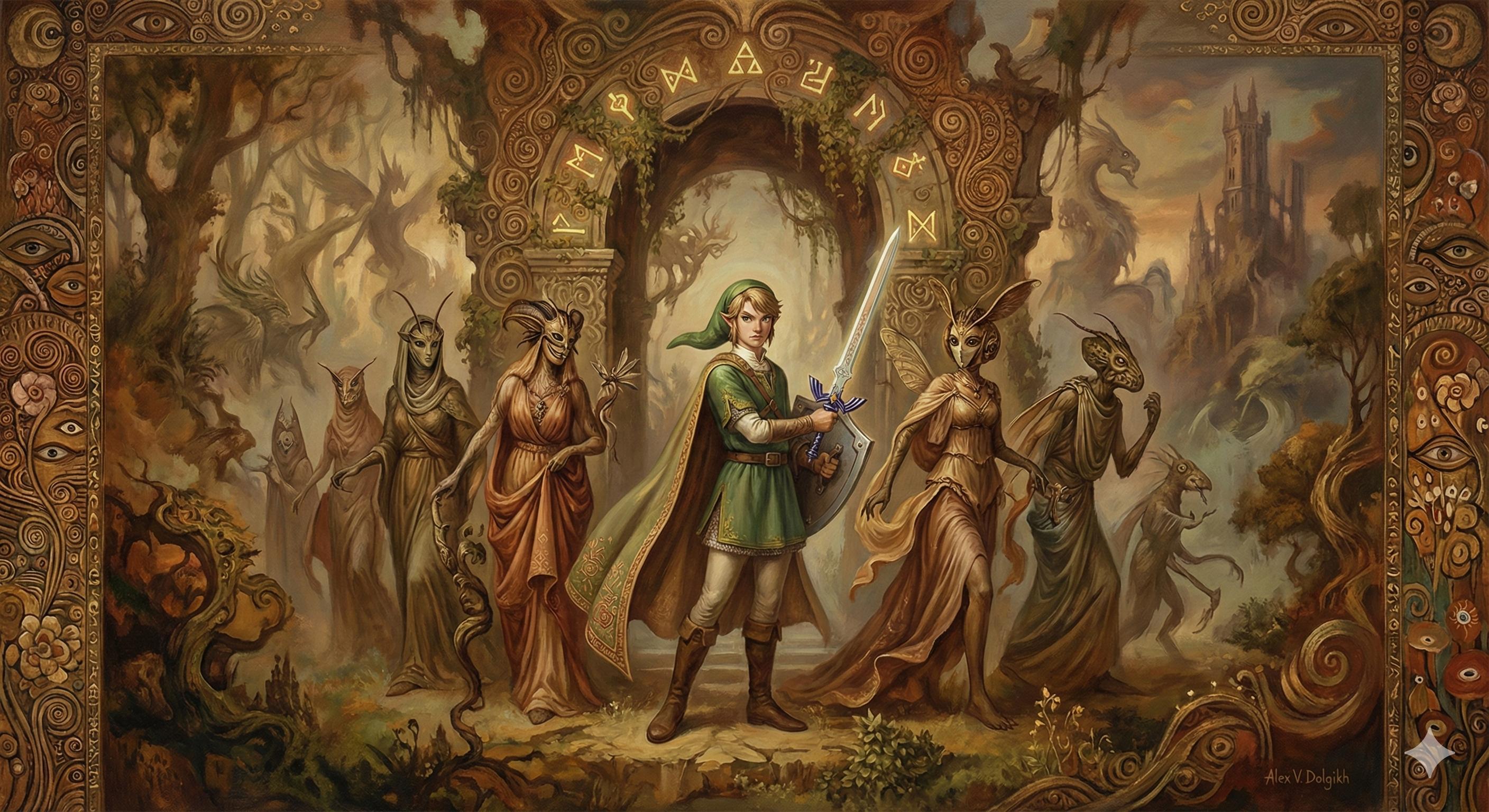
{Link (The Legend of Zelda)} illustrated as a Neo-Symbolist painting in the style of Alex V. Dolgikh—a mythological dreamscape staged with theatrical precision, theatrical academic realism symbolically and optically composed akin to geometric abstraction to parallel visceral insect dramaturgy ad visualize the extreme depths of the human psyche: {
A fantastical, figurative composition that transforms traditional subject categories (Nude, Portrait, Landscape, Flower) through compositional mastery derived from theatrical staging into archetypal mythological entities, thereby elevating them beyond mere representation to embody universal psychological states. The work channels Tim Burton-esque strange-whimsy drama with operatic grandeur, featuring delicate, Pre-Raphaelite figures staged and propped in hybridized, theatrical poses inside a Jacek Yerka-like spatial liminality that invokes pan-mysticism rooted in Northern and Slavic folklore, ancient mythology, legends, and fairy tales, with a hint of ephemeral, romantic perspective akin to Mikhail Vrubel.
The composition achieves Gustav Klimt-like awe-evoking, delicate, monumental balance through symmetrically weighted elements while maintaining high-tension theatrical dynamism—figures and iconography arranged in subtly optical-illusionistic spatial relationships within earthy, warm tones. This duality isolates mythic archetypes as allegorical figures reminiscent of the supreme gods of the pagan Slavic pantheon, locked in dramatically charged stasis. These characters engage in culturally-escapist, ritualized fable scenes that, at first glance, subliminally mimic insect kingdom-like instinctual dramaturgy in their uncanny, cultist arrangements and paganistic, gothic processions. Upon closer examination, the decorative, composition-aware design reveals Ernst Fuchs-like geometric abstraction with theatrically-tensioned visual vectors, where fairy tale iconography is staged in symbolically charged, dynamically poised poses, akin to Gustave Moreau, that convey light-dark transitional narratives from Slavic mytho-lore—an existentialist journey toward the darkest depths of the soul.
Executed with academic hyperrealist rigor as the structural anchor, the work layers gesturally emotive, atmospheric, pastiche-like textural motifs rooted in Abstract Expressionism. The archival-durable technique employs seamless blending: acrylic underpainting superimposed and refined with oil paint (inspired by Franz Hals' mixed-media practice), creating a wide variety of textures and precise tonal range. Crispy focal points define visual flow against flat, matte-finished surroundings, achieving a dream-like, ethereally hazy chiaroscuro, akin to Zdzisław Beksiński and Odd Nerdrum, that holds a fluid tension between physical reality and the subconscious mythological realm. }