If you love Coca-Cola but you're trying to reduce your sugar intake, you've probably wondered about the merits of Diet Coke vs. Coke Zero.
Let's break down the differences between these two drinks.
Advertisement
If you love Coca-Cola but you're trying to reduce your sugar intake, you've probably wondered about the merits of Diet Coke vs. Coke Zero.
Let's break down the differences between these two drinks.
Advertisement
The ingredients in Diet Coke and Coke Zero are almost identical — but not quite. Diet Coke's ingredients are:
In August 2017, Coke Zero rebranded with a new recipe and a new name: Coke Zero Sugar. Coke Zero Sugar's ingredients are:
Advertisement
Diet Coke and Coke Zero Sugar also contain phenylalanine. Here's what we can learn from the ingredient labels of Diet Coke and Coke Zero Sugar.
Both Diet Coke and Coke Zero Sugar list carbonated water and caramel color as the first and second ingredients, respectively. This means that the main ingredients in both drinks are water (pressurized with carbon dioxide) and food coloring.
Aspartame is the third ingredient in Diet Coke and the fourth ingredient in Coke Zero Sugar, which means Diet Coke probably has a little more aspartame than Coke Zero Sugar. Coke Zero Sugar contains two artificial sweeteners: aspartame and acesulfame potassium.
Aspartame is an artificial sweetener that tastes up to 200 times sweeter than sugar. If you want to try aspartame, open one of the little blue packets of Equal next time you're at a diner.
Phosphoric acid is the fourth ingredient in Diet Coke and the third ingredient in Coke Zero Sugar, so Coke Zero contains slightly more phosphoric acid than Diet Coke.
According to Britannica, "it serves as an acidic, fruitlike flavoring in food products." Phosphoric acid is also used in fertilizer and water treatment.
Potassium benzoate is the fifth ingredient in both Diet Coke and Coke Zero Sugar. According to the National Library of Medicine, potassium benzoate is "a fungistatic [inhibits the growth of fungi] compound that is widely used as a food preservative."
The ingredient labels of both Cokes state the function of potassium benzoate is "to protect taste."
Both Diet Coke and Coke Zero list "natural flavors" as their sixth ingredient.
The U.S. Food and Drug Administration (FDA) defines natural flavors as "derived from a spice, fruit or fruit juice, vegetable or vegetable juice, edible yeast, herb, bark, bud, root, leaf or similar plant material, meat, seafood, poultry, eggs, dairy products, or fermentation products thereof, whose significant function in food is flavoring rather than nutritional."
Basically, natural flavors are distillations or extractions of real food products, as opposed to artificial flavors, which are synthesized. What exactly is in these natural flavors we'll never know, but the Coca-Cola company describes the flavor of Diet Coke as "cherry and ginger lime."
Diet Coke's sixth ingredient is citric acid, while Coke Zero's is potassium citrate. Citric acid is the acidic component of citrus fruits like lemons and limes. If you've ever made homemade jam or other canned foods, you may have purchased citric acid at the grocery store. Citric acid is likely responsible for Diet Coke's lime flavor.
Potassium citrate is an alkalizing ingredient that makes soda taste less acidic. You may find Coke Zero has a more balanced flavor than Diet Coke.
Both Coke Zero Sugar and Diet Coke list caffeine as their final ingredient. Caffeine is a chemical stimulant with a bitter flavor. It is found naturally in coffee, tea and chocolate, and added to many other beverages.
Caffeine keeps you awake by blocking your brain's sleepiness (adenosine) receptors. Diet Coke contains 46 milligrams of caffeine per 12 fluid ounces (355 milliliters) while Coke Zero Sugar contains 34 milligrams of caffeine per 12 fluid ounces (355 milliliters).
For reference, the FDA says an 8-ounce (237-milliliter) cup of black tea contains 30 to 50 milligrams of caffeine, and the same amount of drip coffee contains 80 to 100 milligrams of caffeine.
Advertisement
The nutrition facts for Diet Coke and Coke Zero Sugar are almost identical.
Advertisement
The difference in ingredients means that Diet Coke and Coke Zero Sugar have different flavors.
The Coca-Cola Company describes Diet Coke's flavor as "feisty cherry and ginger lime." It says Coke Zero Sugar "tastes like a Coke, but with zero sugar and zero calories."
Advertisement
According to Coca-Cola Great Britain, "Coca‑Cola Zero Sugar looks and tastes more like Coca‑Cola original taste, while Diet Coke has a different blend of flavors which gives it a lighter taste."



Advertisement
By: Sarah Gleim

You'd think Coca-Cola would learn from its mistakes. But apparently the team at the soft drink giant has "forgotten" what happened in 1985 when it decided to reformulate Coca-Cola and rebrand it as "New Coke," the first change to the secret formula in 99 years.
New Coke was a flop, to say the least. It was on shelves for just 74 days before Coca-Cola revived Coca-Cola Classic. Pundits blasted the entire debacle as the "marketing blunder of the century."
Advertisement
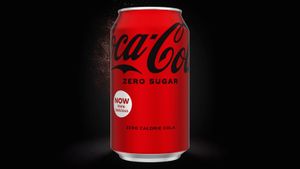
So it's pretty surprising to say the least that Coca-Cola is up to it again and reformulating its popular Coke Zero, the diet version of the much-loved classic Coke flavor. The company announced July 13 it was changing Coke Zero so it would taste more like the iconic Coke. The Coke Zero can is also getting a new look. The new can is solid red with black lettering, rather than red and black.
But this is 2021, not 1985 — and it's also not the first time since it was launched in 2005 that Coke Zero's formula has changed. The company updated it in 2017 to taste more like Coca‑Cola, and Coke Zero has been super popular since then. Though none of this has stopped Coke Zero fans from lambasting the idea on social media.
Coca-Cola says the change is necessary to stay ahead of what its consumers want. "In order to continue to drive growth of our diets and lights category, we must keep challenging ourselves to innovate and differentiate just as other iconic brands have done," Natalia Suarez, senior brand manager, Coca-Cola, North America Operating Unit, said in a statement. "The consumer landscape is always changing, which means we must evolve to stay ahead."
The new Coke Zero has already hit shelves in Europe and Latin America, and will start to become available in the United States this month. It will be fully distributed in the U.S. and Canada by August. Reception so far is mixed, and depends on who you ask.
Rafael Prandini, category lead of Coca-Cola in North America told CNN the company tested the new recipe and the new look "with current Coca-Cola Zero Sugar consumers and non-consumers. And they really love it," he said. But social media is already filled with comments like "Why are you changing my favorite drink?? I like it precisely because it's not as sweet as regular Coke!" and "Here in Mexico it was released last month. I tried it and I'm very disappointed."
The million-dollar question will be whether die-hard Coke Zero fans will love or hate it. Or if this will end up as another marketing blunder of epic proportions. Only time will tell.
Advertisement
By: John Fuller

Water and vitamins are two of the most essential substances available to us. They keep us alive and maintain our health by performing important functions within our bodies. Without them, deficiencies arise and our bodies react negatively. So, what if these two substances joined forces to give us a singularly awesome elixir of pure life?
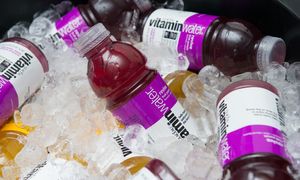
This is exactly what Glacéau has tried to make. The company formed in 1996 to become, according to their Web site, a "pioneer of the enhanced water category." They have developed a massive line of bottled drinks called "Vitaminwater" that combine distilled water with vitamins, herbs and flavors.
Advertisement
The company's timing has been perfect. As scientists better understand the biological and chemical complexities of our bodies, the general public is becoming increasingly health conscious. Along with exercise habits and our genes, what we eat and drink largely determines the quality of our health. People are willing to try anything that advertises healthy living, and Americans spend $750 million a year on energy drinks alone. [source: NewsTarget.com]
With smart advertising, sleek bottle designs and a huge variety of flavors and styles with hip, lowercase names -- some of the choices include "endurance," "power-c" and "vital-t" -- many Americans are buying into what looks like a healthy alternative to other kinds of questionable energy drinks. Even controversial rapper 50 Cent sponsors the drinks with his own flavor, "formula 50," and other celebrities such as Kelly Clarkson and Shaquille O'Neal also promote Vitaminwater.
But is Vitaminwater really as good as it sounds? Some scientists believe that Vitaminwater and many other enhanced energy drinks don't provide all the health benefits the companies advertise. In this article, we'll discuss the functions of water and vitamins in the body. We'll also take a look at the nutrition label on a bottle of Vitaminwater -- and see if it does what it says it does.
Water
We rarely think about how important water is to life on Earth. Water covers 70 percent of the surface, and about 3 percent of it is drinkable (or potable) water. Our bodies are made up of about 60 to 70 percent water, and if you focus even further on specific organs, our need for continual hydration makes sense. The brain is about 80 percent water, blood is about 90 percent and the liver is nearly 97 percent.
Advertisement
Water acts as a messenger within our systems, carrying nutrients to cells and flushing waste and toxins out of our bodies. It also regulates our body temperature -- when it's too hot outside or we exercise, we sweat. As sweat evaporates, our bodies cool down to a manageable temperature.
In the same way a car needs oil to run smoothly, our bodies need water. Just like oil, however, water needs to be replaced. Our bodies lose about 250 milliliters of water every day, and doctors recommend drinking at least eight glasses every day. If we don't, we become dehydrated, leading to headaches, fatigue and lack of concentration. And, although we can survive for weeks without food, it only takes a few days before a lack of water becomes fatal.
Vitamins
When we eat food, a wide variety of substances, including protein, carbohydrates and fats, enters the body and provides us with energy and maintains tissue. These substances carry out their functions by chemical reactions. They wouldn't be able to do so, however, without the help of vitamins.
Found in many foods and beverages, vitamins act as catalysts by accelerating these reactions. When we experience a vitamin deficiency, our bodies can't perform these functions easily, causing us to become sick. Think of it this way -- if water is oil for the body, then vitamins are much like the spark that ignites gasoline in our cars.
Vitamins are split up into two groups and defined by the materials in which they dissolve. Fat-soluble vitamins dissolve in fat, and excesses are stored in fatty tissues -- since they are distributed slowly throughout our bodies, we don't need to replace them daily. Fat-soluble vitamins include vitamin A, vitamin D, vitamin E and vitamin K. Water-soluble vitamins, on the other hand, dissolve in water and are excreted out of the body in urine -- that's why it's important to replace them on a daily basis. Water-soluble vitamins include the vitamin B-complex group and vitamin C.
Aside from foods such as fruits and vegetables, vitamins are also available in supplemental form -- in pills or liquids.
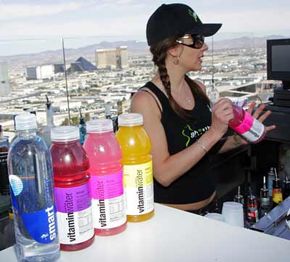
Now that we know how vitamins and water work separately, let's take a look at what's in Vitaminwater.
It's important to keep in mind that Glacéau has listed one bottle of Vitaminwater as 2.5 servings. That means you would have to drink less than half a bottle to get what the numbers on the back say. If you drink the whole bottle, though -- which will probably be the case, since the bottles are fairly small -- you have to multiply each number by 2.5. Right away the packaging appears to be misleading.
Advertisement
Here are the nutrition facts and ingredients from a bottle of "charge" Vitaminwater:
The big red flag here is the amount of sugar. There are 13 grams of sugar in one serving, so an entire bottle contains about 32.5 grams of sugar. For the sake of comparison, a can of Coca-Cola Classic contains about 39 grams of sugar. Because the sugar found in Vitaminwater or Coke is made from a refining (or purifying) process, it contains no nutrients or vitamins beneficial to our health. It instead acts only as a source of energy -- once anything with sugar is ingested, the sugar skips digestion by passing through the stomach wall and raising blood sugar levels. Since your body is programmed to keep its blood sugar at a certain level, the pancreas secretes insulin to balance everything out.
The increase in insulin finally tips the scales, and your body's metabolism is disrupted. Metabolism is simply the process by which molecules in your body combine to create new material or break down to take in energy and release heat. This disruption of metabolism suppresses your immune system, making it easier to get sick or develop diseases.
On top of this, Vitaminwater also contains between 100 to 125 calories. Again, a can of Coke has 140 calories. If you're an athlete or exercise regularly, you can burn off those calories easily. If you don't get any exercise and continue to drink Vitaminwater, however, you're not being quite as healthy as Glacéau advertises -- you're only adding unnecessary substances to your body and potentially gaining more weight.
There are indeed a variety of vitamins in any flavor of Vitaminwater, but it seems the vitamins' benefits are offset by the effects of sugar. So, how can you get the right kinds of nutrients? The best thing to do is to drink regular water and get vitamins from a good source of fruits and vegetables. If you can't change your diet because of medical reasons, convenience or availability, a wide range of vitamin supplements are available in pill or liquid form.
For lots more information on vitaminwater, nutrition and related topics, check out the links on the next page.